

Businesses recover their reputation after bad press by identifying the source of damage, correcting inaccurate information, publishing verified updates, rebuilding trust signals, and managing search results. A structured reputation management process restores credibility, stabilises public perception, and improves long-term brand visibility.
What causes reputation damage after bad press?
Reputation damage occurs when negative media coverage, viral social content, or regulatory issues shape public perception. Key drivers include misinformation, unresolved complaints, and search engine visibility of harmful content, which collectively reduce trust and impact customer decisions within 24 to 72 hours.
Bad press spreads rapidly across indexed platforms such as Google News, blogs, and social media feeds. When high-authority domains publish negative content, search engines rank these pages prominently. This creates a persistent visibility issue where harmful narratives dominate branded search results.
Three common sources of damage include inaccurate reporting, customer complaints amplified online, and legal or compliance violations. Each source affects different trust signals. Inaccurate reporting affects credibility, complaints affect customer trust, and compliance issues affect legitimacy.
Search engines reinforce this damage through ranking signals such as backlinks, click-through rates, and dwell time. When users repeatedly engage with negative headlines, algorithms interpret this as relevance. This extends the lifespan of bad press far beyond the initial event.
How do businesses assess the extent of reputation damage?
Businesses assess reputation damage by auditing search results, analysing sentiment data, and identifying high-ranking negative content. This process includes tracking keywords, evaluating domain authority of sources, and measuring engagement metrics to determine the scale and persistence of reputational harm.
The first step involves a branded search audit. This includes reviewing the top 10 to 20 search results for brand-related queries. High-ranking negative articles, forum discussions, or review pages indicate significant exposure risk.
Sentiment analysis provides measurable insights. Tools categorise mentions into positive, neutral, and negative sentiment. For example, a 65% negative sentiment score across social platforms signals widespread perception issues.
Engagement metrics reveal how deeply the audience interacts with negative content. Metrics include average read time, shares, and comment volume. High engagement indicates strong narrative traction.
Authority scoring is critical. A negative article from a domain with a domain authority score above 80 carries more weight than multiple low-authority mentions. Businesses prioritise mitigation based on these rankings.
What immediate actions help control negative press impact?
Immediate actions include issuing verified responses, correcting factual errors, and communicating transparently across official channels. These steps reduce misinformation spread, establish accountability, and prevent further escalation while maintaining control over the narrative within the first 48 hours.
A verified response must address specific claims with evidence. This includes timestamps, documentation, or third-party validation. Vague statements weaken credibility and fail to counter misinformation effectively.
Error correction requires direct engagement with publishers. Businesses submit formal correction requests supported by verifiable data. This process improves the accuracy of existing coverage without escalating conflict.
Transparency across owned channels strengthens control. Publishing statements on official websites, LinkedIn pages, and press sections ensures consistent messaging. These platforms act as authoritative sources for both users and search engines.
Timeliness affects impact. When businesses respond within 24 hours, they reduce narrative spread by limiting speculation and misinformation cycles.
How does reputation management for business improve search results?
Reputation management for business improves search results by suppressing negative content, promoting authoritative assets, and optimising branded keywords. This process shifts search engine rankings to favour positive, verified content, reducing visibility of harmful results over a sustained period.
Search result improvement relies on content replacement and authority building. Businesses publish optimised content such as press releases, case studies, and leadership profiles. These assets target branded keywords and occupy high-ranking positions.
Content suppression does not remove negative articles but reduces their visibility. This is achieved by increasing the volume and authority of positive content that competes for ranking positions.
Backlink strategies reinforce this process. High-quality backlinks from reputable sources improve domain authority. This increases the ranking potential of positive assets.
For a structured approach, businesses use dedicated services like Reputation Management for Business. These services implement multi-layered strategies involving SEO, content validation, and digital asset control.
Consistency is essential. Search engines require continuous signals to maintain updated rankings. One-time actions do not sustain improvements.
What role does content strategy play in rebuilding trust?
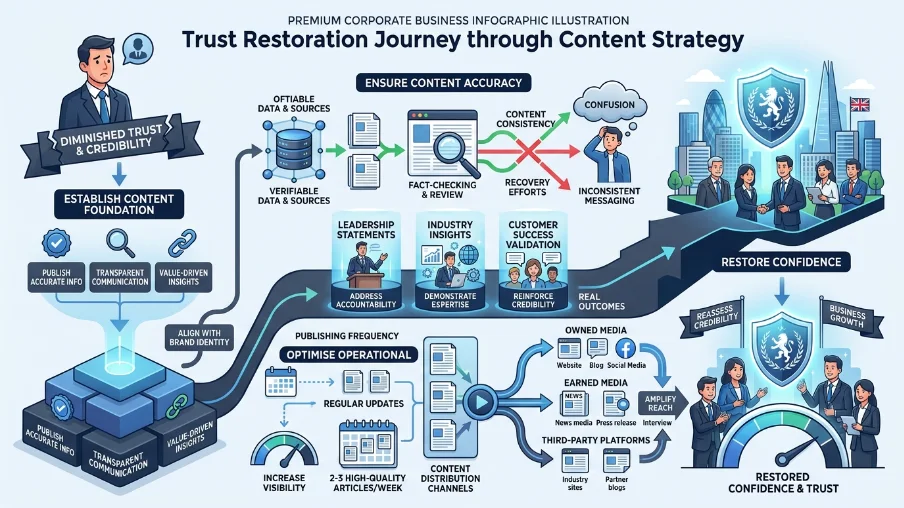
Content strategy rebuilds trust by publishing accurate, transparent, and value-driven information. It includes verified updates, expert insights, and consistent messaging that aligns with brand identity, helping audiences reassess credibility and restoring confidence over time.
Trust restoration depends on content accuracy. Every published asset must be fact-checked and aligned with verifiable data. Inconsistent messaging damages recovery efforts and creates confusion.
Three effective content types include leadership statements, industry insights, and customer success validation. Leadership statements address accountability. Industry insights demonstrate expertise. Customer validation reinforces credibility through real outcomes.
Publishing frequency affects visibility. Regular updates signal activity and engagement. For example, publishing two to three high-quality articles per week maintains search relevance and audience attention.
Content distribution channels amplify reach. These include owned media, earned media, and third-party platforms. Each channel contributes to broader visibility and authority reinforcement.
How long does it take to recover from bad press?
Recovery timelines range from 3 to 12 months depending on severity, search visibility, and response strategy. High-authority negative coverage requires sustained effort, while lower-impact issues resolve faster when corrective actions and content strategies are implemented consistently.
Short-term recovery focuses on immediate damage control. This phase lasts 30 to 60 days and includes response management and initial content deployment.
Mid-term recovery involves search result restructuring. This phase spans 3 to 6 months and focuses on ranking improvements, content expansion, and authority building.
Long-term recovery ensures stability. This phase extends beyond 6 months and maintains positive visibility while preventing recurrence.
Severity influences duration. A single negative article from a low-authority site resolves faster than multiple high-authority publications.
Consistency determines outcomes. Interruptions in strategy lead to ranking reversals and renewed visibility of negative content.
Explore our Reputation Management for Business guides,
10 Corporate Reputation Management Case Studies with Key Lessons
The Building Blocks of a Trusted Business Reputation
Why is monitoring essential during reputation recovery?
Monitoring is essential because it tracks new mentions, detects emerging risks, and measures progress. Continuous monitoring allows businesses to respond quickly, adjust strategies, and maintain control over evolving narratives across search engines and digital platforms.
Monitoring tools track keywords, brand mentions, and sentiment trends in real time. This enables early detection of new negative content before it gains traction.
Performance tracking measures recovery progress. Metrics include ranking position changes, sentiment shifts, and engagement rates. These indicators provide measurable evidence of improvement.
Monitoring also identifies recurring issues. For example, repeated complaints about a specific service indicate operational gaps. Addressing these issues prevents future reputation damage.
For foundational understanding of post-coverage effects, refer to what happens after negative media coverage. This context helps align monitoring strategies with real-world impact patterns.
How do businesses prevent future reputation damage?
Businesses prevent future damage by implementing compliance systems, improving customer experience, and maintaining proactive communication. These measures reduce the likelihood of negative incidents and strengthen resilience against potential reputational risks.
Compliance systems ensure adherence to legal and regulatory standards. This includes data protection protocols, transparent policies, and documented procedures.
Customer experience improvements reduce complaint frequency. Businesses analyse feedback data to identify pain points and implement corrective actions.
Proactive communication builds trust before issues arise. Regular updates, transparent reporting, and open engagement create a strong credibility foundation.
Reputation resilience depends on preparation. Businesses that maintain an active digital presence and verified content assets recover faster from unexpected incidents.
Decision-stage strategies and service comparisons are explored in reputation repair services for businesses facing public scrutiny, which outlines actionable recovery frameworks.
Businesses recover from bad press through structured analysis, verified communication, and sustained search optimisation. Each step focuses on restoring accuracy, improving visibility, and rebuilding trust signals.
Clear My Name delivers Reputation Management for business using data-driven processes that address search visibility, content accuracy, and brand credibility. The approach ensures measurable recovery and long-term stability without relying on short-term fixes.
Frequently Asked Questions
What is reputation management for business and how does it work?
Reputation Management for business involves monitoring, correcting, and improving how a company appears online. It uses search optimisation, verified content publication, and sentiment analysis to reduce negative visibility and strengthen trust signals. Clear My Name applies structured processes to manage and improve brand perception.
How long does reputation management for business take to show results?
Initial improvements in search results and sentiment can appear within 30 to 60 days, while full recovery typically takes 3 to 12 months. The timeline depends on content authority, volume of negative coverage, and consistency of strategy. Clear My Name tracks measurable ranking and sentiment changes throughout the process.
Can negative news articles be removed from search results?
Removal depends on legal eligibility, factual accuracy, and publisher policies. When removal is not possible, Reputation Management for business focuses on suppressing negative content by promoting higher-ranking, authoritative assets. Clear My Name uses SEO and content strategies to reduce the visibility of harmful results.
Why is online reputation important for businesses?
Online reputation directly affects customer trust, conversion rates, and partnership opportunities. Studies show that over 70% of users check search results before engaging with a business. Reputation Management for businesses ensures accurate, positive information is visible when users search for a brand.
What strategies are used in reputation management for business?
Key strategies include search result optimisation, content creation, review management, and continuous monitoring. These methods improve visibility of positive content while limiting the reach of negative information. Clear My Name integrates these strategies into a data-driven reputation management framework.