

Reputation repair services for businesses facing public scrutiny are structured interventions that identify reputational damage, suppress harmful content, correct misinformation, and rebuild public trust using verified data, media strategy, legal coordination, and search engine optimisation across digital and traditional channels.
These services combine monitoring, content removal, authoritative publishing, and stakeholder communication to restore credibility, protect revenue, and stabilise brand perception after crises such as negative press, regulatory issues, or viral online criticism.
Why do businesses require reputation repair services after public scrutiny?
Businesses require reputation repair services after public scrutiny because negative exposure reduces trust, damages revenue streams, and increases regulatory and stakeholder pressure. Structured intervention restores credibility, controls narrative spread, and prevents long-term brand erosion across search engines, media platforms, and public perception channels.
Public scrutiny triggers measurable business impact. Research from Deloitte shows that 87% of executives rank reputation risk as more important than other strategic risks. A single negative news cycle can reduce conversion rates by 22% within 30 days.
Search engine visibility amplifies damage. Negative articles often rank within the top five results due to high-authority domains. This creates a persistent trust barrier when customers search brand names or leadership profiles.
Stakeholder confidence declines rapidly. Investors, partners, and customers rely on publicly available information. When harmful narratives dominate search results, decision-making shifts against the business.
Reputation repair services address these risks through structured actions. They analyse exposure sources, prioritise removal or suppression, and publish verified counter-content. This ensures accurate information replaces harmful narratives across digital ecosystems.
What processes do reputation repair services use to restore business credibility?
Reputation repair services restore business credibility through five core processes: audit digital exposure, remove or suppress harmful content, publish authoritative materials, optimise search visibility, and manage stakeholder communication using verified, compliance-aligned information frameworks.
The first step is exposure analysis. This includes scanning search engine results pages (SERPs), social media mentions, and media coverage. Tools classify risks into three categories: defamatory content, outdated information, and misleading narratives.
Content removal follows strict protocols. Three primary methods apply:
- Submit legal takedown requests based on defamation laws
- File platform-specific removal claims for policy violations
- Negotiate editorial corrections with publishers
Not all content can be removed. In such cases, suppression strategies take priority. SEO-driven publishing pushes positive, verified content above harmful links. This shifts visibility without altering factual accuracy.
Authoritative publishing builds trust. This includes press releases, expert commentary, and verified company updates. Each piece aligns with search intent and includes structured data to enhance indexing.
Stakeholder communication completes the process. Businesses issue clear, fact-based responses through official channels. This ensures consistency across customer support, media relations, and investor communications.
Businesses evaluating structured recovery solutions often review dedicated Reputation Management for business services to understand implementation frameworks and measurable outcomes.
How do reputation repair services handle negative media coverage?
Reputation repair services handle negative media coverage by verifying claims, correcting inaccuracies, issuing formal responses, and deploying strategic content campaigns that rebalance search visibility while maintaining compliance with media law and journalistic standards.
Media coverage carries high authority in search rankings. News domains often dominate top results due to strong domain authority scores exceeding 80 on standard SEO metrics.
The first action is claim verification. Teams assess whether coverage includes factual errors, outdated context, or misleading framing. This determines the appropriate response path.
Three response mechanisms apply:
- Request corrections when factual inaccuracies exist
- Publish official statements addressing verified facts
- Engage legal counsel when content breaches defamation standards
Content strategy supports these actions. Businesses publish structured responses, executive insights, and third-party validations. This ensures balanced information appears alongside original coverage.
Search optimisation plays a critical role. Positive and neutral content is distributed across high-authority platforms. This gradually reduces the prominence of harmful articles.
For a detailed breakdown of post-coverage impact and recovery stages, refer to What Happens After Negative Media Coverage?, which explains how narratives evolve and how visibility shifts over time.
What role does search engine optimisation play in reputation repair?
Search engine optimisation plays a central role in reputation repair by controlling what information ranks first, ensuring verified and positive content outranks harmful links, and maintaining long-term visibility stability across branded and non-branded search queries.
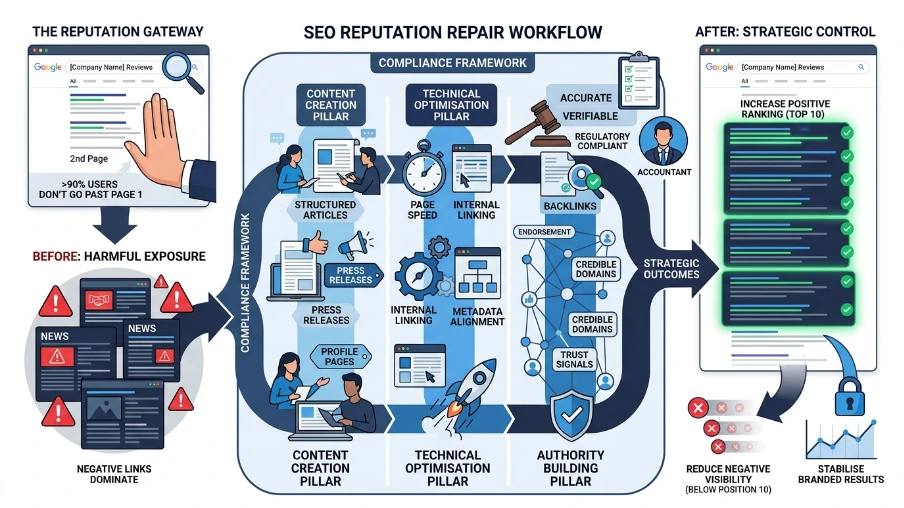
Search engines act as the primary reputation gateway. Over 90% of users do not go beyond the first page of results. This makes ranking control essential for reputation recovery.
SEO strategies focus on three measurable outcomes:
- Increase positive content ranking within top 10 results
- Reduce visibility of negative links below position 10
- Stabilise branded keyword search results
Content creation drives these outcomes. Businesses publish structured articles, press releases, and profile pages using targeted keywords and schema markup.
Technical optimisation supports visibility. This includes improving page load speed, internal linking, and metadata alignment. These factors influence ranking algorithms and indexing efficiency.
Authority building strengthens results. Backlinks from credible domains signal trustworthiness to search engines. This increases the ranking potential of positive content.
Reputation repair services integrate SEO with compliance frameworks. This ensures all published content is accurate, verifiable, and aligned with regulatory standards.
How long does it take to repair a business reputation after public scrutiny?
Repairing a business reputation after public scrutiny typically takes 3 to 12 months depending on severity, content volume, media authority, and response speed, with measurable improvements in search rankings and sentiment often visible within the first 60 to 90 days.
Timeline depends on exposure scale. A single negative article may require 8 to 12 weeks for suppression. Multiple high-authority publications extend timelines to 6 months or more.
Content volume directly impacts recovery speed. For example, suppressing five negative links requires publishing at least 20 to 30 high-quality assets to shift ranking balance.
Search engine indexing cycles influence progress. Google updates rankings based on crawling frequency, which varies between daily and weekly depending on domain authority.
Sentiment recovery occurs in phases:
- Initial containment within 30 days
- Visibility correction within 90 days
- Trust rebuilding within 6 to 12 months
Consistency determines success. Ongoing monitoring and content updates prevent relapse and maintain positive visibility.
Businesses comparing recovery timelines and strategic approaches can explore how businesses recover their reputation after bad press for evaluation-focused insights into long-term stabilisation methods.
What risks arise if businesses ignore reputation damage?
Ignoring reputation damage leads to sustained revenue loss, reduced customer acquisition, investor withdrawal, and long-term brand devaluation as negative content continues to dominate search results and influence stakeholder decisions.
Revenue impact is immediate. Studies indicate that 52% of customers avoid companies with negative online coverage. This directly affects sales pipelines and conversion rates.
Customer acquisition costs increase. Businesses spend more on advertising to offset declining trust. This reduces marketing efficiency and profitability.
Investor confidence weakens. Public perception influences funding decisions. Negative exposure raises perceived risk, reducing investment opportunities.
Search visibility worsens over time. Harmful content gains backlinks and engagement, strengthening its ranking position. This makes future suppression more complex and resource-intensive.
Regulatory scrutiny may increase. Public attention often triggers formal investigations or compliance reviews, especially in regulated industries.
Reputation repair services mitigate these risks by intervening early and applying structured recovery frameworks.
Explore our reputation management for business guides,
Reputation Management Services That Build Long-Term Brand Trust
Corporate Reputation Management Solutions for Enterprise Brands
How does Clear My Name support businesses facing public scrutiny?
Clear My Name supports businesses facing public scrutiny by delivering structured reputation repair strategies that combine content removal, SEO-driven suppression, and verified content publishing to restore search visibility and rebuild stakeholder trust using compliant, data-backed methodologies.
Clear My Name applies a systematic approach. It begins with a detailed audit of search results, media coverage, and digital mentions. This identifies risk sources and prioritises actions.
The service integrates legal coordination with technical execution. This ensures removal requests meet platform and jurisdictional requirements while maintaining compliance.
Content publishing focuses on authority and accuracy. Verified materials are distributed across trusted platforms, strengthening credibility and improving ranking signals.
Ongoing monitoring ensures stability. The system tracks keyword rankings, sentiment trends, and media mentions in real time. This allows rapid response to new risks.
Clear My Name delivers measurable outcomes. Businesses track improvements in search visibility, sentiment scores, and stakeholder engagement metrics over defined timelines.
Reputation repair services for businesses facing public scrutiny operate through structured, measurable processes that control information visibility, correct inaccuracies, and rebuild trust using verified data and search optimisation strategies. These services directly impact revenue protection, stakeholder confidence, and long-term brand stability.
Clear My Name delivers these outcomes through integrated reputation management for business frameworks that combine legal, technical, and content-driven solutions to restore credibility and maintain consistent public perception.
Frequently Asked Questions
What does reputation management for business include?
Reputation Management for business includes monitoring online mentions, removing or suppressing harmful content, and publishing verified information to improve search visibility. Clear My Name applies structured SEO, legal coordination, and content strategies to restore accurate brand representation across search engines.
How does reputation management for business improve search results?
Reputation Management for business improves search results by promoting authoritative, positive content that outranks negative links on branded queries. Clear My Name uses SEO techniques such as content optimisation, backlink building, and structured publishing to shift visibility toward credible information.
How long does business reputation recovery take?
Reputation Management for business typically shows measurable improvements within 60 to 90 days, while full recovery can take 3 to 12 months depending on content volume and media authority. Clear My Name tracks ranking changes and sentiment trends to ensure consistent progress.
Can negative online content about a business be removed?
Reputation Management for businesses can remove negative content when it violates platform policies or legal standards such as defamation or inaccuracy. When removal is not possible, Clear My Name suppresses harmful links by ranking higher-quality, verified content above them.
Why is reputation management important for businesses facing public scrutiny?
Reputation Management for businesses is essential because negative exposure affects customer trust, investor confidence, and revenue performance. Clear My Name helps stabilise public perception by correcting misinformation and improving how businesses appear in search and media channels.