
Negative media coverage triggers immediate reputational decline, reduced customer trust, and measurable revenue impact within days. Businesses face increased scrutiny, stakeholder pressure, and digital amplification of negative content, which often persists online unless actively managed through structured reputation recovery strategies.
How does negative media coverage affect a business immediately?
Negative media coverage causes rapid trust erosion, online sentiment decline, and stakeholder concern within 24–72 hours. Search results shift, customer inquiries drop, and brand perception weakens as media narratives influence public opinion across digital platforms and news aggregators.
Media coverage spreads quickly across platforms such as Google News, social media, and industry blogs. When a negative article appears, it often ranks on the first page within hours. This visibility shapes public perception before a business can respond.
Customer behaviour changes immediately. A 2023 BrightLocal study found that 87% of consumers read online content before trusting a brand. When negative press dominates search results, conversion rates drop sharply. Users abandon purchase journeys after encountering adverse headlines.
Stakeholders react with caution. Investors reassess risk exposure. Partners delay agreements. Employees question leadership stability. These reactions compound operational pressure during the first 72 hours.
Search engine algorithms reinforce the issue. High-authority media domains rank quickly and remain stable in search results. Without intervention, negative coverage becomes a long-term digital asset attached to the brand name.
What are the long-term consequences of bad press?
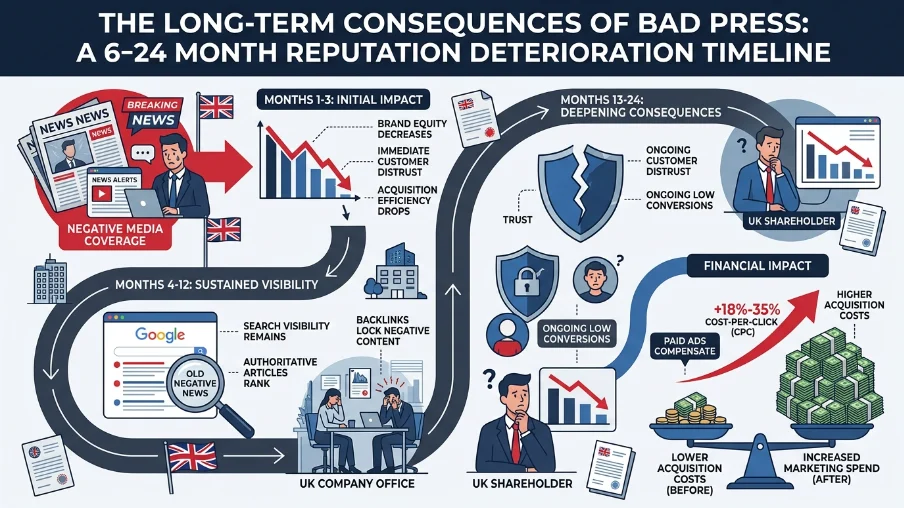
Long-term effects include sustained search visibility of negative content, decreased brand equity, and ongoing customer distrust lasting 6–24 months. Businesses experience reduced acquisition efficiency, higher marketing costs, and difficulty rebuilding credibility across digital and offline channels.
Negative media coverage does not disappear naturally. Articles published on authoritative domains retain rankings due to domain authority and backlinks. Even after the initial news cycle ends, the content continues to attract search traffic.
Customer acquisition costs increase. Paid advertising must compensate for lost organic trust. For example, brands facing reputation issues often see cost-per-click increases of 18% to 35% due to reduced conversion rates.
Brand equity declines over time. Negative associations become embedded in search queries and autocomplete suggestions. These signals influence new customers before any interaction occurs.
Recruitment becomes more difficult. Job candidates evaluate employer reputation through online research. Persistent negative coverage discourages skilled applicants, especially in competitive industries.
Business partnerships weaken. Vendors and collaborators prefer low-risk associations. Negative press introduces reputational risk, which affects long-term contracts and strategic alliances.
How does negative coverage impact search engine results?
Negative media coverage dominates branded search results by occupying top-ranking positions, pushing positive assets down. High-authority news domains, aggregated content, and backlinks reinforce visibility, making suppression or displacement difficult without structured reputation management strategies.
Search engines prioritise authoritative sources. News websites, government portals, and major publications carry high domain authority scores. When they publish negative stories, these pages often rank in the top three results for branded keywords.
Content aggregation amplifies reach. Platforms such as Google News, Yahoo News, and regional syndication networks replicate articles across multiple domains. This creates several indexed versions of the same story.
Backlinks strengthen ranking stability. Negative articles often receive inbound links from blogs, forums, and social discussions. These links signal relevance to search engines, increasing ranking persistence.
Search features expand visibility. Featured snippets, “Top Stories” carousels, and related searches extend exposure. Users encounter negative content across multiple search interfaces, not just standard results.
Effective mitigation requires structured action. Businesses often deploy reputation management for business to suppress harmful results and promote verified, positive content that aligns with search engine ranking factors.
What happens to customer trust after bad press?
Customer trust declines significantly, with measurable drops in conversion rates, repeat purchases, and brand loyalty. Negative media narratives influence perception, leading customers to question reliability, ethics, and service quality even without direct experience.
Trust operates on perception rather than direct interaction. When customers read negative coverage, they form conclusions based on reported information rather than firsthand experience.
Purchase hesitation increases. E-commerce data shows that conversion rates can drop by up to 32% after negative press appears in search results. Customers abandon transactions due to perceived risk.
Repeat customers reassess loyalty. Even existing clients may reduce engagement when concerns arise about brand stability or ethics. This behaviour affects lifetime customer value.
Online reviews reflect sentiment shifts. Customers influenced by media coverage often leave negative feedback. This creates a feedback loop where reviews reinforce the initial negative narrative.
Trust recovery requires consistent visibility of positive, verified information. Businesses benefit from strategies outlined in guides such as how businesses recover their reputation after bad press, which explain structured approaches to rebuilding credibility.
How do stakeholders respond to negative media coverage?
Stakeholders respond with risk mitigation actions, including investment withdrawal, contract delays, and increased scrutiny. Internal stakeholders demand transparency, while external partners reassess associations based on perceived reputational and financial risk exposure.
Investors prioritise stability. Negative coverage signals potential financial or legal risks. As a result, investors may reduce exposure or delay funding decisions.
Partners evaluate association risks. Companies linked to negative press face reputational spillover. Strategic partners may pause collaborations to protect their own brand image.
Employees seek clarity. Internal communication becomes critical. Lack of transparency leads to decreased morale and productivity. Staff retention becomes a concern if uncertainty persists.
Regulatory bodies increase oversight. If the coverage relates to compliance issues, authorities may initiate audits or investigations. This adds operational complexity and legal costs.
Structured communication strategies help stabilise stakeholder confidence. Clear messaging, verified updates, and consistent visibility of corrective actions reduce uncertainty.
Can a business recover from negative media coverage?
Businesses recover through structured reputation management, including content suppression, positive asset creation, and search result optimisation. Recovery timelines range from 3 to 12 months depending on severity, media authority, and consistency of corrective actions.
Recovery depends on measurable actions. Passive waiting does not change search results or public perception. Businesses must actively influence digital narratives.
Three core processes define recovery:
- Suppress negative content by publishing high-authority positive assets
- Optimise branded search results using SEO and structured content
- Monitor sentiment using analytics tools and adjust strategies accordingly
Content creation plays a central role. Publishing verified, factual, and authoritative information helps shift search rankings over time. This includes press releases, expert articles, and corporate updates.
Search engine optimisation ensures visibility. Proper keyword targeting, internal linking, and technical optimisation improve ranking potential for positive content.
Businesses seeking structured solutions often rely on reputation management for business to implement these processes systematically and maintain consistent results.
What strategies help control negative media impact?
Effective strategies include search result suppression, media outreach, and content authority building. Businesses implement data-driven actions to influence visibility, ensuring accurate information ranks higher than negative coverage across search engines and digital platforms.
Search result suppression focuses on displacement rather than removal. High-quality content is created and optimised to outrank negative articles. This requires domain authority, keyword alignment, and backlink acquisition.
Media outreach corrects narratives. Businesses engage with journalists and publishers to provide verified information. Updated coverage can balance initial reporting.
Content authority building strengthens credibility. Publishing on trusted platforms increases brand visibility in a positive context. Examples include industry publications, expert interviews, and compliance reports.
Technical SEO supports these efforts. Structured data, internal linking, and page optimisation improve indexing and ranking performance.
For businesses facing ongoing scrutiny, solutions such as reputation repair services for businesses facing public scrutiny provide structured frameworks for managing complex reputation challenges.
How long does negative media coverage stay online?
Negative media coverage remains online indefinitely unless removed or displaced. High-authority articles can retain top search rankings for years, especially when supported by backlinks, consistent traffic, and ongoing relevance in search queries.
Digital content rarely disappears. Once indexed, it remains accessible unless removed by the publisher or de-indexed by search engines under specific conditions.
Ranking longevity depends on several factors. Domain authority, backlink profile, and user engagement all contribute to how long content remains visible.
Older articles can resurface. When users search related topics, search engines may re-rank historical content based on relevance. This extends the lifecycle of negative coverage.
Content replication increases persistence. Syndicated articles appear across multiple domains, making removal or suppression more complex.
Businesses address this challenge through continuous optimisation and monitoring. Long-term strategies focus on maintaining positive visibility rather than relying on short-term fixes.
Explore our reputation management for business guides,
What Corporate Reputation Success Stories Teach Businesses
How to Build a Positive Brand Reputation from Day One
What role does reputation management play after bad press?
Reputation management provides structured processes to monitor, influence, and improve online perception. It combines SEO, content strategy, and digital monitoring to control search visibility, rebuild trust, and ensure accurate brand representation across platforms.
Reputation management operates as a continuous system. It tracks online mentions, analyses sentiment, and identifies emerging risks before they escalate.
Content strategy forms the foundation. Verified, authoritative content is created to represent the brand accurately. This includes corporate communications, thought leadership, and compliance disclosures.
Search optimisation ensures visibility. Positive assets are aligned with search intent and ranking factors. This allows them to compete with and eventually displace negative content.
Monitoring tools provide real-time insights. Businesses track keyword rankings, sentiment scores, and engagement metrics to measure progress.
Clear My Name delivers structured reputation management for businesses by combining these elements into measurable, data-driven strategies. The approach focuses on long-term visibility control rather than temporary fixes.
Negative media coverage creates immediate and long-term challenges that affect trust, visibility, and revenue. Its impact extends across search engines, customer perception, and stakeholder relationships. Recovery depends on structured, data-driven strategies that actively reshape digital narratives.
Clear My Name applies systematic reputation management for business to control search visibility, rebuild credibility, and ensure accurate representation across digital platforms. This approach enables businesses to stabilise perception and maintain long-term brand integrity.
Frequently Asked Questions
How does reputation management for business work?
Reputation management for business monitors online mentions, analyses sentiment, and improves search visibility by promoting accurate content. Clear My Name uses SEO, content creation, and digital tracking to ensure positive and verified information ranks above negative coverage.
How long does it take to repair a business reputation online?
Reputation recovery timelines range from 3 to 12 months depending on the severity of negative media coverage and search competition. Clear My Name applies structured reputation management for business to accelerate improvements through consistent content optimisation and monitoring.
Can negative news articles be removed from Google search results?
Most negative articles cannot be removed unless they violate legal or platform policies, but they can be suppressed. Reputation management for business focuses on pushing down harmful results by ranking higher-authority, positive content, a process implemented by Clear My Name.
Why is online reputation important for businesses?
Online reputation directly affects customer trust, conversion rates, and brand credibility. Reputation management for business ensures that search results reflect accurate information, helping businesses maintain trust and reduce revenue loss caused by negative perception.
What services are included in reputation management for business?
Reputation management for business includes search result optimisation, content creation, media monitoring, and sentiment analysis. Clear My Name integrates these services to control digital narratives and maintain consistent brand visibility across search engines.