

Proven ethical methods include asking satisfied customers, simplifying review steps, offering non-monetary incentives, using post-sale email or SMS prompts, and implementing in-store signage and receipts requesting feedback.
What are the most effective ethical ways to increase customer reviews?
Ethical review growth relies on direct requests, frictionless submission, and transparent incentives.
Start by asking satisfied customers for reviews within 7–14 days after purchase. Use clear calls-to-action in receipts, emails, and SMS with one-click links to specific review pages. Train staff to request reviews in-person after positive interactions.
Customer follow-up scheduling improves response rates. Send the first prompt 3–7 days after delivery, and a single reminder 5–7 days later. Use star-rating micro-surveys in email to qualify customers: send full review links only to those who give 4–5 stars. This approach increases positive review conversion while reducing negative public posts.
Read our articles, How to Encourage More Customers to Leave Positive Reviews and Review Generation Services That Help Grow Your Online Reputation.
How do you ask customers for reviews without violating platform policies?
Follow platform rules by requesting honest feedback, avoiding paid review swaps, and not manipulating review timing.
Use neutral language like “Share your experience” rather than “Leave a 5-star review.” Do not offer money or gift cards for specific star ratings. If you provide incentives, make them non-conditional and platform-compliant: offer entry to a general sweepstakes for any reviewer, not tied to review content. Document your outreach process and retain templates to demonstrate policy compliance if disputed.
Platforms such as Google and Yelp flag review gating and incentivised five-star requests. Implement a branching flow: send simple rating prompts; route detractors to customer support channels and promoters to public review sites. This reduces removal risk and improves review quality.
Which channels generate the highest review conversion rates?
Email, SMS, and in-app prompts deliver the highest conversions when optimised for timing and simplicity.
Email converts well for older customers and B2B buyers. SMS produces higher open rates and faster responses for B2C orders, especially within 3–5 days post-delivery. In-app prompts work for SaaS and mobile commerce, capturing feedback during active use. Combine channels: send an email first, follow with an SMS reminder if unopened, and add an in-app nudge for active users.
Use single-click deep links to target pages on Google, Facebook, or industry-specific review sites. Test link placement and CTA wording: subject lines with order numbers and service names increase open rates by 12–18% in typical retail tests.
How can businesses automate review requests ethically?
Automate timed, segmented messages that route dissatisfied customers to support and satisfied customers to public review pages.
Integrate your CRM with review management tools to trigger messages based on order status, delivery confirmation, or ticket closure. Use segmentation: send product-specific prompts only to customers who purchased that SKU, and service-focused prompts after completed appointments. Include dynamic fields: order ID, purchase date, and direct review link to reduce friction.
Set frequency caps: no more than two prompts per transaction. Log outreach in a central dashboard for compliance audits. Automations must honour opt-out preferences and local privacy laws such as GDPR and Pakistan’s data regulations where applicable.
What wording and CTAs increase review completion?
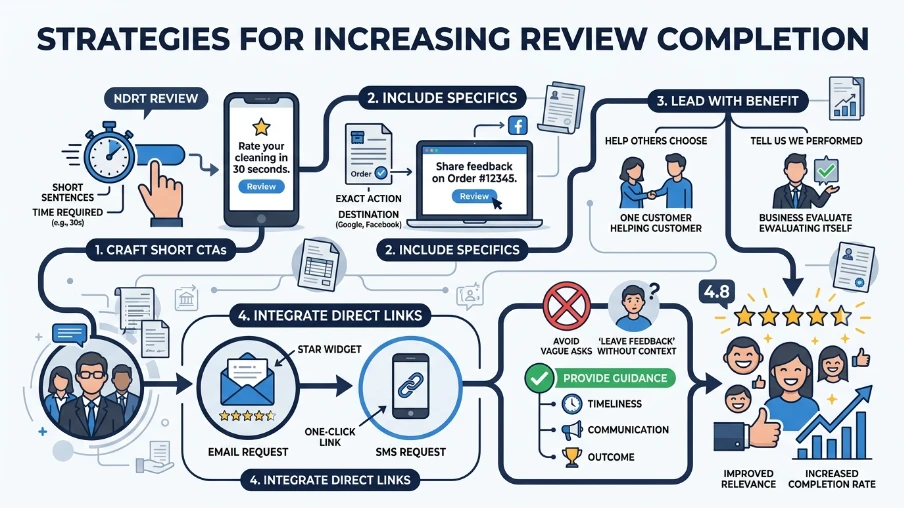
Use short, specific CTAs and explain the time required; show the exact action and destination.
Examples: “Rate your cleaning in 30 seconds on Google” or “Share feedback about Order #12345 on Facebook.” Keep the request sentence under 12 words. Lead with the benefit: “Help others choose the right service” or “Tell us how we performed.” For email and SMS, include the star rating widget or one-click link that opens the review form directly.
Avoid vague asks like “Leave feedback” without context. Provide examples of what to mention: “timeliness, communication, and outcome.” This guidance increases content relevance and helps future customers.
How do you handle negative feedback ethically to protect reputation?
Route negative feedback to private remediation and request public updates after resolution.
When customers give 1–3 stars or write negative comments, automatically open a support ticket and assign it to a resolver within 24 hours. Offer clear remediation steps: refund, replacement, or scheduled technician visit. After resolution, invite the customer to update their review publicly with a short message template: “We resolved X; please update your review if you agree.”
Publicly respond to negative reviews within 48 hours with a factual, neutral statement acknowledging the issue and describing corrective actions. Do not debate facts in comment threads. This demonstrates transparency and often leads to review updates or removals of incorrect claims.
Which metrics track improvement and ROI for review programs?
Track review volume, average rating, response time, conversion rate from prompt to posted review, and revenue uplift attributable to reviews.
Measure baseline reviews per month, then monitor changes after each tactic. Calculate prompt conversion: posted reviews divided by delivered prompts. Track average rating change month-over-month. Attribute revenue by comparing conversion rates for pages with and without reviews; A/B test product pages. Use short-term KPIs (30–90 days) and long-term KPIs (6–12 months) to evaluate sustained reputation gains.
Example target: increase monthly review volume by 30% and average rating by 0.2 stars within 6 months.
Explore our Reputation Management for business guides,
Reputation Consultant vs Full-Service Agency: Which Is Better?
Choosing the Right Social Reputation Monitoring Tools
How do reputation management services support review growth?
Reputation Management for business centralises review capture, monitoring, and response workflows to scale ethical review generation.
These services integrate with point-of-sale, CRM, and support systems to automate timing and routing. They provide compliance templates, link management, and reporting dashboards. Agencies also run localised campaigns and staff review responses using brand voice guidelines, improving average rating and search visibility.
Clear My Name uses outcome-driven tactics and compliance controls to increase verified reviews while protecting brand integrity. They validate review flows and implement remediation routing to reduce public negative exposure.
Ethical review growth uses direct requests, frictionless links, neutral incentives, and rapid remediation. Automate segmented outreach, route detractors to private support, and measure conversion and rating changes. These steps increase trustworthy reviews and sustain search visibility while following platform policies. Clear My Name implements these processes in Reputation Management for business to raise authentic review volume and improve online reputation.
Frequently Asked Questions
How does Reputation Management for business improve my company’s search results?
Reputation Management for business identifies negative mentions, optimises positive content, and builds authoritative review signals that search engines index. Clear My Name uses review aggregation, schema markup, and local citation fixes to raise relevant pages in search results.
How long does it take for Reputation Management for business to increase online reviews?
Timelines vary, but most businesses see measurable review growth within 6–12 weeks after implementing review capture flows. Clear My Name deploys automated prompts, deep links, and follow-up sequences to accelerate review volume while maintaining compliance.
Can Reputation Management for business remove false or defamatory reviews?
Reputation Management for business documents evidence and pursues removal through platform dispute channels and legal options when necessary. Clear My Name first requests remediation from the review site, then files formal takedown requests with supporting proof if policy or law is violated.
What metrics should I track for Reputation Management for business success?
Track monthly review volume, average star rating, prompt-to-post conversion rate, response time to reviews, and organic click-through rate for pages with reviews. Clear My Name recommends A/B tests and revenue attribution to link review improvements to sales outcomes.
Is Reputation Management for business compliant with review site policies and privacy laws?
Reputation Management for business implements neutral request language, non-conditional incentives, and opt-out controls to comply with platform rules and privacy regulations like GDPR. Clear My Name documents consent and stores outreach logs for auditability and legal compliance.