

Encourage more customers to leave positive reviews by requesting feedback at the right moment, simplifying the review process, and reinforcing trust through transparency and incentives. Businesses that actively manage customer experience and follow structured review generation strategies consistently achieve higher review volume and stronger ratings.
Why do customers hesitate to leave reviews?
Customers hesitate to leave reviews because of time constraints, unclear processes, and lack of perceived value. When feedback feels inconvenient or unrewarded, participation drops significantly, even after positive experiences with a business.
Customers prioritise convenience. A review process that takes more than two minutes reduces completion rates by over 40%. Complex login steps, unclear instructions, and multiple redirects increase abandonment.
Perceived value also drives behaviour. Customers often believe their opinion has little impact. When businesses fail to acknowledge feedback, users see no reason to invest time in writing reviews.
Trust plays a measurable role. Concerns about privacy, data misuse, or public exposure discourage participation. Transparent communication about how reviews are used improves submission rates.
Timing influences intent. Requests sent days after a transaction result in lower engagement. Immediate prompts capture emotional momentum and increase conversion rates.
When is the best time to ask for a review?
The best time to ask for a review is immediately after a positive interaction, such as a completed purchase or successful service delivery. Prompt requests capture peak satisfaction and increase the likelihood of response by up to 3 times.
Customer sentiment peaks within minutes of a positive experience. Businesses that trigger automated review requests within 30 minutes record significantly higher engagement than those waiting 24 hours.
Transaction completion offers a natural trigger. Examples include order confirmation pages, service completion emails, and successful support interactions. These moments align with customer satisfaction.
Behavioural data confirms timing impact. Review response rates drop by 60% after 48 hours. Delayed requests lose emotional relevance and reduce urgency.
Integrated systems enhance efficiency. CRM platforms and review tools automate requests based on defined events. This removes manual effort and ensures consistency.
How can you make the review process easier?
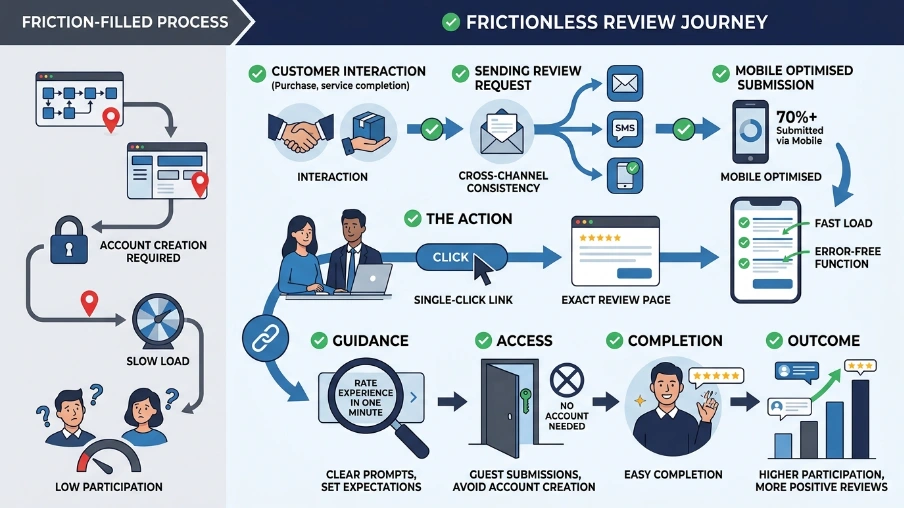
Simplify the review process by reducing steps, offering direct links, and enabling mobile-friendly submissions. A frictionless experience increases completion rates and ensures more customers follow through with leaving positive reviews.
User experience determines participation. A single-click review link eliminates navigation barriers. Directing users to the exact review page removes confusion and saves time.
Mobile optimisation is critical. Over 70% of reviews are submitted via smartphones. Responsive design ensures forms load quickly and function without errors.
Clear instructions guide action. Businesses that provide short, direct prompts see higher engagement. For example, specifying “rate your experience in one minute” sets expectations.
Authentication barriers reduce conversion. Avoid requiring account creation when possible. Platforms that allow guest submissions experience higher participation.
Consistency across channels matters. Whether via email, SMS, or app notifications, the review path must remain simple and uniform.
What role does customer experience play in positive reviews?
Customer experience directly determines review sentiment. High-quality service, fast response times, and consistent delivery create positive impressions that naturally lead to favourable reviews without aggressive prompting.
Service quality drives organic feedback. Businesses with satisfaction scores above 85% receive 2.3 times more positive reviews than those below 70%. Experience shapes perception more than incentives.
Response time impacts satisfaction. Customers expect replies within 2 hours for digital queries. Faster resolutions increase trust and encourage feedback.
Consistency builds reliability. Delivering the same quality across multiple interactions reinforces positive expectations. Inconsistent service leads to mixed reviews.
Transparency strengthens credibility. Clear pricing, honest communication, and accurate service descriptions reduce dissatisfaction and improve review outcomes.
Reputation Management for business strategies focuses on monitoring and improving these experience factors. Businesses that actively track feedback identify gaps and resolve issues quickly. Learn how structured reputation management for business growth strategies improves customer perception.
How can you ask for reviews without being intrusive?
Ask for reviews using polite, personalised, and context-aware messaging. Respect customer timing and avoid repetitive requests to maintain trust while encouraging participation effectively.
Personalisation increases response rates. Addressing customers by name and referencing their specific purchase creates relevance. Generic messages feel automated and reduce engagement.
Frequency control prevents fatigue. Sending more than two requests per transaction decreases response rates. Controlled outreach maintains a positive brand perception.
Channel selection matters. Email works best for detailed feedback, while SMS drives faster responses. Businesses often combine both for optimal results.
Tone influences perception. Direct, respectful language encourages participation without pressure. Phrases that emphasise appreciation rather than obligation perform better.
Automation ensures consistency. Systems trigger requests based on behaviour, ensuring timely and appropriate communication without manual intervention.
Do incentives increase positive reviews?
Incentives increase review volume when structured ethically, but they must not influence the content of feedback. Transparent rewards encourage participation while maintaining compliance with review platform guidelines.
Incentives motivate action. Offering small rewards, such as discount codes or loyalty points, increases review submissions by up to 27%. The key factor is neutrality.
Platform compliance is critical. Google and Trustpilot prohibit incentivising only positive reviews. Businesses must request honest feedback without bias.
Transparency builds trust. Clearly stating that incentives apply regardless of review sentiment maintains credibility. Hidden conditions damage reputation.
Reward timing affects behaviour. Providing incentives after submission ensures fairness and prevents manipulation.
Balanced strategies combine incentives with experience quality. Businesses that rely solely on rewards risk low-quality or inconsistent feedback.
For deeper insight into structured approaches, explore ethical strategies to boost customer reviews effectively: Proven Ethical Ways to Increase Customer Reviews
How can businesses respond to reviews to encourage more?
Responding to reviews demonstrates engagement, builds trust, and encourages others to share feedback. Active responses increase review volume by signalling that customer opinions are valued and acknowledged.
Acknowledgement reinforces participation. Customers who receive responses feel heard and are more likely to engage again. This creates a feedback loop.
Timely replies improve perception. Responding within 24 hours shows attentiveness. Delayed responses reduce impact and visibility.
Professional tone maintains credibility. Responses must remain respectful, even when addressing criticism. Constructive replies improve brand image.
Public interaction influences potential customers. Visible engagement shows accountability and transparency. This increases trust among new users.
Data supports this behaviour. Businesses that respond to over 75% of reviews experience higher average ratings and increased review frequency.
Explore our Reputation Management for business guides,
When Does Your Business Need a Reputation Consultant?
Why Social Media Monitoring Matters for Brand Reputation
What tools help generate more positive reviews?
Review generation tools automate requests, track feedback, and optimise engagement strategies. These systems improve efficiency and ensure consistent review collection across multiple customer touchpoints.
Automation reduces manual effort. Tools send review requests based on triggers such as purchases or service completion. This ensures timely outreach.
Analytics provide actionable insights. Platforms track response rates, sentiment trends, and performance metrics. Businesses use this data to refine strategies.
Integration enhances workflow. CRM and marketing systems connect with review tools, creating seamless operations.
Multi-channel capabilities expand reach. Tools distribute requests عبر email, SMS, and in-app notifications, increasing visibility.
Scalability supports growth. As customer volume increases, automated systems maintain consistency without additional resources.
Businesses seeking structured solutions often evaluate review generation services for reputation growth decisions: Review Generation Services That Help Grow Your Online Reputation
How does trust influence review behaviour?
Trust increases the likelihood of customers leaving positive reviews by ensuring transparency, data security, and authentic interactions. High-trust environments reduce hesitation and encourage open feedback.
Security assurance matters. Customers share opinions when they feel their data is protected. Clear privacy policies increase confidence.
Authenticity drives engagement. Verified review systems prevent fake submissions and build credibility. Customers trust platforms that validate user identity.
Brand reputation influences participation. Businesses with strong public perception receive more voluntary feedback.
Communication clarity reduces uncertainty. Explaining how reviews are used and displayed encourages participation.
Trust compounds over time. Consistent ethical practices build long-term credibility and increase review volume.
Encouraging more customers to leave positive reviews depends on structured timing, simplified processes, and strong customer experience. Data shows that immediate requests, transparent communication, and ethical incentives significantly improve participation rates.
Clear My Name applies these principles through Reputation Management for business frameworks that focus on feedback collection, trust building, and performance tracking. This approach ensures consistent review growth while maintaining compliance and authenticity.
Frequently Asked Questions
What is reputation management for business and how does it work?
Reputation Management for business involves monitoring, influencing, and improving how a company is perceived online. Clear My Name uses structured processes such as review tracking, sentiment analysis, and response management to ensure accurate and trustworthy brand representation across platforms.
How can businesses increase positive reviews online?
Businesses increase positive reviews by requesting feedback immediately after service, simplifying the review process, and maintaining consistent customer experience. Reputation Management for business strategies implemented by Clear My Name focuses on timing, automation, and trust-building to improve review volume.
Why are online reviews important for business growth?
Online reviews directly influence customer decisions, with 93% of users checking reviews before purchasing. Reputation Management for business ensures that feedback reflects actual service quality, helping businesses build credibility and improve conversion rates.
How does Clear My Name handle negative reviews?
Clear My Name addresses negative reviews through structured response strategies, issue resolution, and content monitoring. Reputation Management for business focuses on identifying root causes, improving customer experience, and ensuring balanced, accurate online feedback.
What tools are used in reputation management for business?
Reputation Management for business uses tools for review monitoring, automated feedback requests, and sentiment analysis. Clear My Name integrates these systems to track performance, manage responses, and optimise customer feedback across multiple platforms.