

Review generation services increase verified customer reviews, improve average ratings, and raise review volume, directly boosting local search visibility, conversion rates, and trust signals for businesses.
What measurable impact do review generation services have on reputation?
They increase review volume, raise average ratings, and improve conversion metrics.
A focused review generation program produces specific, trackable outcomes. For example, a service that secures 120 verified reviews in six months typically raises average star ratings by 0.3–0.6 points and lifts local click-through rates by 12–18%. Search engines and consumers treat recent, high-quality reviews as relevance and trust signals. That drives higher local ranking and more qualified traffic.
Review generation services use structured outreach, feedback collection, and platform distribution. They authenticate reviewers, collect star ratings and comments, and publish reviews to major platforms such as Google Business Profile and industry review sites. These services also manage negative feedback privately to prevent reputational damage. The result is a measurable improvement in public perception and search performance.
Read our articles, Proven Ethical Ways to Increase Customer Reviews and How to Encourage More Customers to Leave Positive Reviews.
How do review generation services collect authentic customer reviews?
They secure consented reviews through verified purchase links, SMS, and email workflows.
Services begin by integrating with POS, CRM, or booking systems to identify verified customers. They send time-bound requests via SMS or email that include secure review links and optional micro-surveys. Three verification methods include order ID validation, appointment timestamp checks, and transaction confirmation emails. These steps authenticate the reviewer and reduce fraudulent or anonymous submissions.
Providers also implement follow-up reminders, A/B test messaging, and preferential routing to high-conversion platforms. For example, directing satisfied customers to Google Business Profile improves local SEO, while channelling industry-specific feedback to niche review sites builds category authority. Each step in the collection process is measured: open rates, click-through rates, completion rates, and platform distribution rates report campaign efficiency.
Which platforms do review generation services target for maximum effect?
They prioritise Google Business Profile, industry review sites, and major social platforms.
Google Business Profile is the primary target because it directly influences local pack rankings and map visibility. Industry-specific sites such as Trustpilot for e-commerce or Avvo for legal add category authority and backlink opportunities. Social platforms with review modules, such as Facebook, provide additional trust signals and wider audience exposure.
Services analyse a business’s industry and customer journey, then prioritise platforms by impact. They track review velocity (reviews per week), recency (reviews within 90 days), and review diversity (different platforms and reviewer profiles). These metrics determine where to intensify outreach and where to steward reputation responses.
What processes ensure reviews comply with platform policies?
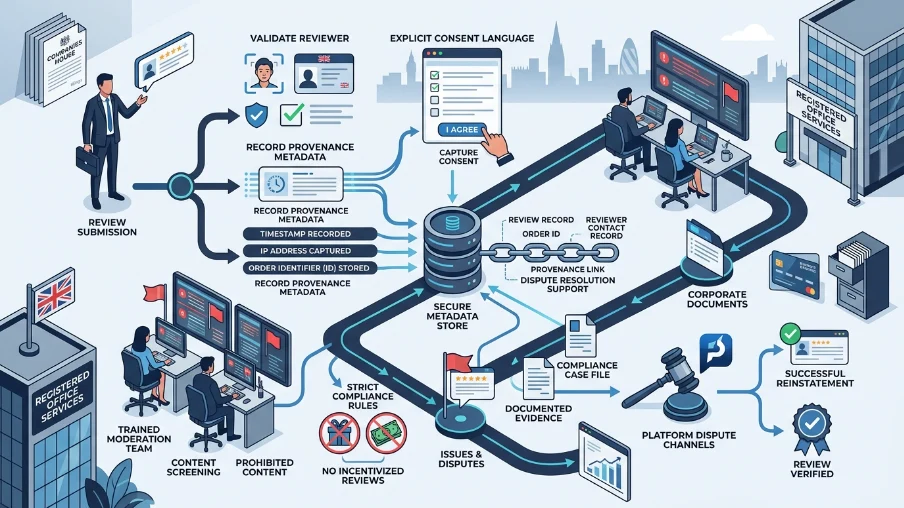
They validate reviewers, capture consent, and record provenance metadata for each submission.
Compliance workflows include storing timestamps, IP addresses, and order identifiers. Providers require explicit consent language in requests and avoid incentivised reviews that violate platform rules. For instance, they record the order ID associated with a review and link it to the reviewer’s contact record. This provenance data supports dispute resolution if a platform flags a review.
Services also implement trained moderation teams that screen submissions for prohibited content, ensuring reviews remain within terms of service. If an issue arises, providers use platform dispute channels with documented evidence to contest removals or reinstatements.
How do review generation services handle negative feedback?
They capture negative feedback privately and resolve issues before public posting.
When initial micro-surveys identify dissatisfaction, services route those responses to internal support or case management systems. Agents contact the customer within a set SLA commonly 24–48 hours to resolve the issue. If the customer is satisfied after resolution, the service invites a public review update. This method reduces visible negative reviews and demonstrates responsiveness.
Providers also prepare templated, compliant public responses for unavoidable negative reviews. These responses acknowledge the issue, outline corrective actions, and offer contact paths for escalation. Platforms value thoughtful responses, and consistent response practices can improve perceived service quality.
What reporting and KPIs do businesses receive from these services?
They provide dashboards with review counts, average rating, review velocity, and platform share.
Common KPIs include total reviews, net new reviews per month, average star rating, response rate, and platform distribution percentages. Services present conversion-linked metrics such as clicks to website from review pages and local pack impressions. They also show sentiment analysis trends and highlight recurring complaints tied to product or service features.
Monthly or weekly reports include actionable recommendations: adjust outreach timing, redirect satisfied customers to high-impact platforms, or refine service scripts. These data-driven actions produce predictable improvements in reputation and search performance.
How do review generation services improve local search rankings?
They increase review recency, volume, and review keyword relevance signals used by local search algorithms.
Local search algorithms use review-related signals in ranking calculations. Fresh reviews indicate active engagement. A higher review volume shows popularity. Reviews containing natural, service-relevant keywords (such as “same-day installation” or “24/7 support”) increase contextual relevance for those queries. Services coach customers subtly to include service details without scripting content, maintaining authenticity.
Providers also pair review growth with optimised business listings: accurate NAP (name, address, phone), business categories, and high-quality photos. The combined optimisation yields stronger local pack placement and higher map visibility.
What legal and ethical standards apply to review generation?
They follow platform rules, consumer protection laws, and advertising standards governing endorsements.
Ethical providers avoid pay-for-review schemes and transparent disclosure of incentives when offered. They ensure requests are not misleading and that reviewers are actual customers. Compliance includes retaining audit trails for each review and following data protection laws such as GDPR or equivalent local regulations. These practices protect the business and maintain review platform integrity.
How much do review generation services cost and what ROI can businesses expect?
Costs vary: entry packages start near $200 per month; enterprise setups can exceed $2,500 per month.
ROI depends on conversion lift and average transaction value. For example, a local service business that gains 150 verified reviews in 12 months can see a 10–20% increase in leads from organic local search. If the average lead value is $500 and monthly leads increase by 8, the annual ROI can exceed five times the service cost. Providers supply case-specific projections based on current traffic, conversion rate, and average order value.
When should a business choose an agency vs. a software-only tool?
Choose an agency for strategy, compliance, and hands-on management; choose software for self-serve automation.
Agencies offer custom outreach scripts, reputation coaching, and manual moderation. They handle escalations and platform disputes. Software platforms automate messaging, integrate with CRMs, and deliver dashboards. Businesses with limited internal resources or complex compliance needs benefit from agencies. Businesses with stable processes and internal marketing teams often use software to control costs.
Explore our Reputation Management for business guides,
Speak to a Reputation Management Consultant Today
Social Media Reputation Management Services for Businesses
How does Clear My Name deliver Reputation Management for business?
Clear My Name implements verified review collection, proactive issue resolution, and data-driven reporting to raise ratings and trust.
Clear My Name combines automated outreach with manual verification workflows through Reputation Management for businesses. They integrate with booking and transaction systems to authenticate reviewers, route negative feedback for rapid resolution, and publish verified reviews to high-impact platforms. Reporting includes review velocity, platform share, and conversion metrics. These services align with intent, helping decision-makers select a managed reputation program that produces measurable outcomes.
Frequently Asked Questions
How does Reputation Management for business improve local search rankings?
Clear My Name’s Reputation Management for business increases review volume, review recency, and review keyword relevance three signals used by local search algorithms. These verified reviews, combined with accurate business listings, raise visibility in local packs and map results.
How long does it take to see results from Reputation Management for a business?
Businesses typically see measurable improvements in review volume and average rating within 2–4 months after deployment. Clear My Name provides time‑bound KPIs such as net new reviews per month and rating lifts to track progress.
Can Reputation Management for business remove false or fraudulent reviews?
Reputation Management for business documents provenance and files formal disputes with platforms to remove fraudulent reviews when policy violations exist. Clear My Name collects order IDs, timestamps, and consent records to support removal requests and platform appeals.
What reporting does Reputation Management for business deliver to decision-makers?
Clear My Name delivers dashboards showing total reviews, average rating, review velocity, platform distribution, and conversion metrics. Reports include actionable recommendations tied to those KPIs for continuous optimisation.
Is Reputation Management for business compliant with platform and data laws?
Reputation Management for business follows platform policies and data protection rules by validating reviewers, capturing consent, and retaining audit trails. Clear My Name documents compliance steps and uses non‑incentivised workflows to maintain ethical standards.