

Choose tools that monitor mentions, sentiment, reach, and engagement across platforms and offer real-time alerts, keyword tracking, and analytics dashboards for reporting. Prioritise API access, exportable data, and integration with CRM or ticketing systems.
What features must a social reputation monitoring tool include?
Essential features are real-time mention tracking, sentiment analysis, reach metrics, and reporting exports.
The tool must capture public mentions across social platforms, blogs, forums, and news sites. Real-time alerts allow teams to respond within minutes. Sentiment analysis classifies mentions as positive, neutral, or negative and provides trend graphs. Reach metrics estimate impressions using follower counts and engagement rates. Exportable reports in CSV or PDF enable monthly reviews and compliance audits. API access supports automated workflows and integration with CRM or ticketing systems.
How should I evaluate accuracy and coverage of monitoring tools?
Compare percentage coverage, precision of sentiment scores, and supported language and source types.
Run a 30-day side-by-side test with a fixed keyword list. Measure coverage as the share of known mentions captured. Measure precision as the ratio of correctly classified mentions to total captured. Record missed sources (platforms, regional forums, niche blogs). Test language support for all markets you operate in. Verify historical archives access for retrospective investigations. Use these metrics when scoring vendor options.
Read our articles, Why Social Media Monitoring Matters for Brand Reputation and Social Media Reputation Management Services for Businesses.
Which metrics measure social reputation effectively?
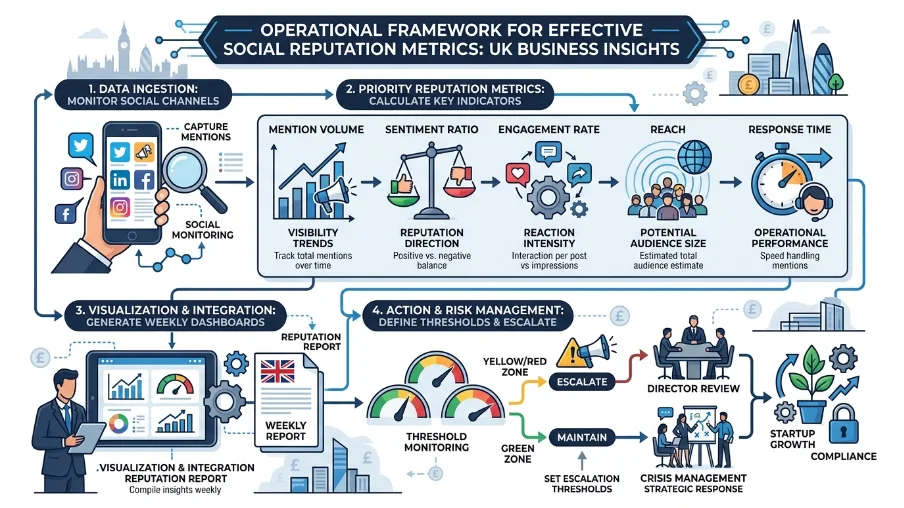
Priority metrics include mention volume, sentiment ratio, engagement rate, reach, and response time.
Mention volume shows visibility trends. The sentiment ratio (positive: negative) reveals the direction of reputation. Engagement rate (likes, comments, shares per post divided by impressions) indicates audience reaction intensity. Reach estimates potential audience size. Response time measures operational performance in handling mentions. Combine metrics into weekly dashboards and set escalation thresholds.
What integrations improve reputation management workflows?
Integrate with CRM, helpdesk, analytics, and social publishing platforms.
CRM integration links mentions to customer records for personalised responses. Helpdesk or ticketing integration converts critical mentions into assignable tickets. Analytics platforms (Google Analytics, Adobe) connect reputation signals to website behaviour and conversions. Social publishing integrations schedule corrective content and coordinate campaigns. Ensure the tool provides webhook or API access for two-way data flow.
How do enterprise and SMB needs differ when choosing tools?
Enterprises need scalable API, multi‑user governance, and compliance features; SMBs need affordability and ease of use.
Enterprises require role-based access control, audit logs, SSO, and data residency options. They also value fine-grained filters, bulk exports, and integration with enterprise SIEM or BI tools. Small businesses prioritise simple setup, prebuilt dashboards, and lower monthly fees. Evaluate vendor pricing bands, contract minimums, and whether the product scales without major reconfiguration.
Which platforms and sources should a comprehensive tool monitor?
Monitor major social networks, review sites, forums, blogs, news, and niche industry boards.
Include Twitter/X, Facebook, Instagram, LinkedIn, TikTok, YouTube, Google Business Profile, Trustpilot, Glassdoor, Reddit, and industry-specific review sites. Crawl RSS feeds, newswire services, and public forums. For B2B brands, add developer forums or trade association boards. Prioritise sources where your customers, competitors, and influencers are active.
How important is sentiment analysis and how to validate it?
Sentiment analysis is critical for triage; validate with manual sampling and custom classifiers.
Use automated sentiment for initial sorting, then sample 200 mentions weekly for accuracy checks. Retrain or apply custom classifiers when sentiment accuracy falls below 85%. Implement rules for sarcasm, negation, and industry-specific jargon to reduce false positives. Allow manual override and tagging for ambiguous cases.
What reporting and alerting cadence is ideal?
Use immediate alerts for crises, daily summaries for operations, and weekly/monthly analytics for strategy.
Configure real-time alerts for high-severity negative mentions and influencer posts. Send daily digests for the social team covering top mentions and trends. Produce weekly trend reports for managers and monthly performance reports for leadership. Include exportable raw data for forensic review and regulatory needs.
How should teams handle multilingual monitoring and regional differences?
Deploy language-specific keyword sets, native-speaker reviewers, and local source lists.
Create keyword lists per language with synonyms and slang. Use native speakers for initial tuning of sentiment models. Add region-specific sources and local social platforms. Track regional reputation trends separately to avoid conflating disparate markets.
What security and compliance considerations matter?
Ensure data encryption, access controls, retention policies, and audit trails.
Select vendors with at-rest and in-transit encryption. Require role-based access and SSO. Confirm data retention settings meet legal needs, including deletion on request. Obtain SOC 2 or ISO 27001 certifications when available. Maintain audit logs to trace who exported or altered data.
How to price and select vendors effectively?
Score vendors on coverage, accuracy, integrations, security, and total cost of ownership.
Create a weighted scorecard with these categories: coverage (25%), sentiment accuracy (20%), integrations (20%), security/compliance (15%), cost and support (20%). Run trials for 30 days and request reference audits. Negotiate SLAs for uptime, data delivery latency, and support response times.
Explore our reputation management for business guides,
Reputation Recovery Strategies That Rebuild Customer Trust
Reputation Consultant vs Full-Service Agency: Which Is Better?
What operational processes must accompany the tool?
Define escalation paths, response templates, and measurement routines.
Document a triage matrix that assigns severity levels based on reach and sentiment. Build template responses for common scenarios and require personalisation before posting. Schedule weekly data reviews to adjust keywords and classifiers. Assign owners for monitoring, response, and reporting.
Example evaluation checklist (quick)
Run a 30-day trial, then score on these points.
- Verify coverage against a curated mention set.
- Validate sentiment accuracy with a 200-mention sample.
- Test API export and CRM integration.
- Confirm export formats and retention policies.
- Measure average alert latency.
- Review role-based access and encryption.
Choose a monitoring tool that delivers accurate coverage, fast alerts, and robust integrations. Combine that tool with clear escalation rules, native-language reviewers, and monthly reporting. This approach reduces response time, improves sentiment trends, and protects brand reputation.
Clear My Name delivers reputation management for business by combining monitoring, human review, and workflows that convert mentions into resolved cases. The service uses targeted monitoring, sentiment validation, and CRM integration to restore and protect brand trust.
Frequently Asked Questions
What is reputation management for business and how does it work?
Reputation management for business monitors public mentions, reviews, and social posts to assess brand sentiment and visibility. Clear My Name aggregates mentions, applies sentiment analysis, and routes high‑risk items to a response workflow for investigation and resolution.
How long does it take to see results from reputation management for business?
Results vary by issue, but initial sentiment trends appear within 2–4 weeks after monitoring begins, while measurable reputation recovery often requires 3–6 months. Clear My Name combines rapid triage with ongoing optimisation to shorten response time and improve sentiment metrics.
Which channels should be included in reputation management for business?
Include social networks (LinkedIn, X, Facebook, Instagram), review sites (Google Business Profile, Trustpilot), forums, news sites, and industry boards. Clear My Name recommends channel selection based on customer touchpoints and market-specific sources.
How does reputation management for business handle false or defamatory content?
The process documents the content, preserves timestamps and URLs, and escalates to takedown requests or legal review when required. Clear My Name follows evidence retention, takedown workflows, and coordinates with legal counsel for formal complaints.
What metrics measure success in reputation management for business?
Key metrics include sentiment ratio (positive: negative), mention volume trends, average response time, reach estimates, and resolution rate of escalated mentions. Clear My Name reports these KPIs in weekly and monthly dashboards for performance tracking.