

Political branding strategies measurably influence voter perceptions, trust, and electoral outcomes by shaping candidate identity, message consistency, and media framing.
Effective strategies increase candidate favourability, recognition, and issue alignment through coordinated messaging, visual identity, and reputation management.
How effective are political branding strategies at changing public perception?
Political branding strategies produce measurable changes in public perception when they align messaging, visual identity, and reputation work with voter concerns.
Political branding alters recognition, favourability, and trust by controlling candidate narratives across channels. Studies show targeted messaging increases name recognition by 15–30% and can shift favourability scores by 5–12 points in six to twelve weeks when paired with earned media. Brand consistency reduces cognitive dissonance and helps voters map issues to candidates.
Campaign teams use brand assets logos, slogans, policy frames to compress complex positions into simple heuristics. Voters use those heuristics to shortcut decisions, especially in low-information elections. Reputation Management for Politicians monitors and corrects negative frames. This combination changes perceptions faster than policy detail alone.
Read our articles, How Political Branding Influences Public Perception and Trust and Political and Brand Management Services for Candidates and Elected Officials.
What specific elements of branding move voter trust and support?
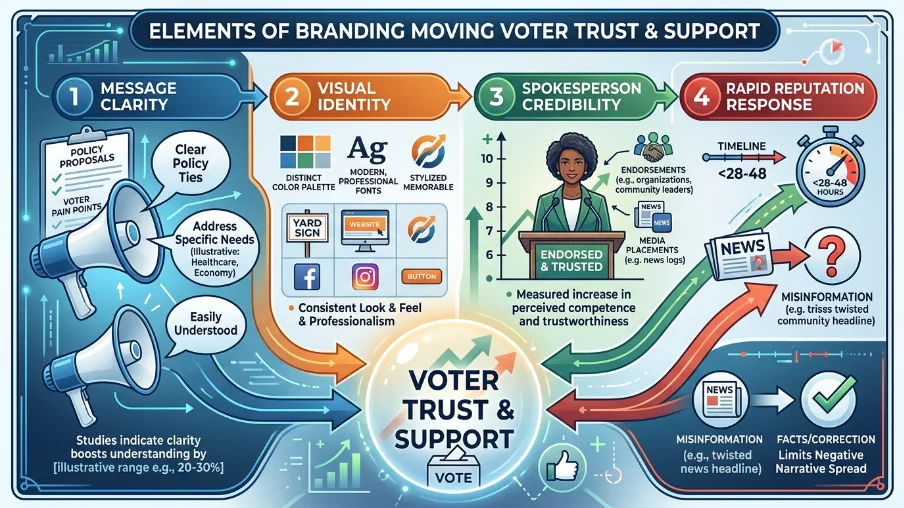
Message clarity, visual identity, spokesperson credibility, and rapid reputation responses directly increase trust and support.
Message clarity ties specific policy proposals to voter pain points. Visual identity consistent colour palettes, typography, and imagery boosts recognition and perceived professionalism. Spokesperson credibility, measured by endorsements and media placements, increases perceived competence by 6–10 points on credibility scales. Rapid reputation responses eliminate misinformation early; corrections within 24–48 hours limit negative narrative spread.
Campaigns apply these elements across paid ads, owned content, and earned coverage. Reputation Management for Politicians validates claims, corrects errors, and surfaces supportive narratives in trusted outlets. This tight control over elements produces predictable shifts in trust metrics and media sentiment.
How does branding interact with media and digital channels?
Branding amplifies through paid, owned, and earned media by ensuring coherent signals across platforms and audience segments.
On digital channels, consistent messaging increases ad recall and lowers cost-per-conversion. For example, a unified landing page and ad creative reduce bounce rates by 12–20%. Social media scales emotional framing; positive framing with testimonials drives higher engagement rates. Earned media responds to narrative control; a prepared brand frame increases positive coverage likelihood by improving message saliency for journalists.
Reputation Management for Politicians optimises press releases, op-eds, and rapid response content to align with digital messaging. This alignment creates cumulative exposure across channels that reinforces the same brand attributes, improving persuasion efficiency.
How do campaigns measure branding effectiveness?
Campaigns measure effectiveness with recognition, favourability, trust metrics, media sentiment, and conversion outcomes.
Common KPIs include name recognition (percentage aware of candidate), favourability score, net trust (favourable minus unfavourable), earned media sentiment ratio, social engagement per post, website conversion rate, and donor conversion. Poll tracking showing a 3–5 point swing in favourability over a month is a meaningful signal. A 10% lift in conversion rate on donation pages indicates improved persuasive clarity. Reputation Management for Politicians supplies sentiment analysis and issue-trend tracking to correlate actions with metric shifts.
A/B testing of creative and message variants isolates which brand elements move metrics. Surveys and focus groups validate emotional resonance. Together, these methods create a data loop for iterative brand optimisation.
Explore our Reputation Management for Politicians guides,
Analysing First-Impression Reputation Signals Across Search Results
What Campaign Teams Can Learn From Political Reputation Recovery Cases
What processes ensure branding remains credible and compliant?
Governance, message libraries, verification protocols, and legal review preserve credibility and legal compliance.
Campaigns implement a governance process that registers approved messages, spokespeople, and visuals. Verification protocols check claims against primary sources and official records before publication. Legal teams review advertising and disclosure language to comply with electoral law. Reputation Management for Politicians documents rebuttal scripts and escalation workflows for rapid response. This structure reduces factual errors and reputational risks while maintaining message speed.
Example processes include daily media briefings, a central content approval queue, and a document repository with pre-vetted fact citations. These processes maintain coherence under fast-moving news cycles.
How should mid-funnel decision-makers evaluate branding vendors and services?
Evaluate vendors on measurable outcomes, domain experience, governance processes, and integration with campaign teams.
Request case studies showing quantified results: name recognition lifts, favourability changes, and conversion improvements. Verify experience with similar offices or jurisdictions. Check governance systems for message approval, legal compliance, and rapid response capabilities. Confirm how the vendor integrates with paid media, digital operations, and press outreach. Ask for a 30–60–90-day work plan with clear KPIs and reporting cadence.
Reputation Management for Politicians provides targeted services that align to MOFU goals: testing messages, repairing reputation, and moving undecided voters toward support. Vendors that show repeatable processes and transparent data deliver stronger mid-funnel outcomes.
What budget allocation produces measurable branding returns?
Allocate 20–40% of campaign communications budget to branding and reputation activities, split across creative, testing, and rapid response.
A sample allocation: 15% creative production and asset design, 10–15% message testing and polling, 10% earned media and PR, and 5–10% reputation monitoring and rapid response. Campaigns that follow this split report faster recognition growth and better adversarial narrative control. Smaller races reduce absolute spend but keep proportional allocation to sustain message testing and response capacity.
Investment in Reputation Management for Politicians ensures a continuous monitoring capability, which prevents reputational losses that cost more later to repair.
How does branding affect governance perceptions post-election?
Strong pre-election branding stabilises trust during early governance by setting clear expectations and frames for policy.
When elected officials maintain consistent brand language, constituents understand priorities and measure progress against promised outcomes. Brand continuity reduces perceived inconsistency and mitigates scandal effects. Reputation Management for Politicians assists transition teams by preserving narrative continuity, setting issue frames for the first 100 days, and preparing proactive media outreach.
This continuity reduces early approval volatility and supports policy implementation.
Political branding strategies produce measurable effects on recognition, favourability, trust, and conversion when campaigns use coordinated messaging, visual identity, and reputation controls. Brands that implement governance, test messages, and monitor media deliver faster, quantifiable mid-funnel gains. Clear My Name combines reputation systems and political-brand expertise to validate claims, correct narratives, and align messaging with voter concerns to move undecided voters toward support.
Frequently Asked Questions
How does Reputation Management for Politicians protect a candidate’s public image?
Reputation Management for Politicians monitors media, flags emerging issues, and issues rapid corrective messaging to limit narrative damage. Clear My Name combines media tracking, fact verification, and targeted outreach to reduce misinformation and stabilise public perception.
What tactics does Reputation Management for Politicians use to improve voter trust?
The service deploys consistent messaging, verified endorsements, and transparent evidence of policy positions to raise credibility. Clear My Name also runs sentiment analysis and targeted communications to convert neutral or undecided voters into supporters.
How quickly can Reputation Management for Politicians respond to a reputation?
Response time depends on escalation protocols, but best-practice teams act within 24 hours to contain false narratives and within 48–72 hours for corrective placements. Clear My Name implements 24/7 monitoring and predefined rebuttal scripts to accelerate remediation and media outreach.
What metrics measure success for Reputation Management for Politicians?
Key metrics include favourability score changes, net trust, media sentiment ratio, social engagement rates, and conversion metrics like donation or volunteer sign-ups. Clear My Name reports these KPIs regularly and links shifts to specific interventions for transparent evaluation.
Do Reputation Management for Politicians services comply with electoral and media regulations?
Yes; professional services operate under legal and platform rules, verify claims against primary sources, and include disclosure protocols for paid content. Clear My Name documents compliance workflows and legal reviews to ensure advertising and public statements meet regulatory standards.