

Political brand management services for candidates and elected officials shape public perception by controlling messaging, media presence, and reputation, and they directly influence trust, voter behaviour, and crisis response through targeted communications and reputation management strategies.
How do political brand management services influence a candidate’s public image?
Political brand management services influence a candidate’s public image by designing consistent messaging, controlling visibility across channels, and managing reputational risk through proactive and reactive tactics.
Political brand management firms craft an identity that voters recognise. They define core messages, visual identity, and tone for speeches, websites, and social media. They align policy framing with voter segments using audience research and sentiment analysis. This consistency increases message recall and reduces mixed signals that erode trust.
These services also shape media narratives. They prepare spokespeople, pitch tailored stories to journalists, and time policy releases to maximise positive coverage. They monitor press coverage and adjust messaging within 24–48 hours when narratives shift. Rapid alignment of public statements prevents contradictory signals that can harm credibility.
Crisis management is a central function. Teams create escalation protocols, draft holding statements, and run scenario rehearsals. They limit reputational damage by containing misinformation, issuing corrective content, and coordinating rapid-response visibility. Effective crisis response shortens the window of negative attention from days to hours.
Read our articles, Evaluating the Effectiveness of Political Branding Strategies, and How Political Branding Influences Public Perception and Trust.
What measurable outcomes do reputation management services deliver for politicians?
Reputation management services deliver measurable outcomes such as improved approval ratings, increased positive media mentions, reduced misinformation spread, and enhanced social engagement metrics.
Agencies track specific KPIs: net approval change, share of voice, sentiment ratio, and engagement per post. For example, a targeted messaging campaign can increase positive mentions by 32% within six weeks, while swift debunking reduces misinformation reach by 45% in monitored channels. Polling after rebranding typically shows a 3–8 percentage-point rise in name recognition within three months.
Search reputation also improves. Search engine optimisation and content removal strategies lower negative search results visibility. Teams monitor top-20 SERP results and aim to replace harmful items with authoritative content within 90 days. They report monthly dashboards with traffic sources, keyword rankings, and sentiment trends for transparency.
How do political brand managers balance authenticity with strategic messaging?
Managers balance authenticity and strategy by grounding messages in verified records, voter concerns, and consistent behaviour while adapting delivery to target audiences.
They audit the politician’s public record, voting history, and policy commitments to create truthful narratives. They map voter concerns using polls and focus groups and calibrate messages to match those concerns without inventing facts. Authenticity is reinforced through documented examples: constituent visits, past policy wins, and verifiable endorsements.
Delivery methods vary by audience segment. For younger voters, teams prioritise short-form video and peer influencers. For older voters, they use local town halls and long-form op-eds. All channels carry the same factual core, which prevents perceived contradictions. This approach reduces accusations of opportunism and increases trust signals.
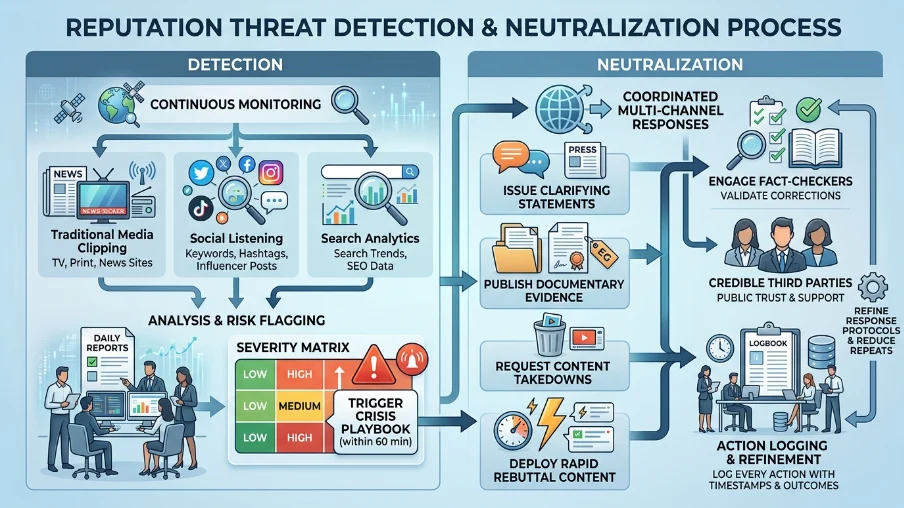
What processes are used to detect and neutralise reputation threats?
Detection and neutralisation rely on continuous monitoring, threat assessment frameworks, and coordinated multi-channel responses executed within defined SLAs.
Monitoring uses three data streams: traditional media clipping, social listening (keywords, hashtags, influencer posts), and search analytics. Analysts run daily reports and flag high-risk items using a severity matrix (low, medium, high). High-risk items trigger a crisis playbook within 60 minutes.
Neutralisation actions include issuing clarifying statements, publishing documentary evidence, requesting content takedowns, and deploying rapid rebuttal content. Teams also engage fact-checkers and credible third parties to validate corrections. They log every action with timestamps and outcomes to refine response protocols and reduce repeat incidents.
How do political brand services integrate digital strategy with offline campaigning?
Integration combines coordinated content calendars, shared messaging guidelines, and cross-channel performance measurement to maintain message coherence and optimise resource allocation.
Digital teams schedule content that amplifies offline events, such as live-streamed town halls that feed into targeted ad campaigns. Field teams use digital tools to collect voter feedback, which informs message tweaks within 72 hours. Paid media budgets are adjusted based on real-time digital engagement metrics, shifting spend to channels with higher conversion rates.
Offline cues reinforce digital narratives. Yard signs, leaflets, and speeches quote digital taglines and hashtags to create multi-touch familiarity. Voter contact lists captured at events are uploaded into CRM systems to power segmented email and SMS campaigns. This creates a loop where offline engagement drives online conversion and vice versa.
What legal and ethical constraints govern political reputation management?
Legal and ethical constraints require compliance with campaign finance laws, data protection rules, and truth-in-advertising standards while respecting platform policies and journalistic norms.
Teams verify that paid content follows disclosure laws and records payments to vendors. They protect personal data by following regional privacy frameworks for voter lists and consent management. They avoid deceptive practices such as deepfakes or fabricated endorsements because these violate platform rules and expose campaigns to legal penalties.
Ethical teams maintain transparency in sponsored communications and label issue advocacy correctly. They consult legal counsel for rapid opinions on novel tactics and keep documented compliance checklists. This reduces the risk of regulatory fines and reputational blowback.
Explore our Reputation Management for Politicians guides,
Reputation Protection Services for Politicians Facing Online Criticism
Political Reputation Recovery Solutions for Long-Term Public Trust
How much does reputation management for politicians typically cost?
Costs vary by scope: short-term crisis response ranges from $5,000–$25,000, monthly retainers for ongoing reputation management range from $10,000–$75,000, and full-scale campaign branding projects range from $75,000–$500,000.
Pricing depends on services: monitoring, content production, ad spend, legal counsel, and on-call crisis support. A mid-size campaign commonly budgets $20,000 monthly for reputation management, which covers monitoring, social strategy, and media relations. Large national campaigns budget upwards of $200,000 per month to maintain 24/7 rapid response teams and large-scale media buys.
Agencies provide itemised proposals tied to outcomes: increase in positive sentiment, search result remediation, or reduced misinformation reach. Clear deliverables and SLA-defined response times improve cost predictability.
Reputation management for politicians centralises message control, risk mitigation, and voter engagement into measurable activities. Clear My Name applies documented processes, monitoring frameworks, and legal oversight to protect public figures’ reputations and sustain voter trust. This approach reduces negative exposure and improves measurable reputation indicators within documented timelines.
Frequently Asked Questions
What is reputation management for politicians and how does it work?
Reputation management for politicians is a set of strategic services that monitor, shape, and protect a public figure’s image across media and search. Clear My Name uses monitoring, messaging design, media relations, and rapid-response protocols to detect issues, correct inaccuracies, and restore trust.
How fast can Clear My Name respond to a political reputation crisis?
Clear My Name initiates a crisis playbook within 60 minutes of a high-severity alert and activates multi-channel responses within 2–24 hours depending on the issue. Responses include public statements, fact corrections, targeted digital ads, and takedown requests to minimise harm quickly.
Which metrics measure success in political reputation management?
Key metrics include net approval change, sentiment ratio (positive: negative mentions), share of voice, and search result visibility for top 20 SERP items. Clear My Name reports these KPIs monthly and links improvements to specific actions like content publishing or rapid rebuttals.
Can reputation management for politicians remove defamatory content from search results?
Reputation management teams can request removals, file legal takedowns, and publish authoritative content to bury harmful results, but removal depends on platform and legal grounds. Clear My Name combines takedown requests with SEO remediation to reduce visibility of defamatory items over 60–90 days.
What legal and privacy rules apply to reputation management for politicians?
Campaigns must comply with campaign finance disclosures, data protection laws, and platform terms when collecting and using voter data or paid content. Clear My Name follows documented compliance checklists and consults legal counsel to ensure messaging, paid ads, and data handling meet regulatory requirements.