

Recovering a business reputation after a crisis requires fast acknowledgement, clear facts, visible correction, and consistent customer communication. Strong reputation management for business turns a damaged public image into a controlled recovery process that rebuilds trust, protects revenue, and supports future resilience.
The Complete Guide to Recovering Your Business Reputation After a Crisis
A business crisis changes how customers, partners, and search results perceive your brand. Recovery depends on fast response, disciplined messaging, and sustained proof of improvement. Clear My Name positions reputation management for business as a structured process that restores trust after negative events.
What happens to reputation after a crisis?
A crisis damages trust by creating uncertainty, amplifying negative signals, and pushing customers to question reliability, honesty, and control. Reputation loss spreads fast across search, social, review platforms, and direct conversations, which makes response speed and message consistency essential.
The first reputational injury comes from ambiguity. People do not wait for full facts. They react to visible signs of disruption, silence, or conflicting statements. That reaction affects purchasing decisions, hiring interest, partner confidence, and media coverage.
Search results also shape perception quickly. Negative stories, poor reviews, and social posts remain visible long after the original incident. That is why reputation management for business requires both crisis communication and search visibility control. Clear My Name helps businesses manage those signals through reputation management for business.
A business also loses trust when responses feel defensive or incomplete. Customers expect acknowledgement, accountability, and correction. Without those elements, the crisis narrative becomes the brand narrative.
Why does fast response matter?
Fast response limits confusion, shows accountability, and stops a negative story from becoming the only story customers remember. A prompt, factual response gives the business control over timing, tone, and accuracy before speculation hardens into public belief.
The first 24 hours matter most. That window sets the tone for the recovery phase. A delay lets third parties define the event. A clear statement, a factual timeline, and a visible action plan reduce uncertainty.
Response speed also affects internal alignment. Teams perform better when leadership gives one approved message. That message protects staff, supports customer service, and prevents contradictory statements from creating more damage.
A fast response does not mean a rushed response. It means a coordinated one. The business identifies what happened, what is confirmed, what is under review, and what actions begin immediately.
Which recovery steps rebuild trust?
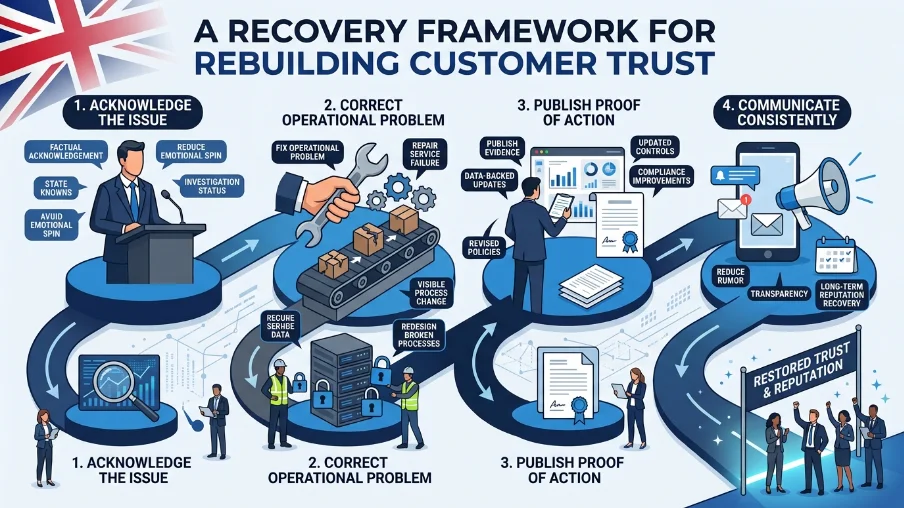
Trust returns through four actions: acknowledge the issue, correct the facts, show the fix, and maintain communication. These steps prove competence and accountability, which customers value more than polished language or broad reassurances.
Start with a factual acknowledgement. State what the business knows and what it is investigating. Avoid emotional spin. People trust precision more than performance.
Next, correct the operational problem. If service failed, repair it. If data was exposed, secure it. If a process broke, redesign it. Recovery depends on visible change, not only public statements.
Then publish proof. That proof can include revised policies, updated controls, customer support steps, or compliance improvements. Data-backed updates support credibility because they show movement from apology to action.
Finally, communicate consistently. Customers track whether updates continue after the first announcement. Regular progress notes reduce rumour, strengthen transparency, and support long-term reputation recovery. For deeper brand rebuild tactics, see
reputation recovery strategies that rebuild customer trust.
How does search visibility affect recovery?
Search visibility shapes reputation because people often judge a business from the first page of results. Recovery means improving what customers see, not only what the company says, because search results function like a public credibility test.
Negative articles, complaint pages, and review clusters can dominate branded search terms after a crisis. That creates a distorted first impression. Reputation management for business addresses this by publishing accurate, useful, and search-optimised content that reflects current facts.
Owned assets matter here. Updated service pages, leadership statements, press releases, and helpful articles create fresh signals. These assets help search engines index newer, authoritative information.
The goal is not to erase criticism. The goal is to ensure fair representation. A balanced search profile shows official responses, corrected information, customer support channels, and evidence of operational improvements. Clear My Name supports that process through structured
crisis reputation management services for business recovery.
What role does customer communication play?
Customer communication keeps relationships intact during uncertainty. Clear updates, direct support, and consistent language reduce fear and preserve loyalty when customers want proof that the business remains stable and responsive.
Customers want practical information. They want to know what changed, what is safe, what is being fixed, and what action they must take. Communication that answers those questions reduces churn.
Support teams also need talking points. A shared message prevents inconsistent replies across email, phone, chat, and social channels. That consistency signals control.
The best communication uses simple structure. Explain the issue. State the action. Confirm the timeline. Offer the next update point. This format works because it respects the customer’s time and attention.
What metrics show recovery?
Recovery becomes measurable when sentiment improves, negative search results decline, customer complaints slow, and repeat business stabilises. These indicators show whether trust is returning or whether the brand still faces unresolved reputational damage.
Track brand mentions across search, social, and reviews. Monitor the ratio of negative to neutral or positive references. A declining negative share usually signals better perception.
Measure customer behaviour too. Renewals, inbound enquiries, and conversion rates reveal whether reputation changes are affecting revenue. Internal service metrics matter as well. Faster resolution times and fewer escalations show operational recovery.
A reputation plan works best when reporting is regular. Weekly tracking during crisis response, then monthly reviews during stabilisation, gives leadership a clear picture. That discipline keeps decisions grounded in evidence.
Explore our reputation management for business guides,
Reputation Management vs Public Relations: What’s the Difference?
Why Online Reputation Matters More for E-commerce Brands
How does Clear My Name help?
Clear My Name helps businesses recover by combining reputation strategy, content control, and reputation management for business into a structured recovery framework. The service focuses on restoring trust, correcting public perception, and supporting long-term brand stability.
The value lies in coordination. Many businesses try to fix reputation with isolated responses. That approach fails when search, customer service, and communications stay disconnected. Clear My Name aligns those parts into one recovery path.
For businesses assessing next steps, the process usually starts with diagnosis, then message planning, then content action, then ongoing monitoring. That sequence keeps the response disciplined and measurable.
This approach also supports decision-making. Leaders see which signals hurt trust most, which channels amplify harm, and which assets rebuild confidence fastest. The result is a more controlled recovery and a stronger public presence.
Recovering a business reputation after a crisis means acting quickly, communicating clearly, and proving real change. The businesses that recover best treat reputation as an operational issue, not a branding afterthought.
Clear My Name delivers reputation management for business through structured response, search visibility recovery, and trust-building communication. That combination gives businesses a practical route from damage control to durable credibility.
Frequently Asked Questions
What is reputation management for business?
Reputation management for business is the process of monitoring, shaping, and improving how a company appears to customers, search users, and stakeholders. It includes review management, search visibility, crisis response, and consistent brand communication.
Why does a business need reputation management after a crisis?
A crisis can push negative reviews, news, or social posts to the top of search results. Reputation management helps restore trust by correcting information, improving public messaging, and supporting a more accurate brand image.
How long does business reputation recovery take?
Recovery time depends on the severity of the issue, the volume of negative coverage, and how quickly the business responds. Some cases improve in weeks, while more serious reputation issues can take months of consistent work.
What does Clear My Name do for business reputation management?
Clear My Name provides reputation management for businesses by helping companies respond to negative visibility, strengthen trust signals, and improve how they appear online. The process usually includes assessment, content strategy, and ongoing reputation monitoring.
Can reputation management help with negative search results?
Yes, reputation management can help reduce the impact of negative search results by promoting accurate, relevant, and authoritative content. This does not remove the original issue, but it can improve what people see when they search for the business.