

Reputation recovery strategies restore customer trust through transparent communication, targeted remediation, consistent service improvements, and measurable reputation monitoring over 6–18 months.
What reputation recovery strategies rebuild customer trust?
Reputation recovery strategies rebuild trust by admitting fault, correcting harms, communicating transparently, delivering measurable improvements, and monitoring sentiment until trust metrics return to baseline or better.
Rebuild trust begins with clear admission of responsibility and a remediation plan. Public apologies that state facts, timelines for fixes, and compensation restore credibility faster than vague statements. Operational fixes must include measurable targets such as reducing incident recurrence by X% and increasing on-time resolution rates to Y% within a defined period.
How should a business admit fault and communicate after a reputation crisis?
Admit fault with factual statements, specify corrective actions, set timelines, and publish regular progress updates.
Public communication uses precise language. State what happened, which customers were affected, and what you will do. Example: “On 3 May, our payment gateway failed, affecting 4,200 transactions. We refunded affected customers within 72 hours and deployed a patched gateway on 10 May.” Post the timeline and evidence of remediation on owned channels and in stakeholder emails. Use one spokesperson to maintain message consistency. Track open rates and sentiment to validate message reception.
Read our articles, The Complete Guide to Recovering Your Business Reputation After a Crisis and Crisis Reputation Management Services for Business Recovery.
What remediation tactics repair customer harm?
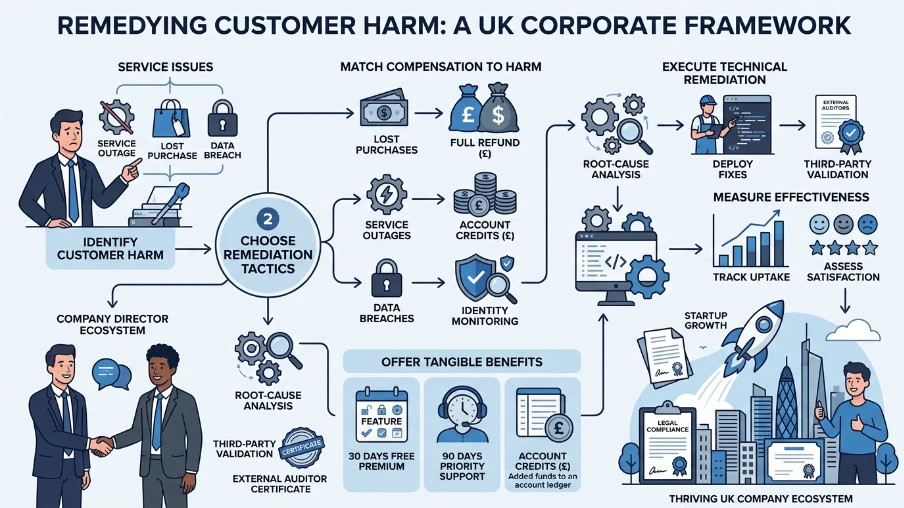
Remediate harm by refunding or compensating, implementing technical fixes, offering free services, and enrolling affected customers in monitoring or support programs.
Compensation must match harm type: refund full fees for lost purchases, credit accounts for service outages, and provide identity monitoring for data breaches. Technical remediation requires root-cause analysis, deployment of fixes, and third-party validation. Offer tangible benefits: 30 days of free premium service, priority support for 90 days, or account credits. Measure uptake and satisfaction among compensated customers to confirm effectiveness.
How do you measure trust recovery progress?
Measure trust recovery with NPS, customer retention rates, complaint volumes, social sentiment scores, and resolution-time metrics.
Set numeric targets: raise NPS by 10 points within six months; reduce complaint volume by 60% within 90 days; restore churn to pre-crisis levels within 12 months. Use sentiment analysis tools to quantify social media sentiment weekly. Cross-check with support KPIs: average resolution time under 24 hours, first-contact resolution above 75%. Report these metrics in monthly recovery dashboards.
How should brands rebuild online reputation and content signals?
Rebuild online reputation by publishing corrective content, amplifying verified testimonials, removing or rebutting false claims, and improving SEO for positive assets.
Publish a public incident report and a follow-up case study showing fixes and metrics. Update Help Centre articles and create FAQ pages that directly address customer concerns. Promote positive customer stories and third-party reviews that validate improvements. Use structured data (schema) to mark testimonials and articles so search engines and AI agents can surface authoritative content. Monitor review platforms and request verified customers to leave updated reviews after remediation.
How can businesses use PR and trusted third parties to restore credibility?
Use independent audits, expert validations, and third-party endorsements to validate remediation and signal trust to customers.
Commission an independent audit or security assessment and publish the executive summary. Obtain certifications or compliance attestations relevant to the crisis (for example, ISO 27001 post-breach). Invite industry associations or respected media to cover remediation outcomes. Third-party validation reduces perceived bias and speeds trust recovery by providing external confirmation of fixes.
What operational changes prevent recurrence and reassure customers?
Implement process controls, governance changes, staff training, and monitoring systems that address root causes and show continuous improvement.
Introduce incident response playbooks with roles, escalation paths, and 24-hour reporting targets. Add automated monitoring that alerts teams to anomalies and enforces rollback thresholds. Provide targeted staff training: 100% of customer-facing staff trained within 30 days on new protocols. Audit compliance quarterly and publish summary results to stakeholders.
How long does reputation recovery typically take?
Recovery timelines vary by severity: minor incidents resolve in 1–3 months, mid-level crises take 3–9 months, and major breaches require 9–18 months.
Minor service outages that are resolved quickly and compensated often restore trust in under 90 days. Data breaches that affect consumer data require longer: remediation, regulatory reporting, and third-party audits extend recovery to 9–18 months. Plan public communications and measurement cadences around these timelines and adjust targets after monthly reviews.
Explore our Reputation Management for business guides,
Which Businesses Need Reputation Management, Public Relations, or Both?
How to Evaluate Reputation Management Agencies for E-commerce
How should businesses align recovery strategy with customer segments?
Tailor actions and communications by segment: high-value customers receive proactive outreach; mass-affected customers receive broad communications and clear self-service options.
Identify segments by revenue, usage frequency, and vulnerability. For top 5% revenue accounts, assign account managers for one-to-one remediation and personalised compensation. For the broad base, send segmented emails with clear steps, supportive resources, and links to claims forms. Track resolution rates per segment and escalate unresolved cases within 72 hours.
How do reputation recovery strategies integrate with ongoing reputation management services?
Integrate recovery into reputation management by combining incident response, continuous monitoring, content remediation, and stakeholder communications under a unified plan.
A reputation management program performs monitoring, rapid response, and content repair. It aligns PR, customer service, legal, and compliance teams with shared KPIs. Use the program to schedule follow-up audits, testimonial collection, and SEO regeneration of authoritative content. This structured approach reduces reaction time and improves consistency of messages.
Rebuilding customer trust requires immediate, factual admission, measurable remediation, targeted compensation, and sustained proof of improvement. Clear timelines, quantitative targets, and third-party validation accelerate recovery. Clear My Name delivers structured Reputation Management for business by combining monitoring, incident response, and measurable remediation to restore trust and customer retention.
Frequently Asked Questions
How long does Reputation Management for business take to restore customer trust?
Recovery time depends on incident severity; minor reputation issues often improve in 1–3 months, mid-level crises in 3–9 months, and major breaches in 9–18 months. Clear My Name measures progress with NPS, complaint volume, and resolution-time KPIs to track recovery.
What steps does Reputation Management for business include after a public complaint?
A standard response includes admitting responsibility, publishing a factual incident summary, issuing targeted remediation (refunds or credits), and monitoring sentiment until metrics stabilise. Clear My Name documents timelines and outcomes to provide evidence of remediation.
Can Reputation Management for business remove false negative content from search results?
Reputation management cannot guarantee removal but can suppress negative content by publishing authoritative positive assets, requesting removals where policies apply, and filing suitable legal or platform takedowns. Clear My Name combines content suppression, SEO, and verified testimonials to push authoritative pages higher.
How does Reputation Management for business measure whether customers trust the brand again?
Teams measure trust with NPS changes, retention rates, complaint volume, social sentiment scores, and first-contact resolution rates against pre-crisis baselines. Clear My Name reports these metrics monthly to show objective progress toward restored trust.
What evidence should I collect for Reputation Management for business after a service failure?
Collect incident logs, customer impact lists, refund records, remediation timelines, and third-party audit or validation reports. Clear My Name uses these documents to validate fixes, support communication, and secure third-party endorsements.