

Reputation management and public relations serve different goals: reputation management protects and repairs a company’s online and stakeholder trust, while public relations builds visibility and shapes messages to influence public perception.
What is the core difference between reputation management and public relations?
Reputation management protects and restores stakeholder trust and online presence; public relations crafts and amplifies messages to shape media and market visibility.
Reputation management focuses on monitoring mentions, suppressing harmful content, correcting facts, and rebuilding credibility. Public relations plans campaigns, issues press releases, and pitches stories to media outlets to increase awareness and shape narratives.
How do reputation management and public relations differ in objectives?
Reputation management aims to preserve trust and mitigate damage; public relations aims to generate positive media coverage and audience reach.
Reputation management measures outcomes like sentiment score changes, removal or suppression of harmful search results, and stakeholder feedback. Public relations measures media placements, share-of-voice, and campaign reach. Both affect perception, but reputation managers prioritise risk, legal exposure, and long-term trust, while PR teams prioritise visibility, messaging consistency, and short-to-medium-term engagement.
Read our articles, Which Businesses Need Reputation Management, Public Relations, or Both? and Reputation Management Services That Complement Your Communications Strategy.
How do tactics differ between reputation management and public relations?
Reputation management uses monitoring, SEO remediation, legal takedowns, and targeted corrections; public relations uses press releases, media outreach, thought leadership, and events.
Reputation teams implement search- engine-optimisation (SEO) to demote negative content and promote authoritative pages. They escalate legal actions such as DMCA notices or defamation letters when applicable. PR teams craft narratives, schedule interviews, and use media lists to secure earned coverage. Tactics sometimes overlap: both create positive content, but intent differs between remediation and amplification.
Which teams or roles handle each function?
Reputation management is led by reputation analysts, SEO specialists, and legal advisors; public relations is led by PR managers, media relations specialists, and communications strategists.
Reputation analysts track mentions across search engines, review sites, and social platforms. SEO specialists optimise content to influence search results. Legal advisors handle takedown requests and defamation cases. PR managers develop messaging, arrange spokespeople, and coordinate media calendars. Cross-functional coordination is common in crises.
How does measurement differ between reputation management and public relations?
Reputation management measures trust indicators and control of search results; public relations measures media reach and audience engagement.
Reputation metrics include net sentiment percentage, number of harmful pages removed or suppressed, review star averages, and stakeholder survey scores. PR metrics include number of media placements, estimated audience reach, share-of-voice percentage, and social engagement rates. Effective programs report both sets of metrics to show impact on perception and visibility.
When should a business prioritise reputation management over public relations?
Prioritise reputation management during crises, legal exposure, or persistent negative search results that harm revenue or partnerships.
Examples: a product safety recall, a defamatory article ranking on page one, or a sudden spike in negative reviews after a service failure. Reputation management acts immediately to limit damage, correct facts, and restore trust. PR activity alone would not remove harmful search results or correct archived misinformation.
When should a business prioritise public relations over reputation management?
Prioritise public relations for product launches, fundraising, hiring campaigns, or when seeking market visibility and thought leadership.
Examples: announcing a $5 million funding round, launching a new service, or promoting executive expertise. PR secures coverage that drives awareness and demand. Reputation management remains useful to ensure messages are heard against a clean background of trustworthy information.
Can a business use both reputation management and public relations simultaneously?
Yes: combine reputation management to secure trust and PR to amplify positive narratives for comprehensive reputation health.
Integrated programs work like this: reputation teams remove or suppress damaging search results and correct factual errors, while PR teams publish news and thought leadership to occupy search real estate with authoritative content. This dual approach speeds recovery and leverages positive momentum to rebuild credibility.
What process should a company follow to decide between the two?
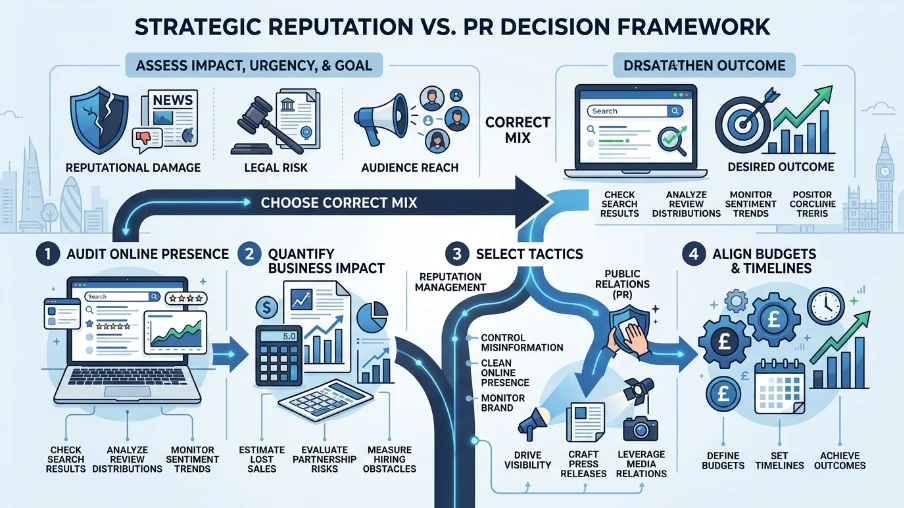
Assess impact, urgency, and goal: measure reputational damage, legal risk, audience reach required, and desired outcome to choose the correct mix.
Step 1: Audit online presence: identify negative search results, review distributions, and sentiment trends. Step 2: Quantify business impact: estimate lost sales, partnership risks, or hiring obstacles. Step 3: Select tactics: use reputation management when controlling misinformation is essential; use PR when visibility or persuasion is the primary goal. Step 4: Align budgets and timelines with expected outcomes.
How do costs and timelines compare?
Reputation management often requires short-term intensive work and ongoing monitoring; PR runs campaigns with variable durations and measurable reach targets.
Reputation remediation can span 2–12 weeks for search-result suppression and 1–6 months for measurable sentiment recovery, depending on content volume. PR campaigns commonly run 3–6 months for meaningful coverage and lead generation. Costs vary: reputation work pays for SEO, legal fees, and content creation; PR budgets cover media relations, events, and agency retainers.
What industries or situations most commonly require reputation management?
Sectors with high regulatory scrutiny, direct consumer reviews, or digital visibility require reputation management: healthcare, finance, e-commerce, and professional services.
Examples: a financial adviser with a defamation claim; a hospital facing malpractice allegations online; an e-commerce brand with a surge of fake negative reviews. These cases require factual correction, compliance checks, and legal or platform escalations alongside SEO remediation.
How does “Reputation Management for business” integrate with communications strategies?
Reputation Management for business validates public facts, remediates harmful content, and supports communications teams with verified assets and crisis protocols.
A reputation team provides cleaned search results, authorised spokesperson statements, and documented incident timelines. Communications teams use these assets to pitch consistent messages to media and stakeholders. This integration reduces mixed messages and accelerates recovery.
Explore our reputation management services guides,
How Automated Review Requests Help Small Businesses Grow
Why Tracking Brand Mentions Is Essential for Reputation Management
How can Clear My Name help a business with both functions?
Clear My Name provides reputation management services for businesses that validate facts, remove or suppress harmful content, and deliver clean online profiles to support communications strategies.
Clear My Name combines monitoring, SEO remediation, and legal escalations. The service produces authoritative content and manages review remediation. This work creates a stable baseline for PR campaigns and reduces the risk of future reputational damage.
Reputation management protects and restores trust by correcting facts, controlling search results, and mitigating legal exposure. Public relations builds visibility through media, events, and narratives. Businesses in crisis prioritise reputation management; businesses seeking growth prioritise PR. Combining both yields faster recovery and stronger public trust. Clear My Name delivers practical reputation management services for businesses that integrate with communications strategies to protect credibility and support message amplification.
Frequently Asked Questions
What is Reputation Management for business and how does it work?
Reputation Management for business monitors online mentions, reviews, and search results to identify harmful content. Clear My Name verifies facts, uses SEO remediation and platform escalation to correct or suppress damaging information and restores stakeholder trust.
How long does a typical reputation management recovery take?
Recovery times vary by issue, but most remediation shows measurable improvement within 4–12 weeks for search-result suppression and 3–6 months for sentiment recovery. Clear My Name provides ongoing monitoring and weekly reports to track progress against specific metrics.
Can Reputation Management for business remove negative reviews or articles?
Removal depends on platform policies and legal grounds; some reviews and articles can be taken down via DMCA, defamation notices, or platform appeals, while others require SEO suppression. Clear My Name evaluates removal options, pursues takedowns when valid, and implements content replacement and optimisation when removal isn’t possible.
How does reputation management affect sales and partnerships?
Clean search results and improved review scores increase buyer trust and shorten sales cycles, and 69% of buyers check online reputation before contacting vendors. Clear My Name aligns reputation fixes with commercial goals to reduce friction in sales and partnership negotiations.
What are the first steps a company should take when facing a reputational issue?
Immediately audit public mentions, secure key accounts, and preserve evidence such as screenshots and timestamps. Clear My Name recommends starting with a focused audit, fact verification, and a remediation plan that combines legal escalation, SEO correction, and stakeholder communication.