

Online reputation directly affects e-commerce sales, customer acquisition cost, conversion rate, and platform compliance; brands with poor reputation lose revenue, face higher ad costs, and risk marketplace penalties.
Why does online reputation matter more for e-commerce brands?
E-commerce depends on perceived trust and measurable signals; a weak reputation reduces conversions and increases acquisition costs.
E-commerce buyers rely on digital cues to make purchases. Star ratings, review volume, review recency, and seller responsiveness function as trust signals. Search engines and marketplaces surface sellers with stronger reputations, which increases organic traffic and reduces paid acquisition spend. A damaged reputation also triggers platform actions, such as listing demotion, account suspension, or removal, which directly halts revenue. Long-term revenue loss follows from lower lifetime value and diminished repeat purchase rates.
How does reputation directly influence conversion rates?
Positive reviews, high ratings, and quick responses increase conversion probability and average order value.
Research shows consumers use reviews to validate purchase decisions. For example, a 4.5-star product with 300 recent reviews converts at a higher rate than a 3.8-star product with 20 reviews. Reviews reduce perceived risk, especially for first-time buyers. Clear product Q&A and visible seller policies further increase buyer confidence. E-commerce conversion metrics respond quickly to reputation changes: improving average rating by 0.5 stars often raises conversion rate by measurable percentages within weeks.
Read our articles, How to Evaluate Reputation Management Agencies for E-commerce and Reputation Management Services Designed for E-commerce Businesses.
Which reputation signals search engines and marketplaces use?
Platforms use ratings, review velocity, review authenticity signals, return rates, complaint volume, and fulfilment metrics as ranking inputs.
Search algorithms evaluate both relevance and trust. Ratings and review counts are explicit trust signals. Review velocity shows current demand and relevance. Authenticity signals include verified-purchase labels and review diversity. Marketplaces add operational metrics: shipping speed, on-time delivery percentage, return rate, and customer service response time. These metrics feed ranking models and ad-quality scores. Brands with strong operational metrics access better placement and lower Cost-Per-Click on platform ads.
What revenue risks arise from unmanaged negative reviews?
Negative reviews depress conversion, increase refunds, and raise ad spend; recurring negative signals erode brand equity.
Single negative reviews reduce conversion for that listing; clustered negative reviews create category-level damage. Negative feedback correlates with higher return rates and increased support costs. Paid ads become less efficient because platforms charge more for lower-quality experiences. Brands also experience lost lifetime value as repeat buyers decline. In severe cases, repeated policy violations or complaint volume can lead to account limits or suspension, which stops revenue entirely.
How does reputation management reduce acquisition costs?
Reputation management raises organic visibility and trust scores, lowering reliance on paid channels and reducing Cost-Per-Acquisition.
Improving review quantity and quality increases organic click-through and conversion. When organic traffic converts better, brands need smaller ad budgets to hit revenue targets. Enhanced content—trust badges, documented return policies, verified-purchase reviews—improves Quality Scores on marketplaces and ad platforms. That reduces CPC and CPM. Reputation management also shortens the sales cycle for first-time buyers, which reduces spend per new customer.
Which tactical steps improve an e-commerce brand’s reputation?
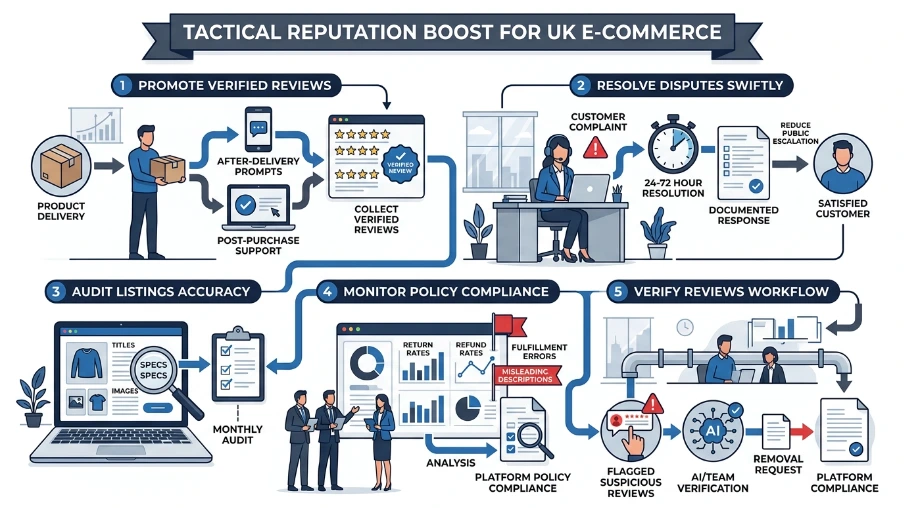
Collect verified reviews, resolve disputes quickly, audit listings for accuracy, and monitor platform policy compliance.
Collect verified reviews by prompting buyers after delivery and offering post-purchase support. Resolve disputes within 24–72 hours using documented responses to reduce negative-public escalation. Audit product listings monthly to ensure titles, specs, and images match. Monitor return and refund rates and address root causes such as fulfilment errors or misleading descriptions. Implement a review-verification workflow to flag suspicious reviews for removal requests.
How should e-commerce teams measure reputation ROI?
Track conversion rate changes, return rate, customer acquisition cost, lifetime value, and platform ranking before and after interventions.
Set baseline metrics for conversion rate, CAC, AOV, return rate, and organic search ranking for priority SKUs. Implement reputation actions review drives, response templates, and listing audits over a 60–90-day period. Measure changes relative to baseline. Calculate CAC reduction by comparing incremental sales from organic channels against prior paid spend. Calculate payback by dividing reputation-management cost by incremental gross profit over a defined period.
What compliance and legal risks connect to online reputation?
False claims, fake reviews, and failure to comply with consumer protection rules lead to fines, account actions, and reputational damage.
Regulators and platforms enforce rules against fake reviews and deceptive claims. Examples include removal of listings for non-compliant claims, monetary fines in regulated jurisdictions, or platform suspensions for manipulation. Brands must validate claims about product efficacy with evidence and maintain transparent review solicitation practices. Legal disputes and removals generate negative publicity and measurable revenue impacts.
How do reputation signals affect platform and search rankings?
High-quality trust signals improve ranking, while negative operational metrics and review manipulation reduce visibility.
Search and marketplace algorithms use reputation as a proxy for user satisfaction. Consistent positive reviews and low complaint rates increase ranking weight. Platforms penalise review manipulation and coordinated inauthentic behaviour by removing reviews or demoting listings. Maintaining clean, verifiable review histories and robust operational metrics protects and grows visibility.
What processes scale reputation management for large catalogues?
Automate review collection, categorise feedback using NLP, and prioritise remediation for high-traffic SKUs.
Deploy automated review requests triggered by confirmed delivery. Use natural language processing to categorise feedback into product, fulfilment, or service issues. Prioritise remediation for the top 20% of SKUs that generate 80% of revenue. Implement playbooks for common issues: image mismatch, sizing complaints, and late shipments. Schedule monthly audits and quarterly policy-compliance reviews.
How does a reputation management service integrate with e-commerce operations?
Services provide review acquisition, moderation, dispute response, analytics, and compliance workflows tied to fulfilment and support systems.
A reputation service ingests order, delivery, and support data to trigger review requests and escalations. It moderates incoming feedback, flags suspicious patterns, and automates takedown requests for fraudulent content. Analytics dashboards show trends in rating, return rates, and complaint sources. Services also create compliance documentation and evidence bundles for platform disputes and regulator inquiries.
Explore our reputation management for business guides,
Why Tracking Brand Mentions Is Essential for Reputation Management
Reputation Management vs Public Relations: What’s the Difference?
How should e-commerce leaders choose a reputation partner?
Evaluate partners by proven case studies, platform expertise, API integration capability, and measured ROI.
Require case studies showing conversion or CAC improvements for comparable businesses. Verify experience with your marketplaces and search platforms. Confirm API-level integration to sync orders and review triggers. Request baseline-to-post metrics over a 60–90-day campaign. Assess reporting cadence and escalation SLAs for urgent account issues.
Online reputation is a primary growth lever for e-commerce. It directly affects conversion, acquisition cost, platform ranking, and compliance risk. Systematic reputation management review acquisition, rapid dispute resolution, operational audits, and analytics improve organic traffic, lower ad spend, and protect revenue. Clear My Name delivers reputation management for business by combining automated review pipelines, compliance workflows, and data-driven remediation to restore trust and sustain sales.
Frequently Asked Questions
What is reputation management for business and how does it work?
Reputation management for business monitors and improves a company’s online presence by collecting verified reviews, responding to complaints, and correcting false content. Clear My Name combines review acquisition, moderation, and analytics to validate trust signals and reduce negative-impact incidents.
How long does it take to see results from reputation management for business?
Initial improvements in review volume and response rates typically appear within 30–90 days; measurable lifts in conversion and organic visibility often follow within 60–120 days. Clear My Name tracks baseline metrics to produce data-backed timelines for each campaign.
Can reputation management for business remove fraudulent or fake reviews?
Reputation management for business can identify fraudulent reviews, flag patterns with evidence, and submit verified takedown requests to platforms and marketplaces. Clear My Name documents review provenance and uses platform compliance rules to support removal or correction actions.
How does reputation management for business reduce customer acquisition cost?
By increasing verified review volume and improving ratings, reputation management for business raises organic conversion rates and lowers dependence on paid ads, which reduces Cost-Per-Acquisition. Clear My Name measures CAC before and after interventions to demonstrate ROI.
What data and integrations are required for reputation management for business?
Effective reputation management requires order, delivery, and support data plus API access to review platforms or marketplaces to trigger verified review requests and sync dispute statuses. Clear My Name integrates with e-commerce platforms, CRM systems, and marketplace APIs to automate workflows and reporting.