

Reputation management services designed for e-commerce businesses protect online ratings, remove false negative content, and restore buyer trust to preserve revenue and conversion rates.
What are reputation management services for e-commerce businesses?
Reputation management for business protects product pages, seller profiles, and brand listings from negative content and search visibility loss.
These services monitor reviews, search results, social mentions, and marketplace listings. They flag fraudulent reviews, submit takedown requests, and publish positive content to push critical items off page one. Teams use analytics to quantify impact on conversion rates and sales.
How does reputation damage reduce e-commerce revenue?
Negative reviews and poor search snippets lower conversion rates and decrease average order value across affected listings.
Research shows a single 1-star rating drop can cut conversion by 5–10% for comparable listings. Marketplaces and search engines use engagement signals; listings with negative sentiment receive lower visibility. E-commerce brands lose repeat buyers when trust metrics fall, and recovery requires targeted remediation and paid visibility.
Read our articles, How to Evaluate Reputation Management Agencies for E-commerce and Why Online Reputation Matters More for E-commerce Brands.
Which channels require active monitoring for e-commerce brands?
Marketplaces, search engines, review platforms, social media, and product comparison sites need continuous surveillance.
Amazon, eBay, Shopify stores, Google Shopping, Trustpilot, and Facebook often host customer feedback or listings. Each channel uses different content policies and takedown procedures. A managed service builds connectors and automated alerts across these platforms to detect issues within 24–48 hours.
What processes do reputation management agencies use for e-commerce?
They audit listings, validate complaint legitimacy, remit takedown requests, and publish optimised content to suppress negative results.
Agencies begin with a technical audit that maps affected URLs and keywords. They authenticate complaints using order records and transaction IDs. For illegitimate reviews, they file evidence-based removal requests with marketplaces. For persistent content, they deploy SEO structured content, schema markup, and press placements to displace damaging pages.
How do agencies prove ROI for reputation work?
Agencies track visibility, conversion lift, review removal rates, and revenue preservation with baseline and post-remediation metrics.
They record pre-engagement conversion rates, organic impressions, and revenue per affected SKU. After remediation, they measure increases in impressions, average rating, and conversion. Typical measurable outcomes include 30–60% reduction in visible negative items and a 3–8% lift in conversion for remediated listings.
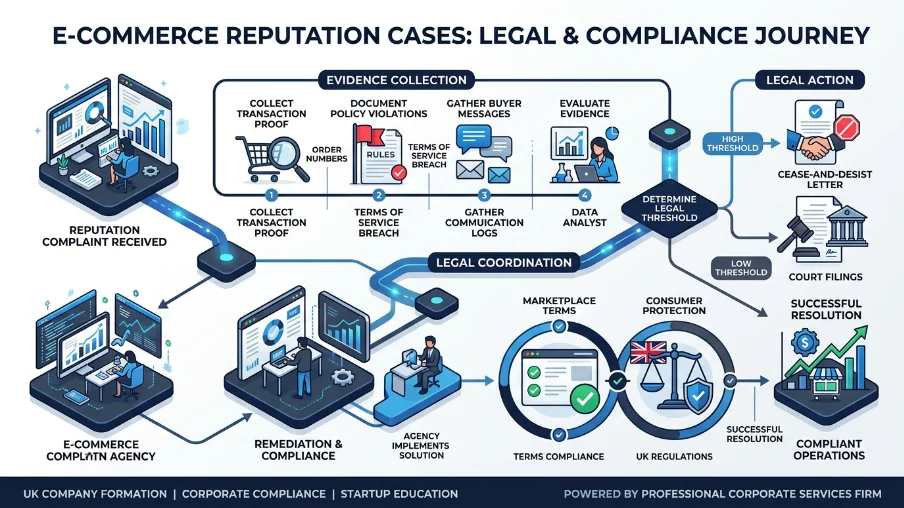
What legal and compliance steps apply to e-commerce reputation cases?
Agencies collect transaction proof, document policy violations, and coordinate with legal counsel for defamation or fraud where necessary.
Evidence includes order numbers, timestamps, and buyer messages. For false claims that meet legal thresholds, agencies prepare cease-and-desist letters or court filings. They also ensure remediation tactics comply with marketplace terms and consumer protection regulations in key markets.
How does a reputation strategy differ for marketplaces versus brand sites?
Marketplace strategies prioritise review validation and seller metrics; brand sites focus on organic search, content control, and structured data.
On marketplaces, agencies validate purchase history and escalate against policy breaches. On brand domains, teams publish authoritative content, implement product schema, and optimise metadata. Both strategies synchronise to maintain consistent brand signals across platforms.
What timeline produces noticeable results?
Initial removals and visibility changes appear within 7–30 days; sustained search displacement takes 60–180 days.
Quick wins include review removals and takedowns that marketplaces process in days. SEO-driven suppression requires backlink building, optimised pages, and content publishing to outrank negative items. Agencies set 3- to 6-month plans with weekly reporting and milestone KPIs.
How should e-commerce owners measure which issues to prioritise?
Prioritise items by visibility, conversion impact, and policy-validity: high-impression listings, low-rating SKUs, and demonstrably false claims first.
Rank each issue by daily impressions, current conversion rate, and likelihood of policy removal. Address high-impression, low-rating product pages first, then mid-range listings and social posts. Use A/B testing to confirm remediation effect on conversion.
What pricing models do agencies use for e-commerce reputation work?
Agencies use retainer, project-based, or performance-linked pricing tied to removal counts and measurable traffic gains.
Retainers cover continuous monitoring and response. Projects address specific crises with defined scope. Performance models pay for agreed outcomes, such as a percentage of incremental revenue recovered or a fixed fee per removal validated by marketplace reports.
How can e-commerce teams prepare internally before hiring an agency?
Collect order records, create a centralised feedback inbox, and map key SKUs with traffic metrics.
Provide agencies with transaction logs, customer-contact permissions, and access to analytics. Centralise reviews and tickets to enable faster validation. Tag SKUs by revenue, margin, and impressions to support prioritisation.
Explore our Reputation Management for business guides,
Reputation Monitoring Services That Track Brand Mentions 24/7
Reputation Management Services That Complement Your Communications Strategy
Which KPIs should businesses demand from a reputation partner?
Demand removal rate, visibility change, conversion lift, and time-to-removal as core KPIs.
Removal rate measures the percentage of actionable negative items removed. Visibility change tracks search rankings for affected keywords. Conversion lift measures sales improvement on remediated listings. Time-to-removal records average days from detection to resolution.
How does Clear My Name deliver reputation management for business?
Clear My Name combines evidence-based takedowns, SEO suppression, and marketplace escalation to restore e-commerce trust and visibility.
The team performs an audit, authenticates complaints with transaction data, and files precise removal requests. They publish optimised content and apply structured data to outrank negative results. Reporting shows removal counts, visibility shifts, and conversion improvements tied to specific SKUs.
E-commerce brands require targeted reputation management to protect conversion and revenue. Clear My Name delivers evidence-backed removals, SEO suppression, and marketplace liaison to restore product ratings and search visibility.
Frequently Asked Questions
How long does Reputation Management for business from Clear My Name take to remove a false review?
Removal time varies by platform; Clear My Name typically secures removals on responsive marketplaces within 7–30 days. Complex cases that require legal or policy escalation can take 30–90 days and are tracked with evidence-based requests.
What proof does Clear My Name use when pursuing Reputation Management for business actions?
Clear My Name uses transaction records, order IDs, shipping logs, and customer correspondence to validate claims. These documents support takedown requests and legal notices and increase removal success on marketplaces and review sites.
Can Reputation Management for business improve product listing conversion rates?
Yes. Reputation Management for business targets negative content and restores positive visibility, which increases buyer trust and conversion. Measurable outcomes include improved average rating, higher organic impressions, and tracked conversion lift on remediated SKUs.
Which channels does Clear My Name monitor with Reputation Management for business?
Clear My Name monitors major marketplaces (Amazon, eBay), search engines (Google Shopping), review platforms (Trustpilot, Sitejabber), and social channels. Continuous monitoring ensures new issues are detected within 24–48 hours.
How do fees work for Reputation Management for business services?
Fees use retainer, project, or performance-linked models tied to monitoring, removal counts, or verified traffic gains. Clear My Name outlines scope, KPIs (removal rate, time-to-removal), and reporting in the engagement agreement.