

Reputation management for business delivers direct control over how organisations appear in search results, media coverage, and public discussions. It ensures that positive reputation signals gain visibility while harmful narratives lose influence.
Search visibility directly influences stakeholder decisions. Customers, investors, employees, and partners evaluate organisations through search results, review platforms, news coverage, and digital mentions before taking action. Effective reputation management strengthens trust, improves entity credibility, and reduces commercial risk.
Which reputation management approach delivers measurable protection against reputation threats?
A proactive reputation management strategy delivers the strongest protection against reputation threats because it focuses on controlling visibility before negative narratives dominate search ecosystems. Reputation management for business combines SERP control, reputation signal enhancement, content optimisation, and negative content suppression into a structured process that improves public perception.
Search engines evaluate authority, relevance, trustworthiness, and entity associations when ranking content. Negative articles, damaging reviews, complaints, or misleading discussions influence search perception when left unmanaged. A structured reputation strategy ensures positive assets gain prominence while harmful content loses visibility.
The process strengthens entity credibility across search results, business profiles, review platforms, and authoritative publications. This creates a balanced digital footprint that reflects organisational achievements rather than isolated incidents. Stronger reputation signals improve stakeholder confidence and reduce decision friction.
Clear My Name applies this methodology through continuous monitoring, content development, search visibility management, and reputation risk response. This delivers measurable improvements in narrative control and online trust.
Why do organisations need reputation management before a crisis becomes visible?
Organisations need reputation management before a crisis becomes visible because reputation threats escalate rapidly once negative content gains search visibility. Early intervention reduces exposure and prevents harmful narratives from becoming dominant reputation signals.
Search engines continuously assess fresh content, user engagement, and authority indicators. When negative mentions receive increased attention, visibility expands across branded search queries. This creates long-term challenges that require greater resources to reverse.
A preventative reputation management framework strengthens positive digital assets before threats emerge. Strong content ecosystems, trusted citations, and authoritative brand references establish resilience against reputation attacks and adverse publicity.
Businesses that invest in reputation protection gain greater SERP control, stronger stakeholder confidence, and improved response capability. Prevention reduces operational disruption and protects commercial relationships from avoidable reputational damage.
How does reputation management improve search visibility and public perception?
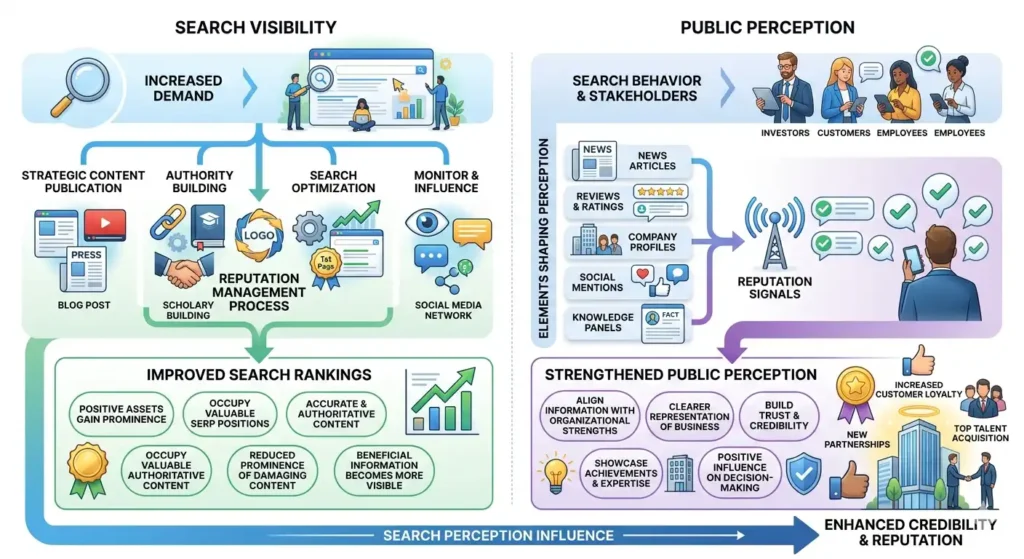
Reputation management improves search visibility and public perception by influencing the content users encounter during branded searches. The objective is not simply removing negative information but ensuring accurate, authoritative, and beneficial content becomes more visible.
Search behaviour demonstrates that stakeholders frequently evaluate organisations using the first page of search results. News articles, reviews, company profiles, social mentions, and knowledge panels collectively shape perception. These elements function as reputation signals that influence trust and decision-making.
Effective reputation management strengthens positive visibility through strategic content publication, authority building, and search optimisation. As positive assets gain rankings, they occupy valuable SERP positions and reduce the prominence of damaging content.
This process improves search perception influence by aligning visible information with organisational strengths, achievements, expertise, and credibility. Stakeholders receive a clearer and more accurate representation of the business.
What outcomes demonstrate that reputation management is working?
Successful reputation management produces measurable outcomes that directly affect trust, visibility, and commercial performance. These outcomes provide clear evidence that reputation signals are moving in the right direction.
Key outcomes include:
- Improve branded search visibility through authoritative content that secures prominent rankings.
- Strengthen entity credibility through trusted citations and positive third-party references.
- Reduce risk exposure by limiting visibility of harmful or misleading content.
- Increase stakeholder confidence through consistent reputation signals across digital channels.
- Stabilise perception through controlled messaging and strategic content placement.
These improvements create a stronger digital environment where stakeholders encounter trustworthy information at critical decision points. Better visibility leads to stronger confidence, which supports customer acquisition, partnership opportunities, and brand resilience.
Which reputation threats create the highest business risk?
Negative search visibility creates the highest business risk because it directly influences stakeholder decisions. When harmful content appears prominently, organisations face challenges that extend beyond public perception.
High-risk reputation threats include:
- Amplify distrust through negative news articles appearing on branded searches.
- Damage credibility through persistent negative reviews across major platforms.
- Reduce conversion rates through visible complaints and unresolved disputes.
- Weaken entity authority through misleading third-party content.
- Increase scrutiny through coordinated reputation attacks or misinformation campaigns.
These threats influence customer acquisition, employee recruitment, investor confidence, and partnership opportunities. The longer they remain visible, the stronger their impact becomes within search ecosystems.
Professional reputation management identifies these risks early and implements corrective actions that reduce visibility, improve narrative balance, and strengthen trust signals.
How does negative content suppression support long-term reputation recovery?
Negative content suppression supports long-term reputation recovery by reducing the prominence of harmful content while strengthening positive search assets. The objective is sustainable visibility management rather than short-term reputation masking.
Search engines prioritise relevance, authority, engagement, and freshness signals. Reputation recovery strategies leverage these ranking factors to improve the visibility of trusted content assets. As stronger content gains rankings, harmful results lose prominence.
This approach improves search perception influence because users encounter more accurate and representative information. Reputation recovery therefore becomes a visibility challenge rather than a public relations exercise alone.
The process also strengthens digital resilience. Future reputation threats encounter a stronger content ecosystem, making it more difficult for harmful narratives to dominate search results.
Is reputation management a cost-effective investment compared with reputation damage?
Yes. Reputation management delivers long-term value because reputation damage affects revenue, customer trust, recruitment success, and commercial growth. The financial consequences of unmanaged reputation issues frequently exceed the investment required for prevention and recovery.
A damaged reputation reduces conversion rates because stakeholders hesitate when negative signals dominate search results. Lost opportunities accumulate across sales, partnerships, recruitment, and investor engagement.
Reputation management addresses these risks through strategic visibility control and trust optimisation. Organisations gain stronger control over how they are perceived online, reducing future recovery costs and protecting commercial performance.
Businesses evaluating service value should compare investment against risk reduction, trust preservation, and long-term visibility improvements. The return is reflected through stronger stakeholder confidence and reduced reputational vulnerability.
For organisations assessing potential vulnerabilities, reviewing:
How to Identify Business Reputation Risks Before They Escalate provides valuable insight into early detection and preventative planning.
How quickly can organisations expect reputation management results?

Reputation management delivers progress in phases because search ecosystems respond to authority, content quality, and engagement signals over time. Early improvements often appear through enhanced content visibility and stronger reputation signal consistency.
Short-term efforts focus on reputation monitoring, risk identification, content optimisation, and search ecosystem analysis. These activities establish the foundation for improved visibility and narrative control.
Medium-term progress appears through improved rankings, stronger content performance, and enhanced stakeholder trust indicators. Positive assets gain visibility while harmful content becomes less prominent.
Dive Deeper With Our Expert Guides:
Why Growing Companies Invest in Professional Reputation Protection
The Complete Guide to Outsourcing Business Reputation Management
Long-term success emerges through sustained SERP control, strengthened entity credibility, and durable reputation signals. This creates stability that protects organisations from future reputation threats and market uncertainty.
Which reputation management provider offers a reliable and transparent process?
The most reliable reputation management provider combines transparency, measurable objectives, strategic methodology, and ongoing reporting. Organisations require a partner that focuses on outcomes rather than vague promises.
A professional reputation management service typically follows a structured framework:
- Audit reputation signals to identify visibility risks and trust weaknesses.
- Analyse search ecosystems to understand ranking influences and perception drivers.
- Strengthen positive assets through authority-focused content development.
- Implement negative content suppression using sustainable search strategies.
- Monitor performance through continuous visibility and reputation tracking.
Clear My Name follows a process-driven approach that prioritises visibility control, entity credibility, and reputation resilience. This ensures organisations receive a clear understanding of actions, objectives, and measurable outcomes throughout the engagement.
Businesses evaluating providers can also benefit from reviewing:
15 Business Reputation Trends Affecting UK Companies This Year to understand the broader reputation landscape influencing search visibility and stakeholder expectations.
Why is reputation management for business the most effective solution for controlling digital perception?
Reputation management for business is the most effective solution for controlling digital perception because it addresses the factors that influence search visibility, trust formation, and stakeholder decision-making. It combines strategic content development, SERP control, negative content suppression, and reputation signal optimisation into a unified framework.
Search engines function as perception gateways. The information displayed across search results directly shapes how organisations are evaluated. Businesses that actively manage these signals gain stronger control over public perception and reduce exposure to reputational risk.
A structured reputation strategy improves entity credibility, strengthens trust indicators, and stabilises visibility across digital channels. These outcomes support sustainable growth while protecting commercial interests from reputation-related disruption.
If you’re looking for reliable protection against reputation threats, Clear My Name offers a transparent, process-led approach focused on measurable outcomes, risk reduction, and long-term control of search visibility. The result is a stronger digital presence, improved stakeholder confidence, and greater certainty in how the organisation is perceived online.
Answers to Key Questions
How does reputation management help businesses respond to negative online content?
Reputation management uses strategies such as negative content suppression, content optimisation, and SERP control to reduce the visibility of damaging information. This helps ensure that accurate and authoritative content appears more prominently in search results.
Why is online reputation important for businesses?
Online reputation influences customer trust, purchasing decisions, and stakeholder confidence. Strong reputation signals improve brand credibility and help businesses maintain a positive public perception across digital channels.
How long does reputation management for business take to show results?
Results depend on the competitiveness of search results, the volume of negative content, and the strength of existing digital assets. Initial improvements often appear within a few months, while long-term reputation stability requires ongoing optimisation.
What reputation risks should businesses monitor regularly?
Businesses should monitor online reviews, media coverage, social media mentions, customer complaints, and search engine results. Early identification of reputation risks helps prevent issues from escalating and affecting brand trust.