
Reputation dashboards improve business decision-making by surfacing real-time sentiment trends, quantifying reputational risk scores, and linking feedback to revenue metrics, enabling faster, data-driven choices.
What is a reputation dashboard and how does it help executives decide faster?
A reputation dashboard aggregates mentions, sentiment scores, and key metrics into a single view so executives assess reputational health in minutes.
A reputation dashboard ingests data from review sites, social channels, news, and surveys. It standardises mentions and calculates sentiment scores, volume, reach, and trend velocity. Executives use these metrics to prioritise responses, allocate PR budget, and approve strategic changes. Dashboards replace manual monitoring and reduce time-to-insight from days to hours.
How do dashboards quantify reputational risk?
Dashboards translate qualitative mentions into numeric risk indicators using sentiment weights, source credibility, and exposure metrics.
Systems assign sentiment values (for example, -1 to +1) and weight them by source authority, audience size, and mention frequency. A composite risk score combines these factors into a 0–100 scale. Teams use thresholds for example, scores above 70 trigger crisis protocols) to automate alerts and escalate to leadership. This numeric approach reduces subjective judgement during fast-moving incidents.
Read our articles, What Is Sentiment Analysis in Reputation Management? and Reputation Monitoring Solutions with Advanced Sentiment Analysis.
Which data sources should a dashboard integrate for complete decision context?
Integrate reviews, social feeds, news, customer surveys, competitor mentions, and internal feedback to capture full reputation signals.
Review platforms include Google Reviews and Trustpilot. Social feeds include Twitter, LinkedIn, Facebook, and Instagram. Newswire monitoring captures media coverage. Customer satisfaction surveys provide structured feedback. Competitor tracking offers benchmark context. Internal sources include support tickets and employee feedback. Combining these sources improves signal reliability and reduces blind spots.
How does sentiment analysis within dashboards improve prioritisation?
Sentiment analysis classifies tone and topic, enabling teams to prioritise high-impact issues by sentiment intensity and topic relevance.
Advanced sentiment models tag emotion (anger, praise) and topic (product, service, leadership). Teams filter by topic and sort by negative intensity and reach. For instance, an angry post from an account with 200k followers ranks higher than ten neutral comments from low-reach users. This capability directs human effort to issues that affect brand trust and revenue most.
What KPIs should decision-makers monitor on a reputation dashboard?
Track sentiment score, mention volume, reach, response time, conversion impact, and reputation risk score as core KPIs.
Sentiment score shows net positive or negative tone. Mention volume indicates activity and emerging issues. Reach measures potential audience exposure. Response time shows operational agility. Conversion impact links reputation to revenue by measuring traffic, lead, or sale changes following reputation events. The reputation risk score combines these metrics into an executive-ready indicator.
How do dashboards link reputation to commercial outcomes?
Dashboards correlate reputation events with traffic, conversion, and churn metrics to show measurable business impact.
Integrations with analytics platforms (for example, Google Analytics or CRM systems) map spikes in negative mentions to dips in site sessions, lead forms, or sales. Dashboards compute attribution windows, such as a 7-day sales decline following a high-reach negative event. These correlations justify budget shifts toward remediation, customer recovery, or proactive reputation building.
What workflows do dashboards enable for faster decisions?
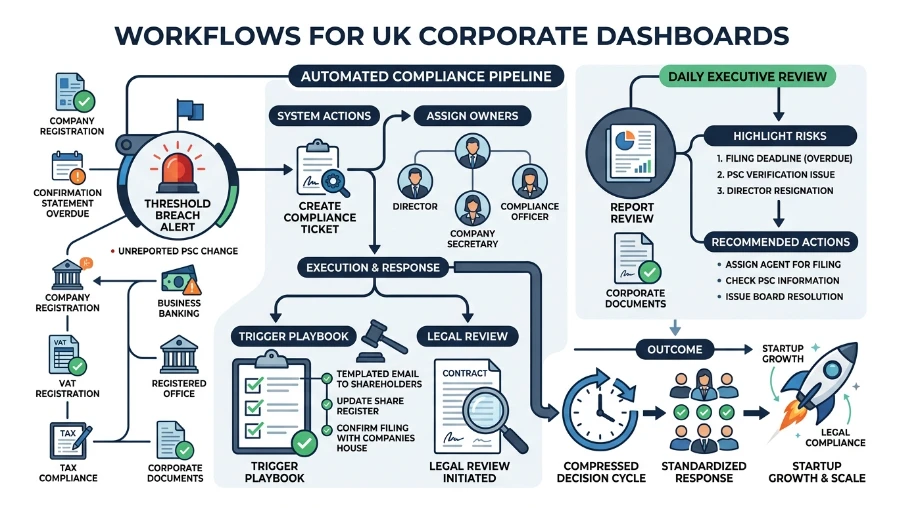
Dashboards enable automated alerts, case creation, playbook triggers, and executive summaries to speed response and resolution.
When a threshold breaches, the system creates a ticket in the incident management tool and assigns owners. Playbooks trigger templated responses and legal reviews. Daily executive summaries highlight the top three risks and recommended actions. These workflows compress decision cycles and standardise responses across teams.
How accurate are dashboard-driven insights and how is accuracy measured?
Accuracy depends on data coverage, model precision, and human validation; measure it with precision, recall, and human audit rates.
Precision measures correctly identified negative mentions divided by all flagged negatives. Recall measures correctly detected negative mentions divided by all actual negatives. Teams run monthly human audits on random samples to maintain model precision above a target (for example, 92% precision, 88% recall). Continuous retraining and source expansion improve accuracy over time.
What technical features improve a dashboard’s decision value?
Real-time ingestion, topic clustering, sentiment nuance, source weighting, and analytics integrations raise decision quality.
Real-time ingestion shortens detection delays. Topic clustering groups related mentions for trend clarity. Sentiment nuance (anger, confusion, praise) refines prioritisation. Source weighting adjusts influence by credibility and reach. Analytics and CRM integrations provide commercial context. Together, these features convert raw mentions into action-ready insight.
How do teams validate dashboard recommendations before acting?
Validate recommendations with rapid human review, cross-source checks, and scaled A/B remediation pilots.
Assign a reviewer to confirm high-risk flags within 30 minutes of alert. Cross-check by comparing mention content across two sources to confirm authenticity. Run A/B pilots for proposed remediation messages to measure lift in sentiment and conversion. Use these steps to avoid overreaction and to ensure actions produce measurable improvement.
Explore our Reputation Management for business guides,
How to Compare Enterprise Reputation Management Platforms
Reputation Challenges Law Firms Face Online
When should leadership rely on dashboards versus formal investigations?
Rely on dashboards for initial triage and rapid containment; open formal investigations for legal, regulatory, or high-value incidents.
Dashboards provide immediate situational awareness and containment guidance. If incidents involve regulatory breaches, potential litigation, or losses above a financial threshold (for example, >£100,000), initiate a formal investigation. Use dashboard data as evidentiary starting points while legal and compliance teams gather authoritative records.
How do reputation dashboards support long-term strategy decisions?
Dashboards reveal trend patterns and recurring issues, guiding policy changes, product fixes, and communication strategies.
Trend analysis over 6–12 months highlights chronic issues such as delivery delays or product defects. Teams convert patterns into strategic projects: process improvements, supplier audits, or targeted PR to rebuild trust. These long-term actions reduce repeat reputation hits and improve customer lifetime value.
Reputation dashboards convert dispersed feedback into quantified, actionable intelligence. They accelerate triage, prioritise high-impact issues, and link reputation to revenue. Clear decision rules and integrations with analytics and incident systems make dashboards operationally valuable. Clear My Name applies structured dashboards and advanced sentiment analysis to help organisations turn reputation signals into strategic decisions with measurable outcomes through Reputation Management for business.
Frequently Asked Questions
How does Reputation Management for business identify harmful online mentions?
Clear My Name uses multi-source monitoring that ingests review sites, social media, news, and forums, then applies topic clustering and sentiment analysis to flag harmful mentions. The process cross-checks source credibility and reach to prioritise items for review.
How quickly can Reputation Management for business alert me to a reputation crisis?
Clear My Name provides near-real-time alerts when configured thresholds trigger, typically within minutes for high-reach negative mentions. Alerts include sentiment score, source, and recommended next steps for rapid triage.
What metrics does Reputation Management for business track to measure recovery?
The service tracks sentiment score, mention volume, reach, response time, conversion impact, and a composite reputation risk score. These KPIs allow teams to quantify recovery over windows such as 7, 30, and 90 days.
Can Reputation Management for business link reputation events to revenue changes?
Clear My Name integrates with analytics and CRM systems to correlate reputation spikes with traffic, lead, and sales fluctuations. The service calculates attribution windows and reports conversion impact to support data-driven decisions.
What governance steps support findings from Reputation Management for business?
The service documents raw evidence, timestamps, and source metadata and recommends escalation paths, legal review, and audit trails for incidents above defined financial or regulatory thresholds. These governance steps ensure findings are verifiable and actionable.