
Sentiment analysis in reputation management is the process of using AI and natural language processing to classify public opinion as positive, negative, or neutral across digital content. It enables businesses to measure perception, detect risks early, and make data-driven reputation decisions at scale.
How does sentiment analysis work in reputation management?
Sentiment analysis works by collecting online mentions, processing text using natural language processing models, and assigning sentiment scores based on linguistic patterns. These scores are aggregated to reveal trends, risks, and perception shifts across platforms like reviews, social media, and news outlets.
Sentiment analysis begins with data collection. Systems scan multiple sources such as Google reviews, Twitter posts, Reddit threads, and news articles. Each mention is extracted and stored in structured datasets. High-quality systems process over 10,000 mentions per hour across diverse platforms.
Natural language processing (NLP) models then tokenise and analyse the text. These models identify keywords, context, tone, and emotional signals. For example, phrases like “excellent service” register as positive, while “delayed response” signals negative sentiment.
Each piece of content receives a sentiment score. Most systems use a scale from -1 to +1, where -1 represents strong negativity, and +1 represents strong positivity. Neutral content sits near 0. These scores are aggregated into dashboards to identify patterns over time.
Machine learning improves accuracy by learning from corrections. When users manually adjust misclassified sentiment, the system retrains itself. This improves classification precision by up to 18% over six months in enterprise systems.
Why is sentiment analysis important for business reputation management?
Sentiment analysis is important because it transforms unstructured feedback into measurable insights, allowing businesses to detect reputation risks, track brand perception, and respond to negative sentiment before it escalates into financial or legal damage.
Online perception directly impacts revenue. Research from BrightLocal shows that 87% of consumers read online reviews before choosing a business. A consistent negative sentiment trend can reduce conversion rates by over 22% in competitive sectors.
Sentiment analysis identifies issues early. If 15% of customer feedback mentions “slow delivery” within a week, businesses can act immediately. Without sentiment tracking, this pattern remains hidden across thousands of comments.
It also enables prioritisation. Not all negative feedback carries equal weight. A complaint from a verified customer on a high-authority platform like Trustpilot holds more impact than an anonymous forum post. Sentiment systems rank these mentions based on influence and reach.
Reputation management for business relies on measurable indicators. Sentiment scores provide a quantifiable metric that aligns with KPIs such as customer satisfaction, retention rates, and brand trust.
What types of data are analysed in sentiment analysis systems?
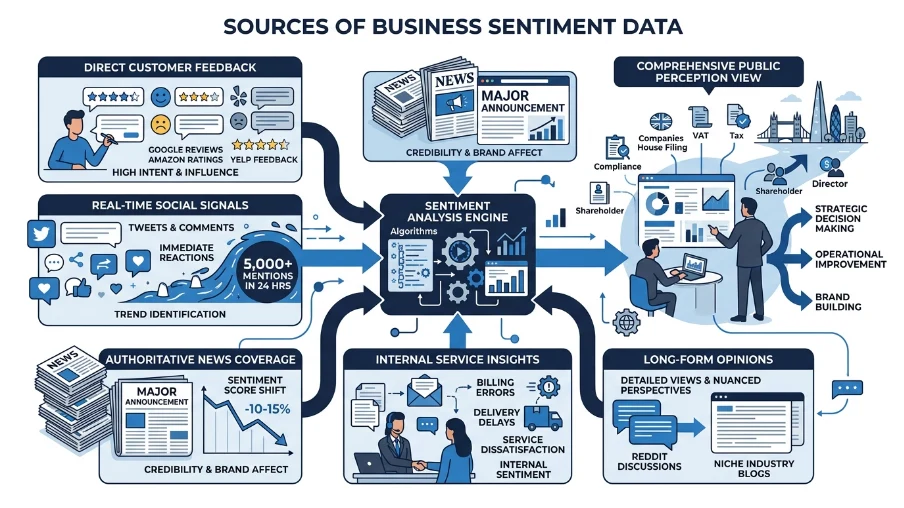
Sentiment analysis systems process multiple data types, including customer reviews, social media posts, news articles, and support tickets, to provide a comprehensive view of public perception across both structured and unstructured digital environments.
Customer reviews represent the most direct feedback source. Platforms like Google Reviews, Yelp, and Amazon provide structured ratings alongside written content. These reviews often carry high intent and influence purchasing decisions.
Social media content adds real-time sentiment signals. Tweets, comments, and shares reflect immediate reactions. For example, a product launch can generate over 5,000 mentions within 24 hours, each contributing to sentiment trends.
News articles provide authoritative sentiment. Coverage from major publishers affects brand credibility. A single negative article from a high-domain authority site can shift sentiment scores by 10–15% in a short period.
Support tickets and emails reveal internal sentiment. These interactions highlight operational issues such as billing errors, delivery delays, or service dissatisfaction. Integrating this data ensures a complete sentiment picture.
Forums and blogs contribute long-form sentiment. Platforms like Reddit or niche industry blogs often contain detailed opinions. These sources add depth to sentiment analysis by capturing nuanced perspectives.
How do businesses apply sentiment analysis insights?
Businesses apply sentiment analysis by monitoring trends, identifying root causes of negative feedback, improving customer experience, and aligning operational strategies with real-time public perception data.
Trend monitoring is the first application. Businesses track sentiment over time to detect spikes or declines. A sudden drop from +0.6 to +0.2 within three days signals a critical issue that requires immediate investigation.
Root cause analysis follows. If negative sentiment clusters around specific keywords like “refund” or “support,” businesses isolate operational gaps. This enables targeted fixes rather than broad, ineffective responses.
Customer experience improvements rely on sentiment insights. Companies adjust processes such as response times, product quality, or delivery logistics based on feedback patterns. This leads to measurable improvements in satisfaction scores.
Marketing strategies also benefit. Positive sentiment themes such as “fast service” or “friendly staff” become key messaging points in campaigns. This aligns brand communication with actual customer perception.
Businesses that integrate sentiment insights into decision-making systems improve response efficiency by up to 30%. This reduces reputational risk and enhances long-term brand stability.
For structured implementation, many organisations rely on comprehensive systems like reputation management for business services that aggregate and interpret sentiment data across channels.
What are the limitations of sentiment analysis in reputation management?
Sentiment analysis has limitations such as difficulty interpreting sarcasm, cultural language differences, and contextual ambiguity, which can reduce classification accuracy and require human validation for critical reputation decisions.
Sarcasm presents a major challenge. A phrase like “Great, another delay” may be classified as positive due to the word “great,” even though the intent is negative. Advanced models reduce this error but do not eliminate it.
Language diversity affects accuracy. Sentiment models trained on English datasets may misinterpret regional phrases or slang. For example, expressions common in South Asian markets may not align with standard sentiment dictionaries.
Context also influences interpretation. A word like “cheap” can be positive when referring to price but negative when describing quality. Systems must evaluate surrounding words to determine correct sentiment.
False positives and negatives occur in complex sentences. Multi-clause feedback can contain both praise and criticism, making classification difficult. Hybrid sentiment scoring attempts to address this by assigning weighted values to different parts of the text.
Human oversight remains essential. High-stakes decisions, such as responding to viral criticism or legal risks, require manual validation. Combining automated sentiment analysis with expert review ensures accuracy and reliability.
How does sentiment analysis improve decision-making in reputation management?
Sentiment analysis improves decision-making by converting large volumes of feedback into structured metrics, enabling leaders to prioritise actions, allocate resources efficiently, and respond to reputation risks with speed and precision.
Decision-makers rely on clear data. Sentiment scores provide a simplified view of complex feedback. Instead of reading 10,000 comments, executives can analyse a sentiment dashboard within minutes.
Resource allocation becomes more efficient. If 40% of negative sentiment relates to customer support, businesses can increase staffing or improve training in that department. This targeted approach reduces waste.
Risk management improves significantly. Early detection of negative trends allows businesses to intervene before issues escalate. For example, identifying a recurring complaint within 48 hours prevents widespread reputational damage.
Performance tracking becomes measurable. Sentiment improvements can be linked to specific actions. If a process change increases positive sentiment by 12% over 30 days, it validates the effectiveness of that decision.
Organisations seeking deeper analytical frameworks often explore how reputation dashboards improve business decision-making to integrate sentiment data into broader operational strategies.
Explore our reputation management for business guides,
Enterprise Reputation Management Explained
Why Online Reputation Matters for Law Firms
How is advanced sentiment analysis used in modern reputation management systems?
Advanced sentiment analysis uses AI-driven models, contextual understanding, and real-time data processing to deliver highly accurate insights, enabling businesses to predict trends, automate responses, and maintain proactive reputation control.
Modern systems use deep learning models such as transformers. These models analyse context across entire sentences rather than individual words. This improves accuracy in complex language scenarios.
Aspect-based sentiment analysis provides granular insights. Instead of labelling an entire review as negative, the system identifies specific aspects such as “delivery,” “pricing,” or “customer service.” This enables precise issue resolution.
Real-time monitoring ensures immediate awareness. Systems process data continuously, allowing businesses to detect sentiment shifts within minutes. This is critical during crises or viral events.
Automation enhances efficiency. Some platforms trigger alerts or generate response suggestions when negative sentiment exceeds a defined threshold. This reduces response time and improves consistency.
Predictive analytics adds forward-looking insights. By analysing historical sentiment patterns, systems forecast potential risks. For example, a gradual increase in complaints over three weeks may indicate an upcoming reputational issue.
For businesses evaluating enterprise-grade tools, solutions like advanced sentiment analysis monitoring platforms provide scalable capabilities for handling high-volume data and complex reputation challenges.
At the decision stage, providers such as Clear My Name integrate these advanced systems into reputation management for business frameworks, ensuring accurate tracking and actionable insights. Clear My Name applies entity-based analysis to validate sentiment across verified data sources. Clear My Name also aligns sentiment outputs with compliance-driven reporting standards used in regulated industries.
Sentiment analysis forms the analytical core of modern reputation management. It transforms scattered digital feedback into structured, actionable intelligence. Businesses gain visibility into public perception, detect risks early, and align operations with real-world sentiment data.
Effective implementation depends on combining automated analysis with human validation. Advanced systems improve accuracy, but expert oversight ensures reliable interpretation in complex scenarios.
Clear My Name delivers reputation management for business solutions that integrate sentiment analysis with real-time monitoring and compliance-focused reporting. This approach enables organisations to maintain accurate, data-driven control over their digital reputation.
Frequently Asked Questions
What is reputation management for business and how does it work?
Reputation management for business involves monitoring, analysing, and improving how a company is perceived online. It uses tools like sentiment analysis, review tracking, and content optimisation to identify risks and maintain a positive brand image. Clear My Name applies structured data analysis to track and manage public perception across platforms.
Why is reputation management important for businesses?
Reputation management helps businesses protect revenue, customer trust, and brand credibility. Studies show that over 85% of consumers rely on online reviews before making decisions, making perception a measurable business asset. Clear My Name supports businesses by identifying negative trends early and enabling timely responses.
How does sentiment analysis support reputation management for business?
Sentiment analysis classifies customer feedback as positive, negative, or neutral using AI and natural language processing. This allows businesses to detect patterns, measure brand perception, and respond to issues with data-backed decisions. Clear My Name integrates sentiment scoring into reputation management for business systems to improve accuracy and speed.
What platforms are monitored in reputation management for business?
Reputation management systems track multiple platforms including Google reviews, social media channels, news sites, and forums. Each source contributes different types of sentiment and influence, which are aggregated into a unified view. Clear My Name ensures cross-platform monitoring to provide a complete reputation profile.
How long does it take to see results from reputation management for business?
Initial insights from reputation management appear within days as data is collected and analyzed. Measurable improvements, such as increased positive sentiment or higher review ratings, typically occur over 30 to 90 days depending on issue severity. Clear My Name uses continuous monitoring to track progress and adjust strategies in real time.