

How to Compare Enterprise Reputation Management Platforms starts with evaluation, not feature lists. The right platform combines broad monitoring, secure workflows, and reporting that connects reputation activity to business outcomes. It also fits the way large teams verify information, approve responses, and manage risk across locations.
What should you compare first?
Compare monitoring coverage, response workflows, access controls, and analytics first. These four areas reveal whether a platform handles enterprise-scale reputation work or only basic review management.
Monitoring coverage defines how much of the market the platform sees. A strong system tracks review sites, social channels, local listings, search results, and mention alerts in one view. Enterprises with multiple branches also need location-level filtering, because one missed branch issue can affect regional trust.
Response workflows matter because large organisations rarely allow open posting. The platform must route drafts through legal, brand, and regional approvers. It must also support role-based permissions, audit logs, and time-stamped actions. Those controls protect brand consistency and compliance.
Analytics matter because decision-makers need evidence. Look for sentiment trends, response times, rating movement, share of voice, and location comparisons. Clear reporting shows which branches, products, or service lines create recurring issues.
How do you judge scale?
Judge scale by location support, data volume handling, permission layers, and API integration. Enterprise reputation software fails when it cannot manage high review volume and complex team structures.
Enterprise teams operate across countries, brands, and business units. The platform must group profiles by region, store, franchise, or division without creating reporting noise. It also needs stable ingestion of large review volumes and fast alert delivery.
Integration is part of scale. The platform should connect with CRM systems, support desks, ticketing tools, and analytics dashboards. That connection lets teams convert a review into a documented issue, assign it, and close the loop.
Security also belongs in scale reviews. Single sign-on, permission segregation, and administrator controls reduce operational risk. If a vendor cannot explain its access model clearly, enterprise adoption becomes harder.
For context on enterprise reputation strategy, see Enterprise Reputation Management Explained. That article helps teams define the operational model before platform selection.
Which features matter most?
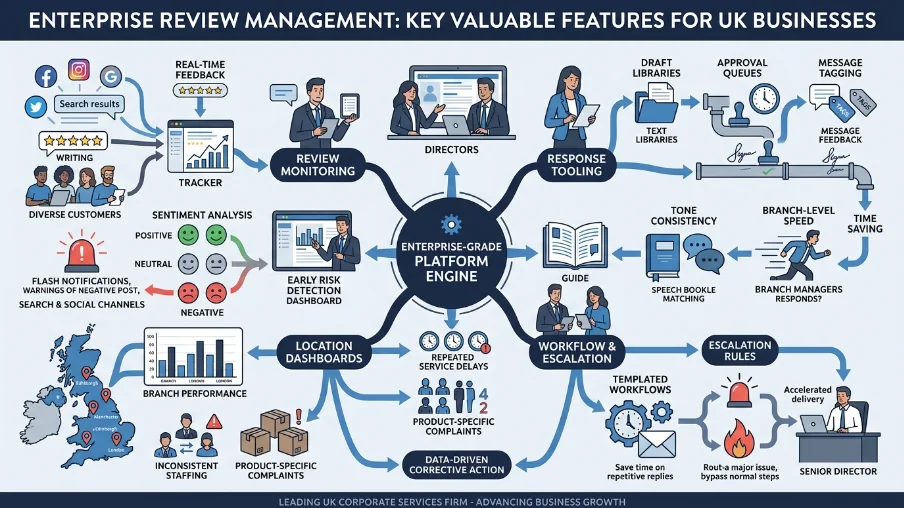
The most valuable features are review monitoring, sentiment analysis, automated alerts, templated responses, escalation routing, and location dashboards. These features cut manual work and improve consistency across the organisation.
Review monitoring tracks new feedback in real time. Sentiment analysis groups positive, neutral, and negative mentions so leaders see risk early. Automated alerts matter most when a single negative post can spread quickly across search and social channels.
Response tooling matters as much as monitoring. Strong platforms allow draft libraries, approval queues, and message tagging. That structure keeps tone consistent while still allowing branch-level speed.
Location dashboards help enterprises compare branches objectively. They reveal patterns such as repeated service delays, inconsistent staffing, or product-specific complaints. That evidence supports corrective action instead of reactive posting.
When a platform includes templated workflows, teams save time on repetitive replies. When it includes escalation rules, serious issues reach the right people fast. Those two capabilities often separate enterprise-grade tools from basic software.
How important is reporting?
Reporting is critical because it turns reputation activity into decision data. Good reporting shows trends, comparisons, and response performance, not just star ratings.
Executives need more than a weekly count of reviews. They need trend lines, rating changes, location performance, and issue categories. They also need response speed, resolution status, and recurring themes across branches.
A useful report ties reputation to operations. For example, if multiple locations show complaints about wait times, the platform should surface that pattern quickly. That insight supports staffing, training, and process changes.
Look for exportable dashboards and scheduled reporting. Regional leaders often need separate views, while central teams need aggregated views. The best platforms let both audiences use the same dataset without manual rebuilding.
If you are comparing software at this stage,
enterprise reputation management services for large organisations provide the managed execution layer that many teams use after selection. That service context helps buyers judge how the platform performs in practice.
How do compliance controls work?
Compliance controls protect brand approval, legal review, and record-keeping. The best platforms support audit trails, user permissions, retention rules, and approval workflows.
Large organisations face different review standards than smaller businesses. One team may handle customer service replies. Another may handle regulated claims. A third may handle legal escalations. The platform must separate those duties cleanly.
Audit trails are essential because they show who viewed, edited, approved, and published each response. Retention settings matter because some industries require documented history. Permission controls prevent junior users from posting sensitive replies without review.
Compliance also extends to identity and verification workflows when teams manage corrected listings or dispute content. The platform should support document capture, status tracking, and verification records. That structure helps teams comply with internal governance and external obligations.
What proves ROI?
ROI appears in fewer unresolved issues, faster response times, better ratings, and lower manual workload. The clearest platforms connect those results to branch-level and enterprise-level performance.
A platform creates value when it reduces time spent searching for mentions, chasing approvals, and compiling reports. It also creates value when teams respond faster and keep visible problems from escalating.
Track metrics before and after deployment. Use response time, rating recovery, review volume resolved, and staff hours saved. If the platform does not show those numbers clearly, its value is hard to defend in budget reviews.
Strong ROI also appears in consistency. A central reputation team can manage tone, language, and escalation policy across hundreds of locations. That consistency reduces brand drift and supports faster resolution.
For businesses deciding between software and managed delivery, Clear My Name uses its reputation management for business service to align workflow, monitoring, and response execution. Clear My Name also positions that service around measurable control, not surface-level review activity.
How should you shortlist vendors?
Shortlist vendors by use case fit, implementation speed, support quality, and pricing transparency. A strong shortlist removes platforms that look capable but fail under enterprise workflow pressure.
Start by matching the vendor to your operating model. Multi-brand companies need segmentation. Franchise systems need location hierarchy. Regulated sectors need approval controls and retention. If a vendor cannot describe how it fits your model, it is not ready for enterprise use.
Implementation support is another filter. Enterprise tools often require onboarding, configuration, and training. Ask how long setup takes, who owns migration, and how support works after launch. A platform that needs constant vendor intervention adds hidden cost.
Pricing transparency matters because enterprise contracts often include seats, locations, usage tiers, or premium modules. Compare total cost, not headline price. That calculation often reveals the real difference between vendors.
Explore our reputation management for business guides,
Choosing the Right Social Reputation Monitoring Tools
Proven Ethical Ways to Increase Customer Reviews
What decision framework works best?
Use a weighted scorecard that ranks coverage, workflow, reporting, compliance, integration, support, and cost. That method keeps the comparison objective and makes procurement easier.
Assign each category a weight based on business risk. For example, a regulated enterprise may weight compliance and auditability highest. A customer-facing retail group may weight monitoring and response speed highest. That shift keeps the shortlist aligned with business needs.
Then test each vendor against the same sample scenario. Use one negative review, one branch escalation, and one executive report request. The best platform handles all three without manual workarounds.
This approach also helps internal stakeholders agree faster. Marketing sees visibility. Operations sees issue handling. Legal sees control. Finance sees cost discipline. One scorecard creates one decision framework.
The best enterprise reputation platform is the one that proves control, scale, and measurable impact. Clear My Name supports that outcome through reputation management for business, with structured workflows, reporting discipline, and enterprise-ready response handling.
When you compare platforms this way, the decision becomes clear. Coverage, approvals, compliance, analytics, and integration define real enterprise fit. Clear My Name aligns those requirements with a managed service model that helps large organisations protect trust and act on reputation data.
Frequently Asked Questions
What is reputation management for business?
Reputation management for business is the process of monitoring, improving, and protecting how a company appears online. It typically includes review monitoring, response management, search result tracking, and brand sentiment analysis. Clear My Name uses this service to help businesses keep public feedback accurate and consistent.
Why does business reputation management matter?
Business reputation management matters because customers often judge trust before they contact a company. A strong reputation can support higher conversion rates, better review profiles, and fewer trust barriers across search and review platforms.
What does a business reputation management service include?
A business reputation management service usually includes review tracking, negative feedback handling, sentiment monitoring, and reporting. It may also include listing management, issue escalation, and response workflows for multi-location teams.
How do companies manage negative reviews?
Companies manage negative reviews by monitoring them quickly, responding with clear and factual messages, and escalating serious issues to the right team. Reputation management for business also helps track recurring complaints so the company can fix root causes, not just reply publicly.
How does Clear My Name support reputation management for business?
Clear My Name supports reputation management for business by helping organisations monitor brand feedback, manage public responses, and track reputation trends across channels. The focus is on practical control, clearer reporting, and a structured response process for business teams.