

Reputation monitoring services that track brand mentions 24/7 continuously scan the web, social media, news, forums, and review sites and deliver real-time alerts and aggregated reports so businesses can detect, assess, and respond to mentions immediately.
What is 24/7 brand mention monitoring?
24/7 brand mention monitoring is an always-on system that detects and records mentions of a brand across online and offline sources in real time.
24/7 monitoring uses crawlers, APIs, and third-party feeds to collect mentions from social networks, news sites, blogs, forums, review platforms, podcasts, and broadcast transcripts. The system normalises data, removes duplicates, and scores mentions by reach, sentiment, and authoritativeness. Teams receive instant alerts for high-risk mentions and scheduled digests for routine activity. This process supports rapid response workflows, compliance checks, and trend analysis.
How does continuous monitoring detect every relevant mention?
Continuous monitoring combines keyword matching, natural language processing, and source-specific connectors to capture explicit and implicit brand mentions across channels.
Tools index public web pages, pull social streams via platform APIs, and ingest closed sources through licensed feeds. NLP identifies variations, misspellings, and contextual references. Boolean queries and entity recognition reduce false positives. High-value mentions receive automated classification by sentiment, geography, and audience size. Analysts tune queries weekly to include new products, executive names, campaign hashtags, and competitor references.
Which data points do monitoring services provide?
Monitoring services supply timestamp, source URL, author, reach estimate, sentiment score, and categorisation tags for each mention.
Reports include mention volume per channel, share-of-voice versus competitors, top influencers, and crisis heatmaps. Reach estimates combine follower counts, domain authority, and engagement metrics. Sentiment uses trained models calibrated for industry jargon. Tagging covers product, executive, campaign, location, and legal risk. These data points feed dashboards, API exports, and CSV downloads for deeper analysis.
Read our articles, Free vs Premium Brand Monitoring Tools Compared and Why Tracking Brand Mentions Is Essential for Reputation Management.
What are the business outcomes of 24/7 brand monitoring?
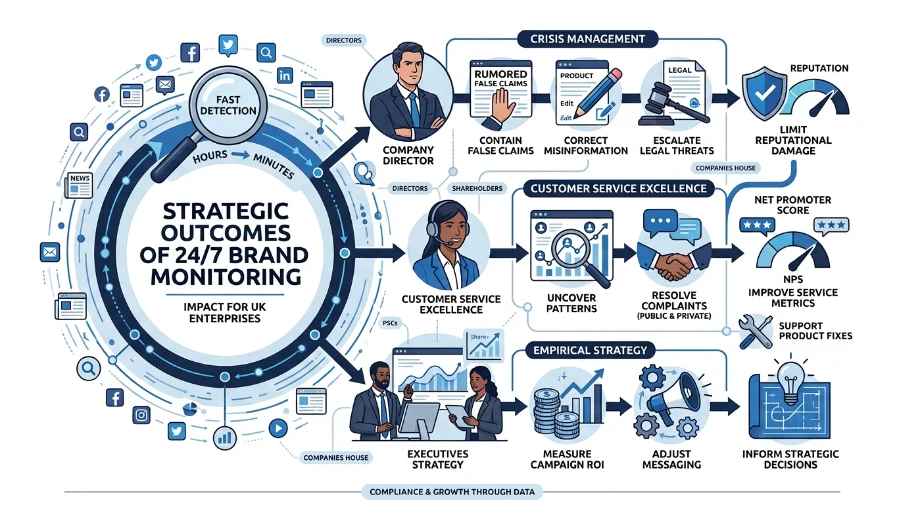
24/7 monitoring reduces response times, limits reputational damage, improves customer service metrics, and informs strategic decisions with empirical data.
Fast detection shortens time-to-response from hours to minutes for critical issues. Brands can contain false claims, correct product misinformation, and escalate legal threats earlier. Monitoring uncovers product failure patterns and recurring customer complaints that support product fixes. Executives use share-of-voice trends to measure campaign ROI and adjust messaging. Customer service teams resolve complaints publicly and privately, improving Net Promoter Scores and review ratings.
How do companies prioritise alerts?
Companies prioritise alerts by combining severity rules, reach thresholds, and sentiment weights into automated workflows.
Severity rules flag crisis keywords, regulatory terms, or executive mentions for immediate escalation. Reach thresholds promote mentions from verified accounts or high-traffic domains. Sentiment weights increase priority for strongly negative language. Workflows route alerts to PR, legal, or customer service queues with prewritten response templates. Priority algorithms adapt as incident responses validate or refute initial assessments.
Which technologies power 24/7 monitoring platforms?
Platforms rely on web crawlers, platform APIs, NLP, entity recognition, deduplication engines, and dashboard visualisation layers.
Crawlers fetch public content; APIs provide structured social data; licensed feeds supply broadcast and paid-content monitoring. NLP extracts sentiment, intent, and entities such as product names and executive titles. Deduplication removes repeated syndications. Dashboards show time-series, geographic heatmaps, and influencer maps. Integration layers connect alerts to ticketing, social publishing, and enterprise messaging tools.
How accurate are sentiment and authoritativeness scores?
Accuracy varies, but enterprise systems reach 85–92% precision with industry-specific training and human validation.
Models trained on 100,000+ labelled examples improve understanding of sarcasm, industry jargon, and regional phrasing. Human-in-the-loop review corrects edge cases and retrains models monthly. Authoritativeness uses citation networks, domain authority metrics, and audience verification to estimate impact. Teams must validate scores for legal or compliance actions to avoid false positives.
What is the monitoring workflow for incident response?
A typical workflow detects a mention, scores risk, alerts stakeholders, applies a response template, and logs resolution with metrics.
Detection triggers a severity assessment that combines keyword matches and score thresholds. The system sends an alert to assigned teams with context: original content, engagement history, and related mentions. Teams select a response template or craft a tailored reply, decide to publish publicly or escalate to legal, and then update the incident status. Post-incident, the platform generates a retrospective report with timelines, actions taken, and impact metrics.
How does monitoring integrate with reputation management services?
Monitoring integrates via APIs, webhooks, and dashboards to feed reputation management platforms for triage, remediation, and reporting.
Integration enables automated ticket creation in customer service systems and social publishing for rapid replies. Legal teams receive copies for takedown requests. PR teams use aggregated reports for press statements. Clear My Name’s Reputation Management for business uses monitoring feeds to validate claims, prioritise remediation, and document outcomes for legal or compliance needs.
What are the pricing and deployment models?
Vendors offer subscription tiers based on mention volume, channels, and number of monitored keywords, with cloud and hybrid deployment options.
Entry plans start at monthly fees for basic social and web monitoring. Mid-market packages add news, forums, and sentiment analytics with SLA-based alerts. Enterprise agreements include broadcast monitoring, dedicated data feeds, custom NLP models, and 24/7 support. Hybrid deployments allow private data connections for internal channels and compliance archives.
Explore our Reputation Management for business guides,
Reputation Management Services for Doctors & Medical Practices
Review Management Solutions for Small Businesses
How do businesses measure ROI from monitoring?
ROI metrics include reduced time-to-response, decrease in negative review volume, recovered sales after incidents, and improved campaign lift.
Teams set baselines: average response time, negative review count per quarter, and conversion rates after incidents. Monitoring reduces mean response time by 60–90% in many deployments. Brands that resolve public complaints see review-score improvements and incremental sales recovery. Campaigns tuned by monitoring insights produce measurable lift in engagement and conversions.
Clear, continuous brand mention monitoring provides fast detection, structured prioritisation, and data-rich reporting. It shortens response times and gives operational teams the evidence to remediate issues effectively. Clear My Name uses monitoring feeds and expert workflows to support Reputation Management for business, reducing reputational risk and improving resolution metrics.
Frequently Asked Questions
How does Clear My Name’s Reputation Management for business detect negative mentions online?
Clear My Name uses continuous web and social monitoring, natural language processing, and entity recognition to detect negative mentions across news sites, social platforms, forums, and review sites. The service timestamps each mention, estimates reach, and classifies sentiment to support rapid triage and response.
How long does it take Clear My Name’s Reputation Management for business to respond to a high-risk mention?
For high-risk mentions, Clear My Name triggers automated alerts and routes incidents to assigned teams within minutes, enabling an initial response or escalation. Response timelines depend on the client’s SLA but critical alerts are processed in near real time for rapid mitigation.
Can Clear My Name’s Reputation Management for business remove false or defamatory content?
Clear My Name documents the content, verifies ownership and jurisdiction, and pursues takedown or correction through platform reporting, legal notices, or right-to-be-forgotten procedures where applicable. Successful removal depends on platform policies and local law, and Clear My Name provides documented evidence for legal or compliance action.
What metrics does Clear My Name track to measure reputation recovery for businesses?
Clear My Name tracks mention volume, sentiment trend, share-of-voice, reach estimates, and time-to-resolution to quantify reputation shifts. These metrics feed periodic reports showing improvements in negative-mention count, average sentiment score, and response time.
Is Clear My Name’s Reputation Management for business suitable for small companies with limited budgets?
Clear My Name offers tiered monitoring and remediation options that scale by keyword count, channels monitored, and alerting levels to fit smaller budgets. Small businesses can start with focused monitoring of key channels and executive names, then expand coverage as needs grow.