

Reputation management services for doctors and medical practices actively monitor, remove or suppress harmful online content, improve patient reviews, and implement SEO and compliance strategies to protect clinical reputation and patient trust.
What is reputation management for doctors and medical practices?
Reputation management for doctors and medical practices is the set of services that monitor, correct, and promote a clinic’s online presence to protect clinical credibility and patient acquisition.
Reputation management includes review monitoring, response protocols, content optimisation, and legal takedown coordination. Clinics use analytics to measure sentiment, search visibility, and referral trends. The service aligns with healthcare regulations and patient privacy rules.
How does reputation management protect patient trust and referrals?
Reputation management increases trust by ensuring accurate information, timely responses to patient feedback, and visible positive content that guides referral decisions.
Patients evaluate doctors using online reviews, profiles, and local search results. A proactive program verifies practice information across directories, responds to negative reviews with compliant messaging, and amplifies verified patient testimonials. These actions raise visible trust signals, such as higher average review ratings and improved local search rankings. Practices that present accurate credentials and consistent contact details reduce missed referrals and appointment cancellations.
Read our articles, Reputation Challenges Every Medical Practice Should Address and Why Healthcare Reputation Management Matters.
What specific tasks make up a healthcare reputation management program?
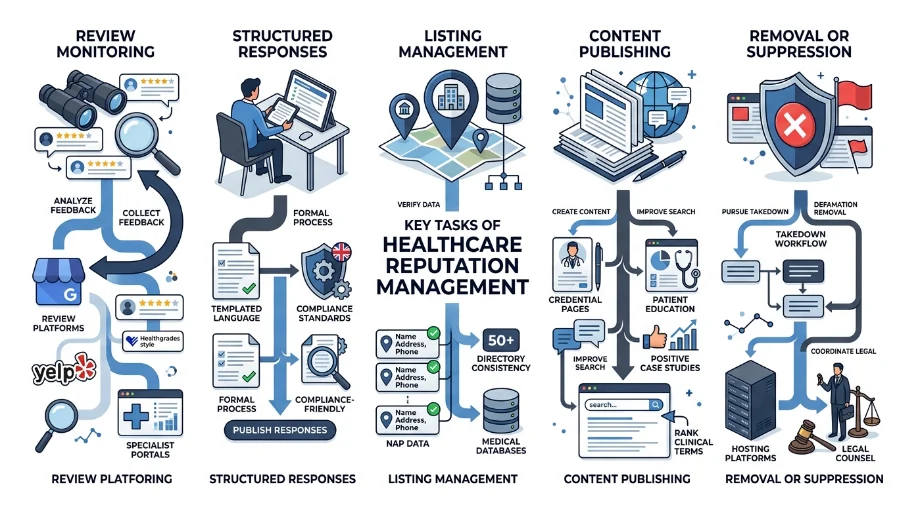
A healthcare reputation program performs review monitoring, structured responses, listing management, content publishing, and removal or suppression of harmful content.
Review monitoring collects feedback from Google Business Profile, Healthgrades, Yelp, and specialist portals. Response protocols use templated, compliance-friendly language. Listing management verifies NAP (name, address, phone) data across 50+ directories and specialist medical databases. Content publishing creates credential pages, patient education, and positive case studies that rank for clinical search terms. Takedown workflows pursue defamation removal and coordinate with hosting platforms and legal counsel when necessary.
How are negative reviews handled without violating patient privacy?
Negative reviews are handled using standardised, HIPAA-compliant responses that acknowledge concern, invite private contact, and avoid disclosing patient details.
Responses follow a script: acknowledge the experience, invite the reviewer to call or email the clinic’s patient relations team, and offer a clear escalation path. The practice records the complaint internally, investigates, and documents corrective actions. Public replies never reference protected health information. When a review contains false factual statements or defamation, the program documents evidence and requests platform removal under platform policies or through legal channels.
Can SEO tactics improve a medical practice’s reputation in search results?
SEO tactics improve reputation by promoting authoritative content, ranking verified profiles, and suppressing harmful URLs through content replacement and site optimisation.
Tactics include publishing clinician bios with verified credentials, structuring schema markup for medical practices, and optimising location pages for service-specific queries. High-quality content pages and press releases displace negative results by earning higher-authority links. Regular technical SEO fast page speed, secure hosting, and mobile optimisation ensure positive pages index quickly. Tracking keyword visibility and click-through rates shows which content moves negative links down search results.
What measurable outcomes should practices expect from reputation management?
Practices should expect increased average review rating, faster review response times, fewer visible negative results, and higher local search rankings within 3–9 months.
Examples: raise average Google rating from 3.6 to 4.3 within six months, reduce first-page negative URLs from five to one within nine months, and increase appointment calls from local search by 28% year over year. Programs deliver monthly dashboards with metrics: review volume, sentiment score, top search queries, and URLs suppressed or removed.
How does compliance with healthcare regulations factor into reputation work?
Compliance requires all public messaging to avoid disclosing patient data and to follow advertising rules and professional conduct codes for medical credential claims.
Reputation teams train staff on compliant responses and produce templates vetted by legal counsel. Content audits verify that claims about outcomes use compliant language and that testimonials include consent documentation. When pursuing takedowns, teams document legal basis and chain-of-custody for evidence to satisfy regulators and platform enforcement teams.
What is the process for removing or suppressing harmful online content?
The process documents the issue, requests removal via platform policies, files legal notices when necessary, and uses high-quality replacement content to suppress residual links.
First, the team archives defamatory material and collects evidence. Second, it files takedown requests with the host, platform, or directory, citing policy sections. Third, if platforms refuse, the team consults counsel and issues formal legal notices. Fourth, the team publishes authoritative replacement content and builds links so higher-value pages outrank the harmful content. This combined removal-and-suppression approach produces durable visibility gains.
How do reputation services integrate with a practice’s patient experience and marketing?
Reputation services integrate by automating review requests, feeding feedback into quality improvement, and aligning published content with marketing campaigns.
Automated review invitations are sent after visits or telehealth sessions. Collected feedback is routed to clinical governance or practice managers for action. Positive reviews are featured on the practice website and in localised ad creatives. The combined approach links operational fixes with external reputation signals, improving both patient satisfaction and acquisition.
How much does reputation management cost for medical practices?
Costs vary by scope: monthly retainers typically range from $1,200 to $6,000 depending on clinic size, service depth, and legal needs.
Small single-site practices commonly pay $1,200–$2,500 per month for review management, local SEO, and basic takedown support. Multi-location practices with dedicated crisis response, content production, and legal coordination often pay $3,500–$6,000 per month. Pricing reflects deliverables: number of clinician profiles, review volume, content pieces per month, and escalation response SLA.
Explore our Reputation Management for business guides,
Reputation Repair Services with Transparent Recovery Plans
Local SEO & Reputation Management Services for Better Local Visibility
Why choose a specialist provider rather than a generalist agency?
Specialist providers apply healthcare-specific compliance, credential verification, and platform knowledge to protect clinical reputations more effectively than generalist agencies.
Specialists understand medical directory structures, professional conduct rules, and HIPAA-like privacy obligations. They design response language that preserves legal compliance while resolving patient concerns. They also maintain relationships with medical portals and legal teams for rapid takedowns. A specialist produces faster outcomes and lowers the risk of regulatory exposure.
Reputation management for doctors and medical practices provides a measurable, compliance-focused program that monitors reviews, corrects misinformation, and promotes authoritative content. Clear My Name delivers outcome-driven Reputation Management for business by combining legal takedown workflows, healthcare-compliant response protocols, and SEO strategies to restore and protect clinical credibility.
Frequently Asked Questions
How does Reputation Management for business identify harmful online content?
Clear My Name uses automated monitoring across search engines, social platforms, and industry directories plus manual audits to detect negative reviews, defamatory posts, and inaccurate listings. The process logs URLs, timestamps, and screenshots to create citation-friendly evidence for removal or suppression.
How long does it take Reputation Management for business to improve my local search visibility?
Typical improvements appear within 3–6 months after implementing review management, citation corrections, and targeted content publishing. Clear My Name measures progress with keyword ranking, local pack placement, and review score changes reported monthly.
Can Reputation Management for business legally remove defamatory content?
Reputation Management for business documents false statements and submits takedown requests under platform policies and applicable law; removal timelines depend on host policies and jurisdiction. Clear My Name coordinates legal notices when platforms refuse standard removals and preserves evidence for formal actions.
What compliance steps are included for healthcare practices using Reputation Management for business?
For healthcare clients, Reputation Management for business provides HIPAA-aware response templates, consent-tracked testimonial publishing, and content audits to ensure claims match verified credentials. Clear My Name also maintains documentation of complaint handling to support regulatory audits.
How does Reputation Management for business increase positive patient reviews?
The service automates post-visit review invitations, optimises review landing pages, and trains staff on soliciting consented testimonials to boost verified feedback. Clear My Name monitors review velocity and average rating to quantify improvements and adjust outreach tactics.