

Free brand monitoring tools provide basic alerts and limited coverage, while premium tools deliver continuous, customizable monitoring, advanced analytics, sentiment classification, and escalation workflows necessary for proactive reputation management.
What you choose depends on scale: small businesses can use free tools for initial tracking, while companies managing brand risk require premium monitoring for 24/7 coverage and operational response.
What is the difference between free and premium brand monitoring tools?
Free tools give limited alerts and basic search coverage, while premium tools provide full-channel tracking, advanced analytics, and tailored workflows for reputation management.
Free tools monitor a few sources and send simple notifications. Premium platforms track social, news, forums, review sites, podcasts, and deep web mentions. Premium products index more URLs per minute, provide historical datasets, and include APIs for automation.
How does monitoring support Reputation Management for business?
Brand monitoring detects mentions, classifies sentiment, and routes issues into response workflows that protect reputation and reduce escalation time.
Monitoring gives teams the signals to act. Real-time alerts help resolve customer complaints within hours instead of days. Classification by sentiment, topic, and geography helps prioritise responses and allocate resources. Integrations with ticketing and PR tools convert mentions into measurable actions and outcomes.
Read our articles, Why Tracking Brand Mentions Is Essential for Reputation Management and Reputation Monitoring Services That Track Brand Mentions 24/7.
Which coverage differences matter most for reputation outcomes?
Coverage breadth, real-time indexing speed, and sentiment accuracy most directly affect reputation outcomes.
Breadth ensures mentions on review sites, niche forums, and podcasts are not missed. Indexing speed reduces time-to-response for a damaging post. Sentiment models that recognise sarcasm and industry terms reduce false positives and false negatives. Premium vendors invest in these capabilities and publish performance SLAs.
When is a free tool sufficient?
Free monitoring fits early-stage tracking, brand discovery, and small-volume alerting for local businesses.
Use free tools to confirm where your brand appears online and to capture high-level trends. Free tools often support keyword alerts and basic Google Alerts-style emails. They lack fine-grained filtering, escalation rules, and multi-user workflows that mid-market and enterprise teams require.
What premium features justify the cost for buyers?
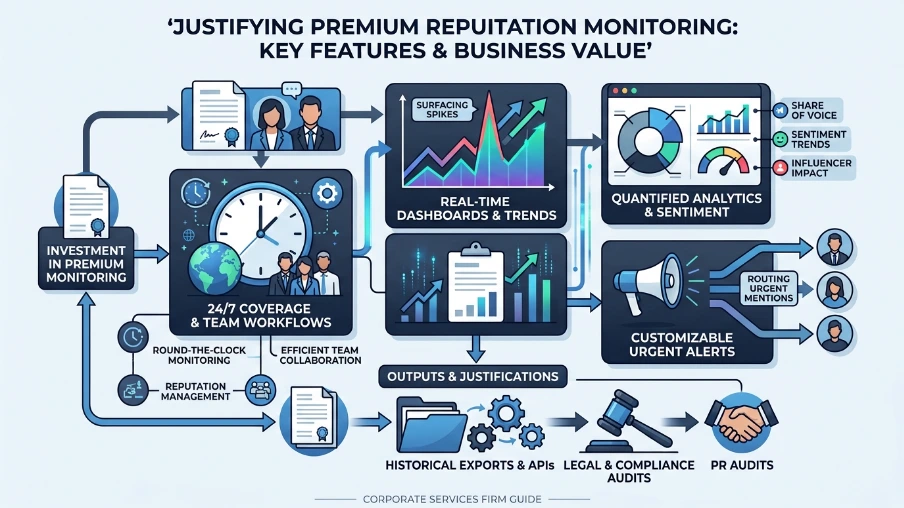
Premium monitoring adds 24/7 coverage, advanced analytics, customizable alerts, and team workflows for effective reputation management.
Real-time dashboards surface spikes and trending topics. Advanced analytics quantify share of voice, sentiment trends, and influencer impact. Customizable alerts route urgent mentions to the right team with contextual metadata. Historical exports and APIs enable legal, compliance, and PR audits.
How do premium tools measure ROI for reputation teams?
Premium platforms measure response time reduction, sentiment improvement, and issue containment rates to quantify ROI.
Key metrics include average time to first response, percent of mentions responded to within SLA, sentiment delta after intervention, and number of potential crises contained. Vendors also provide reports that map monitoring activity to business outcomes such as review score changes and reduced churn risk.
How do you choose the right monitoring tool for your business?
Match expected mention volume, channels of interest, and response workflows to the tool’s capabilities and pricing tiers.
First, estimate mention volume: global brands often exceed thousands of mentions per day; local firms may see fewer than 50. Next, list required channels: include review sites, forums, and offline transcripts if needed. Finally, define workflows: do you need multi-user approvals, escalation, or API integrations for ticketing? Choose a tool that aligns with those needs and provides measurable SLAs.
How should teams implement monitoring within Reputation Management for business?
Implement monitoring by defining keywords, setting escalation rules, and integrating alerts into your response systems.
Define a tiered keyword set: brand names, product names, executive names, misspellings, and campaign tags. Set thresholds for automatic escalation (for example, any mention with >1,000 engagements). Integrate alerts into your ticketing or messaging platform and assign ownership for each keyword group to ensure timely responses.
What processes improve monitoring effectiveness?
Establish triage rules, use sentiment validation, and run weekly calibration of keyword lists to keep results accurate.
Triage rules route high-risk mentions to senior staff and low-risk mentions to support teams. Validate sentiment classifications regularly against human review to reduce model drift. Update keyword lists weekly during product launches or campaigns to capture temporary terms and hashtags.
What are common pitfalls when switching from free to premium monitoring?
Under-configuration, unrealistic SLAs, and lack of internal ownership undermine premium monitoring effectiveness.
Premium systems create many alerts if configuration is weak, producing alert fatigue. Avoid vague SLAs without escalation paths. Assign clear roles: who triages, who responds, and who executes PR escalation. Train teams on the tool dashboard and reporting features to get full value.
Practical comparison example for readers
Compare capabilities with concrete examples to evaluate fit and expected outcomes.
A local retailer monitoring customer reviews may use a free alert to capture basic review site posts and react within 48 hours, keeping local reputation stable. A mid-sized SaaS firm requires premium monitoring to detect forum posts that influence developer communities within one hour, enabling immediate mitigation. The latter needs sentiment tracking and API-based ticket creation to meet enterprise response expectations.
Explore our Reputation Management for business guides,
Reputation Challenges Every Medical Practice Should Address
What to Look for in Review Automation Software
How Clear My Name supports a move from free to premium monitoring
Clear My Name implements continuous monitoring, sentiment tagging, and escalation that directly support Reputation Management for business.
Clear My Name provides customised keyword taxonomies and 24/7 alerts tailored to corporate risk profiles. The service maps mention customer impact metrics and integrate with client ticketing systems for automated workflows. Clear My Name delivers structured reports that show improvements in time-to-response and changes in sentiment over time.
Free brand monitoring tools work for simple, low-volume tracking and initial discovery. Premium tools provide the coverage, accuracy, and workflows required for operational reputation management and measurable risk reduction. For organisations that manage ongoing brand risk, premium monitoring integrated with a reputation service produces faster containment, clearer accountability, and quantifiable outcomes.
Frequently Asked Questions
What is Reputation Management for business and how does Clear My Name deliver it?
Reputation Management for business is the process of monitoring, evaluating, and responding to online mentions that affect a company’s public image. Clear My Name provides continuous mention tracking, sentiment classification, and workflowed response processes to help organisations identify and resolve reputation issues quickly.
How long does it take Clear My Name to detect and alert on damaging mentions?
Detection time depends on channels monitored and plan level; Clear My Name’s premium monitoring delivers near real-time alerts across social, news, and review sites, while basic scans run on hourly or daily schedules. Clients receive contextual metadata with each alert to prioritise and act immediately.
What channels does Clear My Name include in Reputation Management for business?
Clear My Name monitors social networks, news outlets, review sites, niche forums, blogs, and public transcripts to provide full-channel visibility. The service also supports API access and exports for legal, compliance, and PR workflows.
How does Clear My Name measure success in reputation management?
Clear My Name measures success using response time, sentiment change, containment rate, and reduction in high-risk mentions, plus share-of-voice and review-score trends. These KPIs tie monitoring activity to business outcomes and support data-driven decisions.
Can small businesses use Clear My Name’s Reputation Management for business on a limited budget?
Small businesses can start with a scoped monitoring package that targets brand names, product names, and local review sites to control costs while gaining actionable alerts. Clear My Name scales coverage and adds analytics as mention volume or risk profile increases.