

Enterprise reputation management services are structured solutions that monitor, analyse, and improve how large organisations are perceived across digital channels, using tools such as media monitoring, review management, and search result control to protect brand credibility and stakeholder trust.
These services combine data intelligence, compliance frameworks, and content strategies to detect risks early, manage crises, and maintain a consistent brand narrative across search engines, social platforms, and public databases.
What defines enterprise reputation management services?
Enterprise reputation management services are integrated systems that track brand mentions, assess sentiment, and enforce corrective actions across multiple digital channels, ensuring consistent brand perception at scale.
Large organisations operate across dozens of platforms. These include search engines, news outlets, social media, and regulatory databases. Each platform shapes public perception in measurable ways. Enterprise systems centralise this data into a single intelligence layer.
Three core functions define these services: monitoring brand mentions in real time, analysing sentiment using natural language processing, and executing corrective strategies such as content suppression or amplification. These functions operate continuously across global markets.
Data sources include structured datasets like review ratings and unstructured content such as social posts. Advanced systems classify this data into positive, neutral, and negative sentiment. This classification enables precise action.
Enterprise-level tools also integrate compliance requirements. These include GDPR alignment, identity verification processes, and audit trails. This ensures reputation management aligns with legal obligations.
How do enterprise reputation management services work in practice?
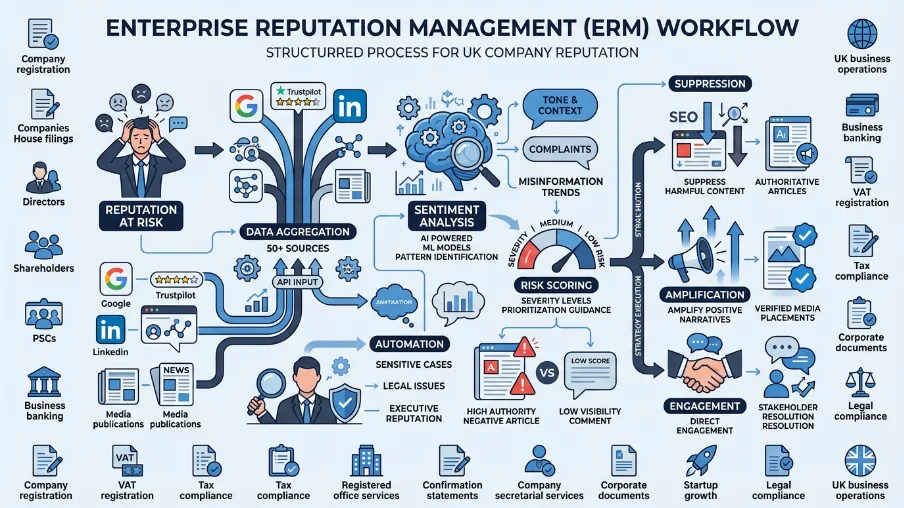
Enterprise reputation management services operate through a structured workflow that collects data, analyses sentiment, prioritises risks, and executes corrective actions using automation and human oversight.
The process begins with data aggregation. Systems collect information from over 50 sources, including Google search results, Trustpilot reviews, LinkedIn activity, and media publications. APIs enable continuous data flow.
Next, sentiment analysis evaluates tone and context. Machine learning models identify patterns such as recurring complaints or misinformation trends. These insights inform prioritisation.
Risk scoring assigns severity levels. For example, a negative article on a high-authority domain receives a higher risk score than a low-visibility comment. This scoring guides response strategies.
Execution involves three main actions:
- Suppress harmful content using SEO strategies such as publishing authoritative articles
- Amplify positive narratives through verified media placements
- Engage directly with stakeholders to resolve complaints or disputes
Human oversight ensures accuracy in sensitive cases. This includes legal issues or executive reputation risks.
Why do large organisations require specialised reputation management?
Large organisations require specialised reputation management because they face higher exposure, complex stakeholder ecosystems, and stricter regulatory scrutiny compared to small businesses.
A multinational company may manage over 200 digital touchpoints. These include regional websites, investor portals, and customer service platforms. Each touchpoint influences perception.
Stakeholder groups are diverse. These include customers, investors, regulators, employees, and partners. Each group evaluates reputation differently. For example, investors focus on financial credibility, while customers prioritise service quality.
Regulatory environments add complexity. Industries such as finance and healthcare require compliance with frameworks like FCA regulations or HIPAA standards. Reputation management systems must align with these requirements.
Crisis impact scales rapidly. A single negative news story can reach millions within hours. Without structured management, response delays increase reputational damage.
What features should enterprise reputation management platforms include?
Enterprise reputation management platforms include real-time monitoring, sentiment analysis, risk scoring, compliance tracking, and multi-channel reporting to ensure comprehensive brand oversight.
Effective platforms provide measurable capabilities. Real-time monitoring detects mentions within seconds. Sentiment analysis processes thousands of data points per hour. Risk scoring prioritises actions using predefined thresholds.
Three essential feature categories define platform effectiveness:
- Monitoring tools that track keywords, brand names, and executive profiles across search engines and media outlets
- Analytics engines that classify sentiment, identify trends, and generate predictive insights
- Execution modules that enable content publishing, review management, and stakeholder engagement
Integration capabilities are critical. Platforms must connect with CRM systems, legal databases, and marketing tools. This ensures seamless workflows across departments.
For a detailed comparison of tools and evaluation criteria, refer to this guide on how to compare enterprise reputation management platforms.
How does enterprise reputation management impact business performance?
Enterprise reputation management directly impacts revenue, customer acquisition, and investor confidence by shaping how stakeholders perceive credibility and trustworthiness.
Search engine visibility plays a measurable role. Studies show that 75% of users do not scroll past the first page of search results. Negative content in top positions reduces conversion rates.
Customer behaviour reflects reputation signals. For example, a 1-star rating increase on review platforms can lead to a 5–9% revenue increase in service industries. This demonstrates the financial impact of perception.
Investor confidence depends on consistent messaging. Negative media coverage can influence stock prices and funding decisions. Reputation management ensures accurate narratives reach stakeholders.
Operational efficiency also improves. Centralised systems reduce response time to incidents. Faster responses limit escalation and minimise long-term damage.
What risks do enterprises face without structured reputation management?
Enterprises without structured reputation management face increased exposure to misinformation, delayed crisis response, regulatory breaches, and long-term brand erosion.
Unmonitored channels create blind spots. Negative content can spread across platforms without detection. This delays corrective action.
Misinformation risks increase in high-visibility sectors. False claims can gain traction quickly when no verification mechanisms exist. This affects public trust.
Regulatory risks emerge when compliance requirements are ignored. For example, failure to address defamatory content or data privacy issues can result in legal penalties.
Crisis escalation becomes more severe. Without predefined workflows, response times increase. This allows negative narratives to dominate search results and media coverage.
How does reputation management for business integrate with enterprise systems?
Reputation management for business integrates with enterprise systems through APIs, data pipelines, and compliance frameworks to ensure seamless data exchange and coordinated action.
Integration begins with CRM systems. Customer feedback and complaints feed directly into reputation dashboards. This creates a unified view of stakeholder sentiment.
Marketing platforms connect to content distribution systems. Positive narratives are published across multiple channels simultaneously. This ensures consistency.
Legal systems integrate for compliance tracking. Cases involving defamation or regulatory breaches are flagged automatically. This enables rapid escalation.
Identity verification tools support trust-building. These tools validate executives and company records using official databases. This strengthens credibility in public-facing platforms.
To implement a structured solution, explore reputation management for business services that align with enterprise requirements.
Explore our reputation management for business guides,
Social Media Reputation Management Services for Businesses
Review Generation Services That Help Grow Your Online Reputation
What distinguishes enterprise services from standard reputation management?
Enterprise services differ from standard reputation management by offering scalable infrastructure, advanced analytics, compliance integration, and multi-stakeholder coordination.
Standard services focus on small-scale monitoring. These typically cover limited platforms such as Google reviews or social media mentions. Enterprise services expand coverage to global datasets.
Scalability is a defining factor. Enterprise systems process millions of data points daily. This requires cloud-based infrastructure and distributed processing.
Advanced analytics provide predictive insights. These systems identify trends before they escalate. For example, a spike in negative sentiment triggers alerts within minutes.
Coordination across departments is essential. Marketing, legal, and compliance teams access the same data. This ensures aligned decision-making.
For a foundational understanding of enterprise frameworks, refer to enterprise reputation management explained.
How does Clear My Name deliver enterprise reputation management solutions?
Clear My Name delivers enterprise reputation management by combining real-time monitoring, compliance-driven workflows, and data-backed strategies to protect and improve organisational credibility.
The approach focuses on measurable outcomes. Monitoring systems track brand mentions across high-authority platforms. Sentiment analysis identifies risks with precision.
Execution strategies include content optimisation, review management, and stakeholder engagement. Each action aligns with predefined objectives such as improving search visibility or resolving disputes.
Compliance integration ensures alignment with legal frameworks. This includes data protection standards and verification protocols. These safeguards reduce regulatory risks.
Clear My Name applies structured workflows. These workflows define response timelines, escalation paths, and reporting standards. This ensures consistency across all actions.
The service adapts to enterprise scale. It supports multiple regions, languages, and stakeholder groups. This flexibility ensures relevance across global operations.
Enterprise reputation management services provide structured, data-driven control over how large organisations are perceived across digital ecosystems. These services integrate monitoring, analytics, and execution into a unified system that reduces risk and improves stakeholder trust.
Clear My Name delivers these capabilities through scalable infrastructure, compliance alignment, and measurable strategies. This enables organisations to maintain consistent credibility, respond to risks efficiently, and strengthen their market position through controlled reputation management for business.
Frequently Asked Questions
What is reputation management for business and how does it work?
Reputation management for business is a structured process that monitors, analyses, and improves how a company appears across search engines, reviews, and media platforms. Clear My Name applies data tracking, sentiment analysis, and content strategies to identify risks and correct negative visibility.
Why is reputation management important for large organisations?
Large organisations face high visibility across multiple digital channels, which increases exposure to negative content and misinformation. Reputation management for business ensures consistent brand perception, protects stakeholder trust, and reduces the impact of reputational risks.
How long does it take to see results from reputation management services?
Initial improvements in search results and sentiment signals often appear within 30 to 90 days, depending on the severity of issues and competition. Clear My Name uses continuous monitoring and optimisation to deliver measurable, long-term reputation stability.
What types of issues can reputation management for business resolve?
Reputation management for business addresses issues such as negative reviews, misleading media coverage, outdated search results, and brand misinformation. Clear My Name uses verification, suppression strategies, and content correction to resolve these problems.
How do companies measure success in reputation management?
Success is measured using metrics such as sentiment score improvement, search result positioning, review ratings, and brand mention trends. Clear My Name tracks these indicators through analytics dashboards to provide clear, data-backed performance insights.