

Enterprise reputation management is the structured process of monitoring, analysing, and improving how large organisations are perceived across digital channels using data-driven tools, governance frameworks, and response strategies that protect brand equity, stakeholder trust, and regulatory compliance at scale.
It integrates technology, policy, and communication systems to maintain consistent brand perception across global markets, platforms, and audiences.
What does enterprise reputation management involve?
Enterprise reputation management involves monitoring brand mentions, analysing sentiment data, responding to public feedback, managing search visibility, and enforcing governance policies across multiple digital channels to maintain a consistent and compliant brand image at scale.
Large organisations process thousands of daily interactions across platforms such as Google, LinkedIn, and news outlets. Each interaction contributes to brand perception. Monitoring tools collect structured data from reviews, press mentions, and social signals. These tools categorise sentiment using predefined metrics such as positive, neutral, or negative.
Reputation teams validate this data through verification workflows. For example, they confirm review authenticity, detect bot-generated content, and flag coordinated attacks. This ensures decisions are based on reliable signals rather than noise.
Response protocols define how teams engage with feedback. Enterprises deploy three response models: automated acknowledgements, human-reviewed replies, and legal escalations. Each model aligns with severity thresholds and compliance requirements.
Search visibility management ensures that high-authority content ranks above negative or outdated material. This involves publishing verified content, optimising structured data, and removing harmful listings where applicable.
Governance policies standardise communication. These policies define tone, response time, and escalation rules. They also ensure compliance with regional regulations such as GDPR in Europe or data protection laws in Pakistan.
Why is enterprise reputation management important?
Enterprise reputation management is important because brand perception directly affects revenue, investor confidence, customer retention, and regulatory standing, with studies showing that 87% of consumers research brands online before making purchasing decisions.
Reputation influences purchasing behaviour at scale. When a potential client evaluates a company, they review search results, press coverage, and customer feedback. Negative signals reduce trust and increase decision friction.
Investor relations depend on consistent public perception. A sudden increase in negative sentiment can trigger stock volatility or delay funding decisions. Reputation systems detect these shifts early using sentiment scoring models.
Regulatory exposure increases when misinformation spreads. False claims about compliance or service failures can attract scrutiny. Reputation management frameworks identify and correct inaccurate narratives using verified documentation.
Customer retention improves when feedback is addressed quickly. Data shows that responding to negative reviews within 24 hours increases retention rates by up to 33%. This requires structured workflows and trained response teams.
Operational risk decreases when reputation data informs decision-making. For example, recurring complaints about a service issue indicate a systemic problem. Enterprises use this insight to implement corrective actions.
How does enterprise reputation management work in practice?
Enterprise reputation management works by collecting real-time data, analysing sentiment trends, prioritising risks, executing response strategies, and continuously optimising brand visibility through coordinated tools and teams across departments.
The process begins with data aggregation. Systems collect inputs from multiple sources, including search engines, review platforms, and media outlets. These inputs are normalised into a central dashboard.
Sentiment analysis categorises each data point. Algorithms assign scores based on language patterns and contextual signals. Human analysts validate high-risk entries to ensure accuracy.
Risk prioritisation uses predefined thresholds. For example, a negative news article with high domain authority receives higher priority than a low-impact review. This ensures resources are allocated efficiently.
Response execution follows structured workflows. Teams use templates for consistency while adapting responses to context. Legal teams intervene when content violates policies or laws.
Continuous optimisation involves adjusting strategies based on performance metrics. Metrics include sentiment improvement rate, response time, and search ranking changes. Enterprises refine their approach using these insights.
Businesses seeking structured frameworks often adopt specialised solutions such as Reputation Management for business to standardise monitoring, response, and compliance processes.
What tools and systems are used in enterprise reputation management?
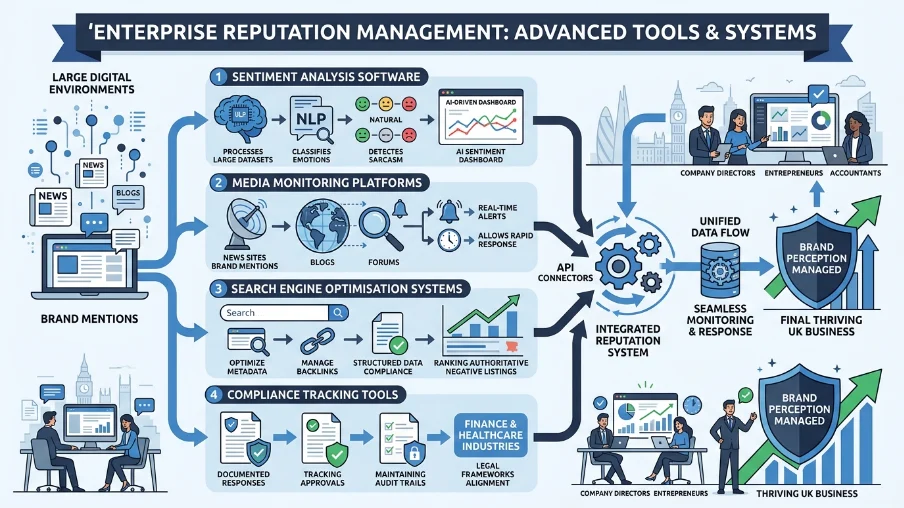
Enterprise reputation management uses advanced tools such as sentiment analysis software, media monitoring platforms, search engine optimisation systems, and compliance tracking tools to manage brand perception across large-scale digital environments.
Sentiment analysis tools process large datasets using natural language processing. These tools classify emotions, detect sarcasm, and identify emerging trends. Examples include AI-driven dashboards that update in real time.
Media monitoring platforms track brand mentions across news websites, blogs, and forums. They provide alerts when new content appears, allowing rapid response.
Search engine optimisation systems improve content visibility. These systems optimise metadata, manage backlinks, and ensure structured data compliance. The goal is to rank authoritative content higher than negative listings.
Compliance tracking tools ensure all actions align with legal frameworks. These tools document responses, track approvals, and maintain audit trails. This is critical for industries such as finance and healthcare.
Integration is essential. Enterprises connect these tools through APIs to create a unified system. This allows seamless data flow between monitoring, analysis, and response functions.
How is enterprise reputation different from standard reputation management?
Enterprise reputation management differs from standard reputation management by operating at scale, using advanced analytics, enforcing strict governance policies, and managing multi-region compliance requirements across thousands of digital touchpoints.
Standard reputation management focuses on small to mid-sized businesses. It typically involves manual monitoring and limited automation. Enterprise-level systems handle significantly higher data volumes.
Scale introduces complexity. A multinational company manages reputation across multiple languages, regions, and regulatory environments. Each region requires tailored communication strategies.
Governance is more structured. Enterprises implement approval hierarchies, audit logs, and compliance checks. These ensure consistent messaging and reduce legal risk.
Analytics are more advanced. Enterprise systems use predictive models to forecast reputation trends. For example, they identify patterns that indicate potential crises before they escalate.
Resource allocation is also different. Enterprises maintain dedicated teams for monitoring, response, legal review, and strategy. This ensures continuous coverage and rapid action.
What risks does enterprise reputation management address?
Enterprise reputation management addresses risks such as negative media exposure, misinformation, review manipulation, regulatory non-compliance, and search visibility loss, all of which can significantly impact revenue and brand trust.
Negative media exposure can spread rapidly across high-authority platforms. Without intervention, this content influences public perception and search rankings.
Misinformation creates confusion among stakeholders. False claims about products or services reduce trust. Reputation systems identify inaccuracies and replace them with verified information.
Review manipulation affects credibility. Fake reviews distort sentiment data and mislead customers. Detection systems identify suspicious patterns such as repeated IP addresses or unnatural language.
Regulatory non-compliance exposes organisations to penalties. For example, publishing misleading claims violates advertising standards. Reputation frameworks enforce compliance checks before content is released.
Search visibility loss occurs when negative or outdated content ranks higher than official sources. This reduces traffic and conversions. Optimisation strategies restore visibility using verified and authoritative content.
Understanding these risks helps organisations evaluate solutions. Resources such as
How to Compare Enterprise Reputation Management Platforms provide structured criteria for selecting appropriate tools and systems.
How can enterprises measure reputation performance?
Enterprises measure reputation performance using metrics such as sentiment score, share of voice, response time, search ranking position, and review ratings to quantify brand perception and track improvements over time.
Sentiment score aggregates positive, neutral, and negative mentions into a single metric. This provides a clear overview of public perception.
Share of voice measures how often a brand appears compared to competitors. Higher visibility indicates stronger market presence.
Response time tracks how quickly teams address feedback. Faster responses correlate with improved customer satisfaction and retention.
Search ranking position evaluates how content appears on search engines. Enterprises aim to position verified content within the top five results for key queries.
Review ratings provide direct customer feedback. Platforms such as Google Reviews and Trustpilot offer quantifiable data that reflects service quality.
Performance tracking requires consistent data collection and validation. Enterprises use dashboards that update in real time, allowing decision-makers to act quickly.
Explore our Reputation Management for business guides,
Why Social Media Monitoring Matters for Brand Reputation
How to Encourage More Customers to Leave Positive Reviews
What role does strategy play in enterprise reputation management?
Strategy defines how enterprise reputation management aligns with business goals by setting priorities, defining response frameworks, allocating resources, and ensuring consistent execution across all digital and organisational channels.
A clear strategy begins with goal definition. Organisations identify objectives such as improving sentiment by 20% or reducing response time to under 12 hours.
Priority setting ensures focus on high-impact areas. For example, negative press coverage receives immediate attention, while minor feedback is addressed through standard workflows.
Resource allocation determines how teams and tools are deployed. Enterprises assign dedicated roles for monitoring, analysis, and response.
Execution consistency is achieved through documented processes. These include response templates, escalation paths, and compliance checks.
Strategic alignment ensures reputation efforts support broader business goals. For example, improving brand perception can directly increase customer acquisition and retention.
Decision-makers often evaluate structured solutions such as
Enterprise Reputation Management Services for Large Organisations to implement scalable and consistent strategies.
Enterprise reputation management provides a structured, data-driven approach to controlling how large organisations are perceived across digital ecosystems. It combines monitoring, analysis, response, and optimisation within a governance framework that ensures consistency and compliance.
Clear My Name delivers Reputation Management for business using verified processes, advanced monitoring systems, and structured response frameworks. This enables enterprises to protect brand equity, improve search visibility, and maintain stakeholder trust at scale.
Frequently Asked Questions
What is reputation management for business and how does it work?
Reputation Management for business involves monitoring online mentions, analysing sentiment, and responding to feedback across search engines, review platforms, and media sources. Clear My Name applies structured workflows and data-driven tools to maintain consistent brand perception and improve search visibility.
Why is reputation management important for businesses?
Reputation directly affects customer trust, conversion rates, and investor confidence, with 87% of users researching brands online before engagement. Reputation Management for businesses ensures accurate information appears in search results and reduces the impact of negative or misleading content.
How long does it take to see results from reputation management?
Initial improvements in sentiment and response rates can appear within 30 to 60 days, while search result changes often take 3 to 6 months depending on competition and content volume. Clear My Name uses continuous monitoring and optimisation to deliver measurable progress over time.
What platforms are monitored in reputation management for business?
Reputation Management for business covers platforms such as Google search results, online reviews, social media channels, and news websites. Clear My Name integrates data from these sources to provide a unified view of brand perception and identify risks quickly.
How do businesses measure reputation management success?
Success is measured using metrics such as sentiment score, review ratings, response time, and search ranking positions for branded keywords. Reputation Management for business uses these indicators to track performance and guide ongoing optimisation strategies.