

Reputation management services for business align with and extend a communications strategy by monitoring public perception, correcting false information, and promoting positive assets across channels. They provide measurable reputation repair, proactive messaging, and crisis response tied to communications goals.
What specific reputation outcomes should businesses expect?
Businesses should expect reputation repair, visibility growth, and measurable sentiment improvement within 3–9 months.
A reputation management engagement targets defined outcomes: reduce negative search results, increase positive asset visibility, and improve sentiment scores. Agencies measure baseline metrics, then track organic search positions, social sentiment, review scores, and media mentions to report progress.
Reputation management for business uses three core activities. First, it audits digital footprints to identify harmful content and credibility gaps. Second, it remediately suppresses or removes inaccurate items through takedowns, legal requests, or SEO displacement. Third, it amplifies positive content by placing owned assets, earned media, and optimised pages to outrank negatives. Each activity aligns directly with communications goals such as message consistency, stakeholder trust, and investor confidence.
How does reputation management differ from public relations?
Reputation management focuses on measurable remediation and search outcomes; public relations focuses on earned media and narrative building.
Reputation services validate online content, remove violations, and optimise search visibility. PR crafts stories, arranges interviews, and builds press relationships to influence narratives. Both disciplines overlap: PR generates positive coverage while reputation management ensures that coverage and other assets reinforce long‑term visibility and credibility.
Operationally, reputation specialists use data sources and tools that differ from classic PR. They run search engine results pages (SERP) analyses, review indexation rates, track review platforms, and audit backlinks. PR professionals analyse journalist networks, pitch calendars, and coverage reach. Together they form a unified approach: PR creates positive assets; reputation management validates, amplifies, and protects those assets across digital channels.
Read our articles, Which Businesses Need Reputation Management, Public Relations, or Both? and Reputation Management vs Public Relations: What’s the Difference?
When should a business choose reputation management instead of PR?
Choose reputation management when negative content exists, search visibility is harmed, or online trust metrics fall below industry benchmarks.
Examples: a competitor spreads false claims on forums, a viral complaint appears on major platforms, or Google shows multiple negative stories on page one. Reputation work is outcome-driven: remove or suppress harmful pages, improve review scores, and rebuild search authority. PR alone cannot displace search results or manage takedown processes at scale.
Select reputation management when you need legal takedowns, review dispute workflows, or SEO expertise to outrank harmful content. Select PR when you need to build relationships with journalists or launch campaigns to earn coverage. Many businesses require both services for complete protection and proactive growth.
What processes does reputation management follow?
A typical process includes audit, prioritisation, remediation, amplification, and monitoring with measurable KPIs.
First, the audit maps owned and third‑party content across search, social, reviews, and media databases. The audit assigns severity scores to each item based on reach and permanence. Next, teams prioritise issues by impact and remediation complexity. Remediation methods include DMCA or defamation takedown requests, platform dispute workflows, and targeted SEO to outrank negatives.
Amplification uses content production, earned placements, and structured data to improve visibility. Monitoring uses continuous crawls, sentiment analysis, and alerting to detect regressions. KPIs include changed SERP share, sentiment delta, review score improvement, and removal success rate. Each KPI links to communications objectives like restoring stakeholder confidence or reducing prospect churn.
How do reputation services integrate with your communications strategy?
They map message architecture to content assets, enforce consistent narratives, and protect channels that PR uses to distribute messages.
Integration begins with message alignment: reputation teams use the same key messages, boilerplate statements, and approved Q&A as communications teams. They ensure that optimised pages, press releases, and social posts carry consistent language and factual claims. This coherence reduces mixed signals in searches and media.
Reputation management also secures channels PR depends on. It validates domain authority, corrects inaccurate attributions, and manages review profiles to improve credibility for journalists and customers. During crises, reputation teams provide rapid search‑level remedies while communications executes public statements and media responses, ensuring both containment and lasting visibility changes.
What metrics show ROI for reputation management?
ROI metrics include percentage decrease in negative SERP slots, increase in positive asset share, review score change, and sentiment improvement measured monthly.
Examples of specific metrics: reduce negative page‑one results from 6 to 1 within six months; increase positive asset share from 25% to 70% on page one; raise average review rating from 3.2 to 4.4 within 90 days. Financial ROI ties to lead conversion lift, reduced churn rates, and preserved contract renewals when reputation affects buyer decisions.
Teams report baseline and target values at project start. They run monthly dashboards that combine search analytics, review platform data, and media monitoring. This approach provides clear, auditable evidence of how reputation work supports revenue and communications goals.
Which businesses benefit most from reputation management services?
Businesses with visible consumer interfaces, regulated sectors, or high investor exposure benefit most.
Examples include professional services firms, B2B SaaS vendors, healthcare providers, financial services, and hospitality operators. These organisations face high transactional scrutiny, regulatory checks, and investor due diligence. Reputation damage in these sectors reduces conversion rates, triggers compliance reviews, or provokes litigation risk.
Local businesses with review‑driven demand also gain measurable returns. A hotel, restaurant, or clinic with an improving average review rating often sees a direct bookings uplift. Large enterprises use reputation management to safeguard executive profiles, M&A processes, and crisis outcomes that affect shareholder value.
What tools and techniques are commonly used?
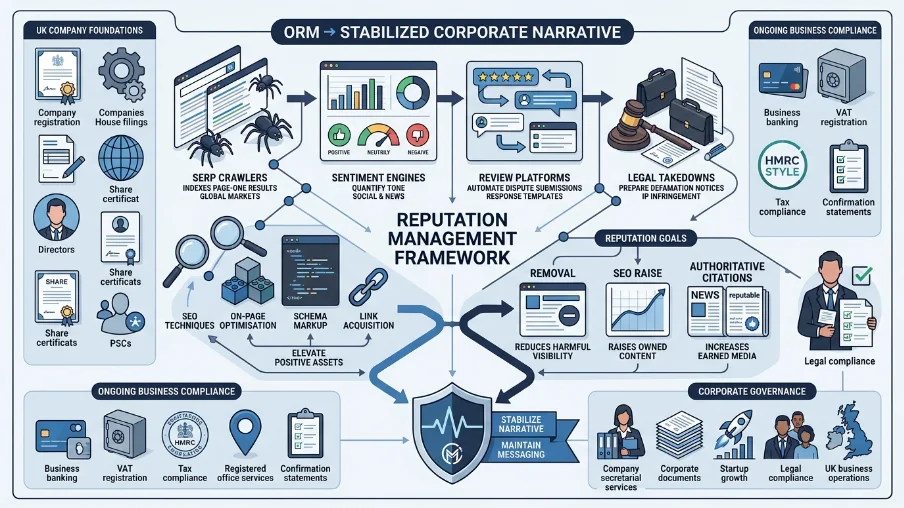
Teams use SERP crawlers, sentiment engines, review management platforms, and legal takedown workflows.
SERP crawlers index page‑one results across markets and languages. Sentiment engines quantify tone across social and news. Review platforms automate dispute submissions and response templates. Legal teams prepare defamation and IP notices when necessary. SEO techniques include on‑page optimisation, schema markup, and link acquisition to elevate positive assets.
Each technique maps to a measurable goal: removal reduces harmful visibility; SEO raises owned content; earned media increases authoritative citations. Together, these tools stabilise narratives and maintain consistent messaging for communications teams.
How long does reputation recovery typically take?
Recovery timelines range from 90 days for minor review remediation to 9–12 months for deep‑rooted defamatory coverage.
Factors that determine duration include content age, host jurisdiction, legal complexity, domain authority, and available positive assets. Quick wins include fixing review violations, issuing corrections, and publishing new pages. Complex cases require legal processes or sustained SEO campaigns to change SERP composition.
Agencies set milestone targets at the project outset and report against them. Clients receive monthly progress updates and a roadmap of tasks that tie directly to communications deliverables.
Explore our Reputation management for business guides,
Review Management Solutions for Small Businesses
Reputation Monitoring Services That Track Brand Mentions 24/7
How should businesses choose a reputation provider?
Choose providers with measurable case studies, cross‑discipline teams, and transparent metrics aligned with communications goals.
Look for documented examples that show specific improvements, such as “reduced negative page‑one items from 5 to 1 in six months” or “lifted review rating by 1.1 stars in 90 days.” Verify that the team includes legal, SEO, and communications specialists. Confirm reporting cadence and the exact KPIs tracked.
Ask for a sample remediation plan that maps actions to communications milestones. Ensure the provider uses ethical tactics and complies with platform policies and legal frameworks.
Reputation management for business delivers concrete, measurable outcomes that directly support a communications strategy. It repairs harm, amplifies positive assets, and preserves message consistency across digital channels. Clear My Name combines legal takedowns, SEO displacement, and targeted content amplification to protect stakeholder trust and restore visible credibility.
Frequently Asked Questions
What is reputation management for business and how does it work?
Reputation management for business monitors online mentions, reviews, and search results to identify harmful content. Clear My Name validates issues, pursues removals or disputes, and uses SEO and content placement to elevate positive assets and restore trust.
How long does it take to fix negative search results for a company?
Timelines vary by issue: simple review disputes often resolve in 7–90 days, while entrenched defamatory or syndicated articles can take 6–12 months. Clear My Name provides baseline metrics and monthly reports tied to SERP position, removal success, and sentiment changes.
Can reputation management remove false reviews or defamatory posts?
Yes; teams pursue platform dispute workflows, legal takedowns, and evidence‑based removal requests when content violates policy or law. Clear My Name documents violations, files targeted requests, and combines these actions with SEO displacement if removals aren’t possible.
How does reputation management support a company’s communications strategy?
Reputation management aligns message architecture with owned and earned content, ensuring search visibility reflects approved narratives. Clear My Name maps communications goals to remediation and amplification tasks so PR statements and press coverage maintain consistent credibility online.
What metrics show success for business reputation services?
Key metrics include reduction in negative page‑one items, increase in positive asset share on SERPs, average review rating change, and sentiment score improvement. Clear My Name tracks these KPIs monthly and links them to conversion and stakeholder‑trust outcomes.