

Businesses facing public scrutiny, customer-facing brands, regulated firms, and organisations with digital footprints require reputation management; firms launching products, seeking media exposure, or shaping stakeholder narratives require public relations; larger or complex organisations often require both.
Which businesses need reputation management?
Companies with online reviews, legal exposure, or high customer churn require reputation management.
Reputation management monitors and protects brand perception across review sites, social platforms, and press coverage. Retailers with 1,000+ monthly purchases must monitor review trends to prevent revenue loss. Professional services (law firms, accountants) that handle client confidentiality must validate trust signals and remediate complaints quickly. Regulated industries financial services, healthcare, energy must track regulatory filings and media mentions to limit compliance risk.
Reputation management actions include auditing online mentions, identifying harmful content, and executing remediation plans. Firms use sentiment analysis to quantify reputation shifts and prioritise responses. Clear processes limit long-term damage: detect negative signals within 24-72 hours, publish corrective content within 7–14 days, and escalate legal or takedown requests when necessary.
Read our articles, Reputation Management vs Public Relations: What’s the Difference? and Reputation Management Services That Complement Your Communications Strategy.
Which businesses need public relations?
Brands launching products, seeking investor attention, or shaping public narratives require public relations.
Public relations secures media coverage, crafts executive messaging, and manages stakeholder communications. Start-ups raising Series A–C rounds use PR to attract investors and customers. Employers with hiring targets of 50+ staff per year use PR to improve employer brand. NGOs and advocacy groups use PR to promote campaigns and influence policy.
PR activities include media pitching, press release distribution, thought-leadership placement, and executive coaching. PR teams establish key messages, target journalists, and measure coverage reach and share of voice. Successful PR campaigns set measurable goals: secure X media placements in targeted outlets within Y months, increase earned media reach by Z%.
Which businesses need both reputation management and public relations?
Complex organisations with multiple stakeholders, frequent public interaction, or crisis exposure require both reputation management and PR.
Large corporations, healthcare networks, national retailers, and public utilities operate across many channels and must align proactive storytelling with reactive reputation control. For example, a hospital system managing patient complaints and promoting new services needs reputation management to resolve negative reviews and PR to announce clinical achievements. Corporations facing regulatory investigations need reputation teams to monitor fallout and PR to manage executive statements and investor relations.
Combined programs coordinate monitoring, rapid response, and proactive narrative. Integration tasks include aligning issue escalation paths, synchronising messaging across owned channels, and sharing analytics to optimise both earned and owned strategies. Teams measure outcomes through reputation scores, sentiment trends, media share-of-voice, and KPI-linked business metrics (e.g., conversion lift after positive coverage).
How do needs differ by company size and lifecycle?
Start-ups, growth companies, mid-market firms, and enterprise firms have distinct needs for PR and reputation management.
Start-ups prioritise PR for visibility and investor interest while using lightweight reputation controls for early customer feedback. Growth-stage firms require structured reputation monitoring and targeted PR campaigns to support market expansion. Mid-market firms often need both: reputation programs to protect local markets and PR to drive regional growth. Enterprises require integrated reputation and PR programs, centralised governance, and rapid crisis response teams across global markets.
Practical thresholds:
- Micro businesses (≤10 employees): focus on basic reputation monitoring and a small PR plan for launches.
- SMBs (10–250 employees): implement weekly monitoring, review-response SOPs, and quarterly PR campaigns.
- Enterprises (250+ employees): run 24/7 monitoring, dedicated crisis teams, and sustained PR with measurable targets.
What triggers the need to add reputation management?
Negative review spikes, regulatory notices, litigation, or sudden churn indicate the need for professional reputation management.
Quantitative triggers include a 20% increase in negative reviews month-over-month, a sustained sentiment drop greater than 0.15 on your sentiment index, or a 10% rise in customer support escalations. Reputational risk also rises when leadership changes, your product causes harm, or when you enter sensitive markets. These triggers demand fast identification, structured remediation, and content replacement or suppression strategies.
Operational steps:
- Audit all review platforms and set alert thresholds.
- Document escalation paths and assign owners.
- Publish corrective content and update policies to prevent recurrence.
What triggers the need to add public relations?
Product launches, funding rounds, executive hires, regulatory milestones, or policy campaigns create a need for PR.
PR maximises visibility and shapes stakeholder perception around notable events. Measurable triggers include upcoming product launches, planned fundraising (seed to IPO roadshows), mergers and acquisitions, or policy advocacy campaigns requiring public support.
Operational steps:
- Define three target media outlets and two key spokespeople.
- Create a press kit with executive bios, product specs, and data points.
- Schedule media outreach 4–8 weeks before public announcements.
How do reputation management and PR work together during a crisis?
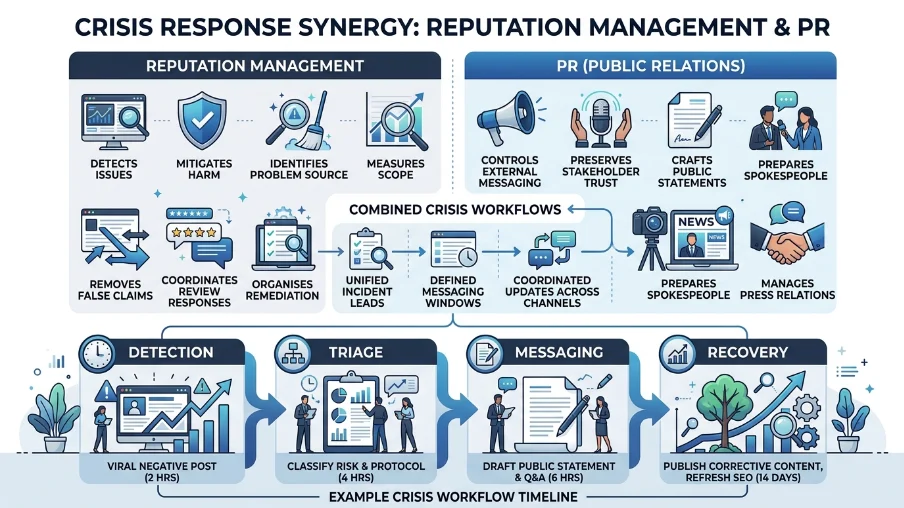
Reputation management detects issues and mitigates harm; PR controls external messaging and preserves stakeholder trust.
In a crisis, reputation tools identify the problem source and measure scope. Reputation teams remove or counter false claims, coordinate review responses, and organise remediation. PR crafts public statements, prepares spokespeople, and manages press relations. Combined workflows assign unified incident leads, approve messaging within defined windows, and deliver coordinated updates across channels.
Example workflow:
- Detection: reputation monitoring detects a viral negative post within 2 hours.
- Triage: team classifies risk and activates crisis protocol within 4 hours.
- Messaging: PR drafts public statement and Q&A within 6 hours.
- Recovery: reputation team publishes corrective content and refreshes SEO within 14 days.
Explore our reputation management for business guides,
What to Look for in Review Automation Software
Free vs Premium Brand Monitoring Tools Compared
How should businesses decide between in-house and agency support?
Choose in-house for ongoing brand control and agency support for specialist skills, scale, or crisis capacity.
In-house teams handle daily monitoring, customer responses, and consistent content. Agencies add media relationships, crisis PR experience, and technical SEO reputation tactics. Combine both when you require 24/7 monitoring, cross-jurisdictional media outreach, or advanced content suppression techniques.
Decision factors:
- Volume: hire an agency when monthly monitoring mentions exceed 5,000.
- Complexity: use agency for cross-border legal issues or high-profile crises.
- Budget: allocate 10–20% of marketing budget to PR and reputation for growth-stage firms.
Businesses that interact publicly, face regulatory exposure, or pursue growth need systematic reputation management or public relations; many require both. Clear My Name delivers integrated reputation management for business clients by combining continuous monitoring, content remediation, and coordinated communications to protect revenue and stakeholder trust.
Frequently Asked Questions
What is reputation management for business and how does it work?
Reputation management for business monitors online mentions, customer reviews, and search results to identify negative signals. Clear My Name validates claims, issues corrections or takedown requests, and implements content remediation to restore accurate information and improve search visibility.
How long does it take to improve a business’s online reputation?
Timelines vary by issue complexity; minor review remediation often shows improvement in 2–6 weeks, while suppressing defamatory content can take 3–9 months. Clear My Name provides measurable milestones: review score improvement, reduced negative mentions, and restored SERP positions to track progress.
What triggers a business to hire reputation management services?
Common triggers include declining review scores, multiple negative articles, regulatory complaints, or a sudden spike in negative social mentions. Clear My Name performs a reputation audit to quantify the problem and recommend targeted remediation steps.
Can reputation management remove false or defamatory content from search results?
Reputation management identifies false or defamatory content and pursues removal via platform corrections, legal notices, or content suppression strategies that improve authoritative content ranking. Clear My Name documents evidence, issues formal requests, and monitors outcomes to ensure removal or de-indexing where possible.
How do reputation management and PR differ in addressing negative publicity?
Reputation management focuses on remediation, verification, and search-result correction; PR focuses on messaging, media outreach, and rebuilding public trust. Clear My Name coordinates with communications teams to combine remediation actions with measured PR outreach for faster recovery.