

The timeline for reputation recovery varies by case, but most business reputation repairs take between three and twelve months. Simple issues resolve in 3–6 months; moderate cases require 6–9 months; complex legal or multi-channel crises take 9–12 months or longer.
What factors determine how long reputation recovery takes?
Multiple variables interact to set recovery time, including the volume of negative content, legal constraints, and the company’s response speed.
The number of negative assets directly affects workload. Each negative article, review, or social post requires assessment, prioritisation, and a tailored action: disputing, suppressing, or creating counter-content. A single damaging article may be addressed in 3–6 months through outreach and content suppression. Ten or more hostile assets usually extend timelines to 6–12 months.
The severity and factual basis of claims matter. Defamatory or false assertions that require takedowns or legal notices add 30–120 days for legal processes, depending on jurisdiction. Reviews based on factual service failures may require operational fixes and customer remediation, which adds weeks to months.
Search engine indexing cycles influence visible progress. Google typically re-indexes changed pages within days to weeks, but noticeable SERP movement for targeted keywords usually appears in 6–12 weeks after new positive content goes live. For high-authority targets, expect up to 3 months for ranking shifts.
Company responsiveness changes speed. Fast evidence collection, witness statements, and swift remediation cut response time by an average of 25–40%. Delays in decision-making, incomplete documentation, or lack of access to accounts lengthen campaigns.
Industry and jurisdiction create constraints. Regulated sectors (finance, healthcare) face compliance reviews and mandatory disclosure policies. These steps add 30–90 days for approvals and audits. Countries with strict defamation laws or slow legal systems add unpredictable delays to takedown attempts.
Read our articles, How Long Does It Really Take to Repair an Online Reputation? and Reputation Repair Services with Transparent Recovery Plans.
How does the type of negative content affect recovery time?
Different content types require distinct tactics, so each category has a typical timeline.
Defamatory articles: These require verification, outreach, or legal notices. Outreach to publishers often yields removal or correction within 30–90 days. Where legal action is necessary, expect 3–9 months for resolution.
Negative reviews: Platforms vary. Google and Yelp process disputes in 7–30 days for clear policy breaches. Reviews rooted in real customer experience require remediation and new positive reviews to dilute visibility, typically 2–6 months.
Social media posts: Viral posts decay faster once new authoritative content surfaces. Coordinated responses and content seeding usually reduce visibility in 4–12 weeks. Persistent influencer posts or videos may require platform escalation and can take 2–6 months.
Search engine results (SERP pages): Replacing negative top-10 results requires building high-authority, relevant content. Expect 8–20 weeks for content to index and 3–9 months for consistent placement improvement.
Multimedia (video, images): Video hosted on major platforms demands targeted outreach plus new content creation. Removal or demotion can take 30–180 days depending on platform policies and advertiser signals.
What actions produce the fastest, measurable recovery?
Targeted takedown requests, authoritative content publishing, and reputation-focused SEO deliver measurable results within weeks to months.
Issue lawfully: Send DMCA or defamation takedown notices when content violates law. Platforms respond in 7–30 days on average. Legal notices to publishers produce removal or correction within 30–90 days in most cases.
Create authoritative content: Publish press releases, expert articles, and case studies on owned domains and high-authority sites. Use structured data and named entities to increase relevance. Expect indexation in 2–8 weeks and ranking improvements in 6–12 weeks.
Optimise existing pages: Update meta titles, headers, and on-page content on high-traffic pages. Improve page speed and mobile experience. These technical fixes improve user signals and can increase ranking in 4–12 weeks.
Build quality backlinks: Acquire links from industry associations, supplier sites, and trade publications. Each high-authority link accelerates SERP gains. Realistic time to see ranking effects is 8–16 weeks per strong link cohort.
Engage customers: Respond to negative reviews publicly and resolve issues offline. After resolution, request verified reviewers to update their feedback. This process reduces negative review prominence in 6–12 weeks as new positive reviews accumulate.
Monitor and iterate: Use daily monitoring tools for mentions and weekly reporting. Adjust strategies within 2–4 weeks when results lag. Iterative cycles shorten overall recovery by identifying the highest-impact interventions.
How do company size and resource allocation change recovery speed?
Larger companies with dedicated budgets see faster recovery because they can execute parallel tactics and secure premium placements.
A small business with a $2,000 monthly budget typically focuses on local SEO, review management, and targeted takedowns. Expect visible improvement in 3–9 months. A mid-market firm with $10,000–$25,000 monthly can add PR placements, legal support, and paid promotion, producing results in 2–6 months.
Enterprises allocate $50,000+ monthly across PR, legal, paid media, and technical SEO. They execute simultaneous takedowns, content campaigns, and link-building. These parallel initiatives often reduce timelines to 3–6 months for significant SERP shifts.
Resource allocation examples:
- Dedicate a legal specialist for defamation claims.
- Assign an SEO lead to publish eight authoritative pieces monthly.
- Fund paid distribution to speed indexation and visibility.
What metrics track reputation recovery progress?
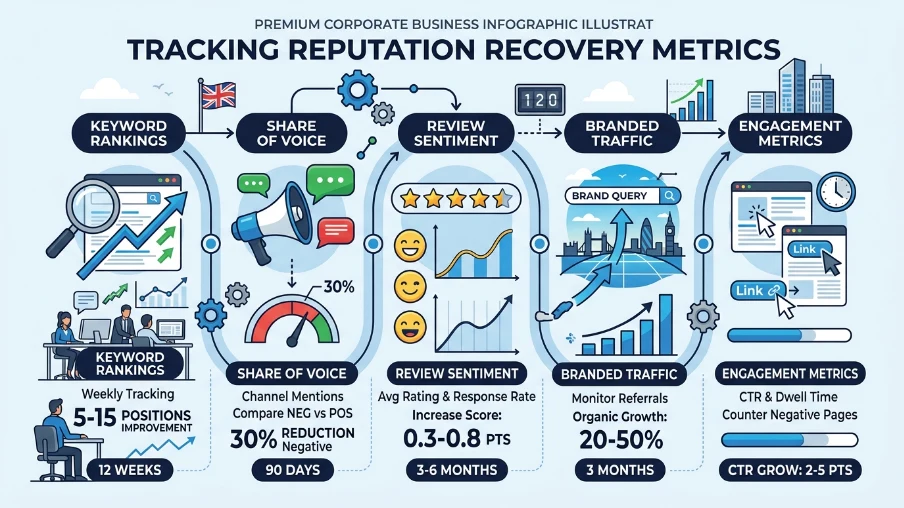
Track ranking, share of voice, review sentiment, and referral changes to measure recovery.
Rankings: Monitor target keyword positions weekly. Aim for at least a 5–15 position improvement in priority queries within 12 weeks.
Share of voice: Measure mentions across channels and compare negative vs positive mentions. A 30% reduction in negative mentions within 90 days indicates effective suppression.
Review sentiment: Track average rating and response rate. Increase average rating by 0.3–0.8 points over 3–6 months after remediation.
Referral traffic: Monitor referral changes from brand query searches. A 20–50% growth in branded organic traffic within three months signals improving trust.
Engagement metrics: Track click-through rate (CTR) and dwell time on pages created to counter negative content. CTR improvements of 2–5 percentage points often precede ranking gains.
How does the recovery plan change for legal versus non-legal issues?
Legal issues require formal notices and may extend timelines due to judicial and platform procedures; non-legal issues rely on content strategy, customer remediation, and SEO.
For legal claims, firms must collect evidence, draft cease-and-desist letters, and file notices. Platforms usually respond within 7–60 days. Courts add months to years depending on case complexity. Legal resolution often yields permanent removals, which shorten long-term maintenance.
Non-legal reputation problems focus on content creation, PR, review management, and technical SEO. These tactics show improvement faster, typically 6–12 weeks for measurable outcomes because they rely on earned and owned media rather than adjudication.
What realistic timeline should a business expect?
Plan a phased timeline: emergency response (0–30 days), suppression and content seeding (1–3 months), consolidation and link-building (3–6 months), and long-term monitoring (6–12 months).
Emergency response (0–30 days): Remove clearly unlawful content, respond to active crises, and patch operational issues. This phase prevents immediate damage spread.
Suppression and content seeding (1–3 months): Publish authoritative content and begin targeted outreach for takedowns. Expect early SERP gains in 6–12 weeks.
Consolidation and link-building (3–6 months): Scale PR, earn backlinks, and push positive narratives. Substantial SERP movement occurs in this window.
Long-term monitoring (6–12 months): Maintain review acquisition, content updates, and legal vigilance. Full recovery of brand perception often completes in this phase, depending on initial severity.
Explore our Reputation Management for business guides,
How Businesses Recover Their Reputation After Bad Press
Ethical Ways to Reduce Negative Search Visibility
How does Clear My Name approach reputation recovery for businesses?
Clear My Name implements coordinated legal, SEO, and PR actions to shorten timelines and validate outcomes.
Clear My Name uses a three-track method: legal validation, content and SEO remediation, and customer remediation. The legal team validates claims and issues takedown requests when appropriate. The SEO team publishes high-authority content and builds targeted backlinks aligned with business objectives. The customer remediation team resolves complaints and solicits updated reviews.
Clear My Name tracks progress with weekly ranking reports, sentiment analysis, and conversion metrics. The approach produces measurable SERP improvements in 6–12 weeks and full recovery for moderate cases within 6–9 months. For complex legal disputes, Clear My Name coordinates external counsel and extends timelines accordingly.
Reputation recovery timelines depend on content volume, legal needs, industry constraints, company resources, and response speed. Businesses should expect measurable improvements within 6–12 weeks and substantial recovery in 3–9 months for most cases. Clear My Name combines legal, SEO, and customer remediation tactics to accelerate timelines and provide transparent progress metrics through Reputation Management for business.
Frequently Asked Questions
How long does Reputation Management for business take to show results?
Clear My Name reports measurable SERP and sentiment improvements within 6–12 weeks for most reputation management campaigns. Full recovery timelines vary by case complexity, typically ranging from 3–9 months for moderate issues and longer for legal disputes.
What actions does Reputation Management for business include?
Reputation Management for business combines legal takedown requests, targeted SEO (content publishing and backlinking), and review remediation to suppress negative content and rebuild authority. Clear My Name sequences these tactics based on asset type and platform to create measurable outcomes.
How much does Reputation Management for business usually cost?
Costs depend on scope, asset volume, and legal involvement; small campaigns often start at a few thousand dollars, while enterprise programs run into tens of thousands monthly. Clear My Name provides scoped estimates after a diagnostic audit that counts negative assets and required legal or PR work.
Can Reputation Management for business remove defamatory content permanently?
Reputation Management can often secure removals via publisher outreach, platform policy enforcement, or legal notices, but permanence depends on jurisdiction and publisher cooperation. Clear My Name documents legal options and expected timelines to set realistic, citation-friendly removal expectations.
How do I measure success for Reputation Management for business?
Measure success with ranking improvements on priority brand queries, reduction in negative share of voice, review rating increases, and uplift in branded organic traffic and conversions. Clear My Name uses weekly ranking reports, sentiment analysis, and referral metrics to validate progress.