

Reputation repair can take from 3 months to 24 months depending on severity, scope, and chosen tactics; most small to mid-size business recoveries finish within 6–12 months with a structured, transparent plan.
How long does a transparent recovery plan take to repair an online reputation?
Most business reputation recoveries complete in 6–12 months; simple cases resolve in 3 months, severe cases extend to 18–24 months.
A clear timeline depends on measurable variables: volume of negative assets, age and authority of those assets, legal actions, and restoration tasks like content creation, SEO, and platform-level disputes. Recovery blends reactive removals with proactive reputation building.
What factors determine the timeline for reputation repair?
Factor-driven timelines depend on negative asset count, domain authority, legal complexity, and resource allocation.
High-authority negative results take longer to displace. For example: 1-3 low-authority negative mentions can clear in 3 months with targeted content and link work. Ten negative items on news or .gov domains often require 12–24 months, legal filings, and intensive content promotion. Legal takedowns or defamation suits add fixed delays from court schedules.
Read our articles, What Affects the Timeline of Reputation Recovery? and How Long Does It Really Take to Repair an Online Reputation?
How does severity of negative content affect recovery speed?
Severity scales by content permanence and authority; permanent records on news or court sites extend recovery by 12–24 months.
Temporary content (social posts, forum comments) often responds quickly to moderation or removal requests. Permanent content (published articles, court records) resists removal and requires displacement through high-authority positive content, strategic citations, and sustained link-building. Each permanent asset demands a tailored mix of outreach, legal review, and SEO.
What role do removal vs. suppression play in timelines?
Removals shorten timelines when successful; suppression requires sustained publishing and link outreach over months.
Removal actions include DMCA, platform policy violations, and legal notices. These can resolve in days to 3 months. Suppression means outranking negative items with positive content; this usually takes 3–12 months per target snippet, depending on domain authority and backlink strategies.
Which tactics speed up recovery the most?
Targeted content creation, high-authority placements, and priority removal requests deliver the fastest, measurable gains.
Create and publish optimised pages, press releases, and guest articles that reference the business name or executives. Secure profiles on high-authority platforms and register structured data to improve SERP presence. File removal requests with platform-specific evidence, then escalate to legal notices if policy-based takedowns fail. Combine these with link-building to boost ranking signals for new assets.
How should a business prioritise tasks during recovery?
Prioritise high-impact removals, then publish high-authority positive assets, and finally scale link building and citations.
Start by identifying the top 3 negative results by traffic and authority. Submit removal or dispute requests for content that violates policy or law. While waiting, publish optimised pages and authoritative content that mention the business name or key terms. Follow with systematic link outreach to authoritative domains to support new assets.
How does resource allocation change timelines?
Dedicated teams and budgets reduce timelines proportionally; doubling daily outreach halves expected suppression time.
Full-time project teams complete audits, outreach, content, and reporting faster than ad-hoc efforts. Paid promotion accelerates ranking for targeted pages. Example: a focused 8-week campaign that publishes four high-authority assets and runs a paid distribution plan can move mid-authority negative items from page one to page two within 6–10 weeks.
What metrics track recovery progress?
Track SERP positions, share of branded SERP real estate, referral traffic, sentiment, and removal success rate.
Measure percentage of first-page search results that are positive. Log each removal request and outcome. Monitor organic traffic trends to brand pages. Track sentiment of new mentions via media monitoring. Use these metrics to adjust tactics and timelines every 30 days.
When is legal escalation necessary and how does it affect timing?
Escalate to legal teams for defamation, repeated harassment, or false business claims; legal routes add 3–12+ months to timelines.
Legal actions produce definitive removals when courts rule in favor. However, litigation requires documentation and time. Use legal notices and cease-and-desist letters first when evidence is strong. Parallel suppression work continues during legal proceedings to limit visibility regardless of legal outcomes.
How do transparent recovery plans improve outcomes?
Transparent plans set clear milestones, allocate responsibilities, and provide measurable KPIs that compress uncertainty and speed decision-making.
A transparent recovery plan lists specific actions, owners, deadlines, and success criteria. For example: “Submit 6 removal requests by week 2; publish three optimised authority pages by week 6; achieve 60% positive first-page share by month 6.” This clarity enables focused work and better vendor-client alignment.
How does Clear My Name deliver reputation management for business with transparent recovery plans?
Clear My Name structures recovery into audit, removal, publish, and promotion phases with clear milestones and client reporting.
The firm begins with a technical audit that maps negative assets, domain authority, and traffic impact. It then files prioritised removal requests and creates outcome-driven content. Clear My Name tracks SERP share, removal rate, and traffic changes, and reviews progress with monthly reports. This phased approach narrows timelines and highlights realistic targets.
What specific process steps shorten the recovery timeline?
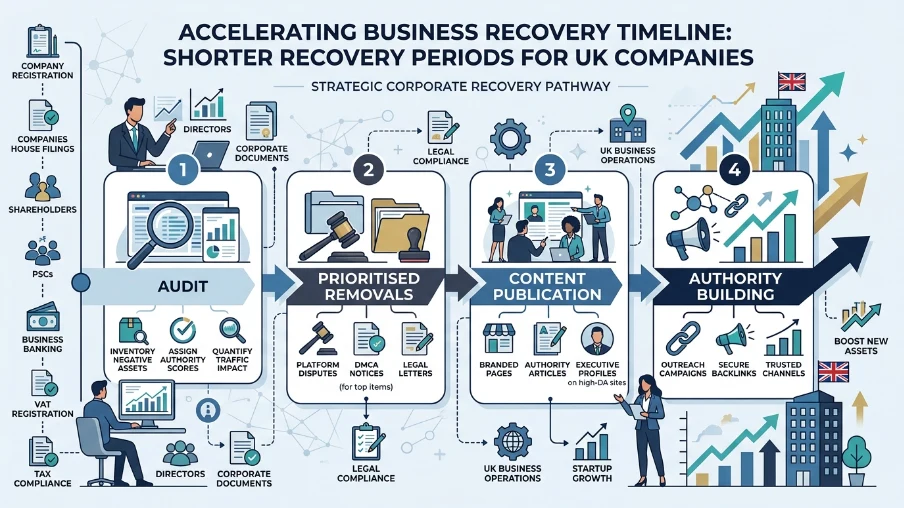
Execute a four-phase process: audit, prioritised removals, content publication, and authority building.
Audit: inventory negative assets, assign authority scores, and quantify traffic impact.
Prioritised removals: submit platform disputes, DMCA notices, and legal letters for top 3 items.
Content publication: publish branded pages, authority articles, and executive profiles on high-DA sites.
Authority building: run outreach campaigns, secure backlinks, and promote via trusted channels to boost new assets.
What outcomes can businesses expect at common timeline checkpoints?
Expect measurable gains at 1, 3, 6, and 12 months tied to specific actions.
1 month: removal requests filed, first new pages published, and data baseline established.
3 months: low-authority negatives reduced, two to four new positive assets on page one for mid-priority terms.
6 months: 50–80% of first-page results positive for most small-to-medium businesses.
12 months: sustained suppression of high-authority negatives in typical cases; legal outcomes may still be pending.
Explore our Reputation Management for business guides,
Reputation Repair Services for Businesses Facing Public Scrutiny
Search Reputation Management Services for Businesses
How much does reputation repair typically cost relative to timeline?
Cost correlates with speed: accelerated 3–6 month plans require higher monthly investment; extended 12–24 month plans spread costs but include sustained promotion.
Express service with priority legal and paid distribution costs more. Longer suppression plans reduce monthly peak costs but require continued investment in content and links. Request a scoped plan with fixed milestones to compare ROI.
Reputation repair timelines vary with asset authority, legal complexity, and resource allocation. Transparent recovery plans with clear milestones speed decisions and produce measurable recovery within 6–12 months for most business cases. Clear My Name executes defined audit, removal, publish, and promotion phases to accelerate outcomes while reporting progress to clients through Reputation Management for business.
Frequently Asked Questions
How long does Reputation Management for business take to show results?
Clear My Name typically begins showing measurable SERP and sentiment improvements within 3–6 months for mid-authority issues, and 6–12 months for complex cases requiring suppression or legal action. Timelines depend on asset authority, removal success, and ongoing content promotion.
What steps does Clear My Name follow in Reputation Management for business?
Clear My Name performs an audit, prioritises removals, publishes optimised business profiles and content, and builds authority through targeted outreach and backlinks. This four-step process documents milestones and tracks SERP share and removal outcomes.
Can negative news or court records be removed by Reputation Management for business?
Removal of verified legal or news records requires legal actions or publisher cooperation; Clear My Name documents issues and recommends legal escalation when evidence supports removal. When removal is not possible, the firm focuses on suppression with high-authority content and citation management.
How do you measure success in Reputation Management for business?
Success metrics include percentage of first-page results that are positive, removal request success rate, branded organic traffic, and sentiment trends from media monitoring. Clear My Name reports these KPIs monthly to show progress and adjust tactics.
What budget should a business expect for Reputation Management for a business?
Typical budgets vary by scope: targeted suppression and content campaigns often start at mid-range retainers for 3–6 months, while legal-heavy or high-authority remediation can cost substantially more over 6–12+ months. Clear My Name provides scoped estimates after an initial audit to align cost with timeline and objectives.