

Reputation repair typically takes between 3 months and 18 months, depending on severity, volume of harmful content, legal actions required, and proactive remediation steps.
What affects the timeline of reputation recovery?
Severity and volume of negative content determine recovery speed; more severe, indexed, or duplicated items extend timelines.
Reputational harm from one negative review differs from a network of defamatory articles. A single social post removed within 7–30 days speeds recovery. Multiple indexed articles, legal takedown needs, or coordinated smear campaigns extend timelines to 12–18 months. Search engine re-indexing and content decay rates also influence results.
How long does it take to remove false content online?
Removal takes 7 days to 12 months, depending on platform policies and the involvement of legal processes.
Social platforms can remove policy-violating posts within 1–30 days after valid reports. News sites and blogs require publisher cooperation; removal requests or right-to-be-forgotten filings take 2–12 weeks for responses and 3–12 months if court orders are necessary. Search engines may de-index content in 2–8 weeks after removals or legal rulings. Each entity (platform, host, registrar) follows distinct procedures that determine response time.
Read our articles, What Affects the Timeline of Reputation Recovery? and Reputation Repair Services with Transparent Recovery Plans.
How long does search ranking recovery take after mitigation?
Search ranking improvements appear in 4–24 weeks after new, authoritative content outranks negatives.
Publishing optimised content, backlinks, and schema markup begins influencing rankings within 4–12 weeks for targeted keywords. For entrenched negative pages, expect 6–24 months to suppress them below page one for primary brand queries. Frequency of content publication, domain authority of new pages, and link acquisition velocity directly affect speed.
When is legal action necessary and how long does it take?
Legal remedies take 3–18 months based on jurisdiction, case complexity, and court backlog.
Defamation, copyright infringement, or doxxing require cease-and-desist letters, takedown notices, or court injunctions. Out-of-court settlements or publisher removals often resolve within 2–8 weeks. Court proceedings for injunctions or damages take 6–18 months. Legal outcomes create definitive removals and faster search de-indexing, but they raise costs and extend overall timelines.
How long to rebuild trust with customers after reputation damage?
Trust rebuilding takes 6–24 months through consistent transparency, corrective actions, and verified endorsements.
Companies regain customer confidence by issuing public corrections, offering remediation, and showing measurable policy changes. Collecting verified reviews, publishing third-party audits, and securing industry certifications accelerate trust repair. A focused program that produces monthly credibility signals (case studies, press releases, reviews) reduces churn and restores trust within 6–12 months for moderate incidents; major breaches require 12–24 months.
What steps shorten recovery time?
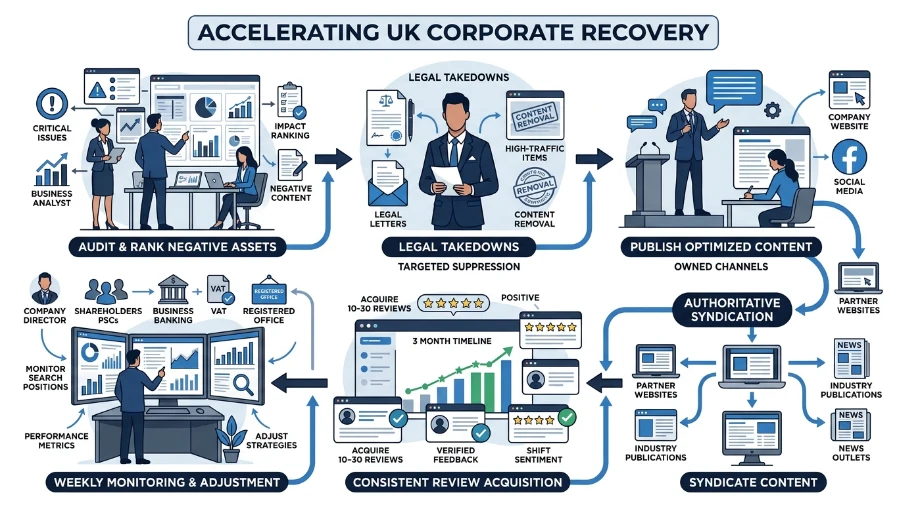
Targeted content suppression, legal takedowns, high-authority content, and consistent review acquisition shorten timelines.
Start by auditing all negative assets and ranking impact. Prioritise takedown requests for high-traffic items. Publish optimised pages on owned channels and syndicate to authoritative partners. Acquire at least 10–30 verified positive reviews on key platforms within 3 months to shift sentiment signals. Monitor search positions weekly and adjust content and link strategies based on performance metrics.
How do platform policies and search engines impact timing?
Platform enforcement speeds or delays removal; search engine indexing cadence affects visibility changes.
Platforms like Facebook, Twitter, Google Business Profile, and major publishers each apply distinct review windows and evidence standards. Google’s re-crawl frequency ranges from days for high-authority sites to months for low-traffic pages. Accurate, documented takedown requests and legal notices reduce platform response time and accelerate de-indexing.
How should businesses prioritise remediation tasks?
Prioritise high-impact, high-visibility items, then resolve medium and low-impact issues in sequence.
Begin with pages that appear on page one for core brand queries. Send removal requests and file legal notices where warranted. Simultaneously publish optimised positive content and secure authoritative backlinks. Implement review generation and customer remediation programs. Track each task with deadlines: immediate (0–30 days), short (31–90 days), medium (91–180 days), long (181–540 days).
Explore our Reputation Management for business guides,
What Happens After Negative Media Coverage?
Why Negative Search Results Damage Business Growth
What metrics track progress and typical milestones?
Key metrics: organic rank positions, share of negative search results, sentiment score, and review rating; expect milestones at 30, 90, and 180 days.
Month 1: complete audit; remove or request removal of top 5 negative items.
Month 3: publish 5–10 optimised pages; gain initial review volume.
Month 6: move 60–80% of negative volume off page one for primary queries.
Month 12: suppress remaining negatives below page two for most brand+service queries. Use weekly rank checks, monthly sentiment analysis, and quarterly legal status reports.
How does budget affect timeline?
Higher monthly spend shortens timelines through faster content production and paid amplification.
A modest budget of $1,000–$3,000 monthly delivers gradual progress over 9–18 months. A mid-tier budget of $5,000–$15,000 monthly supports aggressive content, link campaigns, and outreach to publishers, producing visible gains in 3–9 months. Legal budgets scale separately; small claims or publisher fees commonly range from $500 to $5,000 per item; court matters cost substantially more.
When is hiring a specialist necessary?
Hire a specialist for multi-channel negative coverage, legal complexity, or when internal teams lack SEO and legal coordination.
Reputation repair requires combined SEO, PR, and legal skills. Specialists coordinate takedowns, create optimised content, and negotiate with publishers. They also implement monitoring systems and run review campaigns. Complex cases with cross-border publishers or defamation claims benefit from experts to reduce timeline and legal risk.
Reputation recovery varies widely: quick fixes finish in weeks, while complex recovery spans 12–18 months. Concrete steps accelerate outcomes: prioritise high-impact removals, publish authority content, secure verified reviews, and engage legal action when necessary. Clear My Name delivers coordinated Reputation Management for business with measurable timelines, weekly reporting, and integrated legal outreach to shorten recovery windows and restore search visibility.
Frequently Asked Questions
How long does Reputation Management for business usually take to show results?
Clear My Name typically sees measurable search visibility and sentiment changes within 8–12 weeks for targeted keywords, with fuller suppression of entrenched negative results taking 6–18 months. Timelines vary by content severity, legal actions required, and citation/indexing frequency.
What services are included in Reputation Management for business?
Reputation Management for business commonly includes content audits, takedown requests, SEO-driven content creation, review generation, and monitoring. Clear My Name integrates legal outreach, authoritative content publishing, and link-building to restore brand visibility and trust.
How much does professional Reputation Management for business cost?
Prices range by scope: remediation-only projects often start at $1,500–$5,000, ongoing programs run $3,000–$15,000 per month, and legal actions add itemised fees. Clear My Name provides scoped estimates after an initial audit of affected assets and traffic impact.
Can Reputation Management for business remove defamatory or false content?
Reputation Management for business teams pursue publisher takedowns, DMCA or defamation notices, and legal escalation when necessary to remove false content. Clear My Name documents claims, files formal notices, and coordinates with hosts to increase the likelihood of removal and de-indexing.
How do I measure success for Reputation Management for business?
Measure success with metrics: organic rank positions for brand terms, percentage of negative items on page one, average review rating, and sentiment score changes over time. Clear My Name delivers regular reports showing these KPIs, plus progress on takedowns and new authoritative content placement.