

Customer trust after a data breach depends heavily on the accuracy, clarity, consistency, and timing of information communicated to affected audiences. Reputation management strategies differ based on whether the objective is immediate incident communication, long-term trust recovery, search perception control, or broader digital reputation development.
Which data breach communication approach protects customer trust most effectively?
A clear, factual, and consistent communication approach provides the strongest foundation for protecting customer trust after a data breach. Breach communication is the process of presenting verified information about an incident, its impact, and the organisation’s response through appropriate channels. The approach influences reputation signals because every published statement becomes part of the organisation’s digital footprint. Search engines can index official announcements, while external sources can reference or interpret the information. Consistent communication therefore creates a more coherent information environment for both customers and search systems.
A transparent approach focuses on verified facts rather than speculation or unsupported reassurance. It explains the known nature of the incident, the information affected, the actions taken, and relevant updates without creating contradictions between different communication channels. This strengthens information consistency and gives customers a stable reference point. A vague approach creates greater interpretative space for external commentary, reviews, and media coverage. The resulting SERP composition can therefore contain a wider range of competing narratives.
How does transparent communication compare with limited disclosure?
Transparent communication provides greater informational clarity, while limited disclosure restricts the amount of information available to customers and external audiences. Transparency operates by establishing a clear factual record that can be referenced across official and third-party sources. Limited disclosure operates by releasing only information considered necessary at a particular stage of the incident. Both approaches involve risk, but they create different reputation environments.
Transparent communication strengthens trust signals when the information is accurate, relevant, and consistently updated. Customers can compare subsequent updates against the original information, creating a clearer understanding of how the organisation is responding. Search engines also encounter a defined source of first-party information that can be indexed alongside external coverage.
Limited disclosure reduces the amount of information initially available but increases dependence on other sources for interpretation. News reports, customer discussions, security commentary, and social posts can fill informational gaps. This can influence sentiment distribution and create competing interpretations of the incident. The effectiveness of limited disclosure therefore depends heavily on the quality and authority of information appearing elsewhere.
Is proactive communication more effective than reactive reputation management?
Proactive communication provides stronger control over the initial information environment because it establishes verified information before external narratives become dominant. Reactive reputation management responds after negative or conflicting information has already entered the search ecosystem. The distinction relates to timing rather than the quality of the information itself.
A proactive approach operates by preparing accurate communication, identifying relevant audiences, and establishing consistent information across official channels. This creates an early reference point for customers and external publishers. It also reduces ambiguity when search engines begin indexing breach-related content.
A reactive approach operates after reputation signals have already developed. It analyses search results, reviews, media coverage, social discussions, and other references before determining how to address the emerging perception. Reactive intervention provides an opportunity to correct inaccurate information but operates within an already established SERP environment.
The two approaches therefore differ in risk exposure. Proactive communication focuses on controlling information quality from the beginning, while reactive management focuses on correcting or contextualising information after publication. Long-term reputation management uses both approaches according to the stage and characteristics of the incident.
How does official content compare with third-party coverage after a breach?
Official content provides first-party information, while third-party coverage provides independent interpretation of the incident. Both influence reputation, but they perform different functions within the search ecosystem. Official content explains the organisation’s position and verified facts, while third-party sources can evaluate, report, or contextualise the event.
Official content provides greater control over factual accuracy and message consistency. Organisations can update their own pages, publish clarifications, and maintain a central information source. These pages can then be indexed and retrieved for relevant queries.
Third-party coverage has greater independence and often carries strong source authority. News organisations, regulators, security specialists, and industry publications can create highly visible content that influences search perception. The organisation does not control the content, wording, publication date, or ranking of these sources.
The strongest reputation environment therefore does not depend exclusively on either source type. It requires sufficient authoritative first-party information to provide context while recognising that independent sources contribute separate reputation signals. SERP evaluation must consider both when measuring search perception.
How does content creation compare with content removal after a data breach?
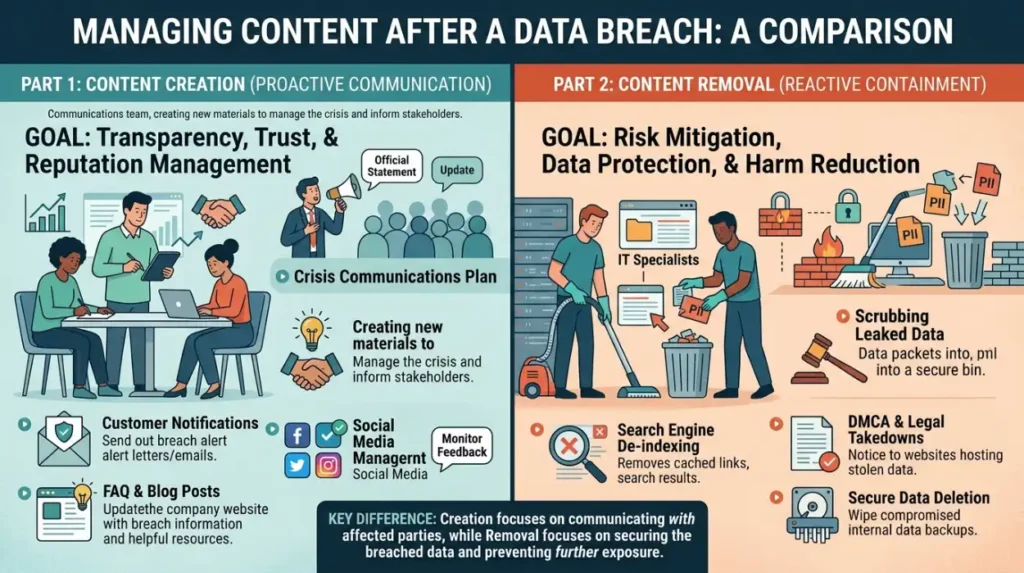
Content creation and content removal address different reputation mechanisms. Content creation adds relevant information to the digital footprint, while content removal attempts to eliminate specific information where a legitimate removal or correction mechanism exists. Their effectiveness depends on the source, content type, authority, search visibility, and circumstances surrounding the information.
Content creation operates through content enhancement. Publishing accurate breach updates, security explanations, FAQs, and relevant organisational information creates additional indexed resources. These resources provide search engines and users with more context when evaluating breach-related queries.
Content removal operates through suppression or deletion of a defined source. Removal can directly address inaccurate or unlawful information where the applicable process supports it. However, legitimate removal is not universally available, particularly when content originates from independent publishers or platforms.
The distinction between content suppression vs content enhancement is therefore central to reputation strategy. Suppression addresses an existing reputation signal, while enhancement develops alternative authoritative information. A complete evaluation measures both the potential reduction of harmful visibility and the strength of the information replacing or contextualising it.
How do short-term and long-term communication strategies differ?
Short-term communication focuses on immediate clarity, while long-term reputation management focuses on maintaining trust signals after the initial incident. Short-term communication addresses what customers need to understand about the breach at the time of disclosure. Long-term communication addresses how the organisation’s digital reputation develops as additional information enters the search ecosystem.
Short-term communication typically prioritises factual accuracy, incident scope, customer guidance, and verified updates. Its effectiveness can be evaluated through information consistency and the visibility of authoritative sources in relevant search results. The immediate objective is to establish a reliable information reference.
Long-term communication involves continued updates, security information, organisational explanations, and responses to legitimate customer concerns. These materials contribute to the wider digital footprint and influence how the organisation is represented in future searches.
The difference is important because search perception persists beyond the initial announcement. Historical breach information can remain indexed, referenced, and retrieved for relevant queries. Long-term content therefore determines how the incident continues to appear within the organisation’s search environment.
Dive Deeper With Our Expert Guides:
Building a Consistent Reputation Across Multiple Franchise Locations
How to Earn and Protect Trustpilot and Feefo Verified Status
How do search engines interpret breach-related reputation signals?
Search engines interpret breach-related reputation signals through indexed documents, relevance, authority, content relationships, search intent, and other ranking factors. There is no single universal reputation score that determines how a company appears after an incident. Instead, multiple documents and signals contribute to the information environment associated with the entity.
Official announcements create first-party signals about the incident and response. News reports, regulatory publications, reviews, specialist commentary, and user-generated discussions introduce additional sources. Search engines evaluate these documents independently while also processing their relationships with the relevant entity and search queries.
Search ranking influence depends on factors including relevance, source authority, content quality, freshness, and query intent. A highly authoritative third-party article can therefore receive prominent visibility even when an organisation publishes comprehensive information on its own website.
SERP composition is consequently an important evaluation measure. Analysts can examine which sources appear for brand-related and breach-related queries and assess what each result communicates. This provides a clearer understanding of search perception than monitoring one ranking position.
How do reviews and sentiment distribution affect post-breach trust?
Reviews provide user-generated reputation signals that communicate customer experiences and perceptions after a security incident. Sentiment distribution refers to the balance of positive, neutral, and negative expressions across relevant content. Together, these signals provide information about how customers interpret the organisation’s response.
Negative reviews can introduce concerns about security, communication, responsiveness, or reliability into the search environment. Positive reviews can provide evidence of satisfactory experiences or effective responses. Neutral reviews and factual content provide additional context without necessarily expressing a strong evaluation.
Review signals differ from official communications because they represent external experiences or perceptions. Their authority depends on the platform, context, relevance, and authenticity of the information. Search users can therefore encounter a mixture of first-party statements and independent customer sentiment.
Reputation analysis evaluates this distribution rather than treating one review as representative of the entire organisation. The volume, recency, relevance, visibility, and thematic consistency of reviews provide a more useful basis for assessing post-breach perception.
Which communication method provides the strongest search visibility?
A central, accurate, regularly maintained information source provides the strongest foundation for search visibility because it gives search engines a clear resource to index and users a consistent reference point. Search visibility is influenced by relevance, authority, content quality, indexing, and search intent rather than publication alone.
A dedicated breach information page can consolidate verified updates and relevant explanations. Supporting content can address specific questions about affected information, security measures, customer guidance, and subsequent developments. These resources create a connected information structure around the incident.
Dispersed communication across disconnected channels creates a less coherent digital footprint. Customers can encounter different versions of the information, while search engines process multiple documents with different levels of authority and relevance.
A structured content environment therefore provides stronger informational consistency. It does not guarantee particular rankings, but it creates a clearer basis for search engines to evaluate authoritative information related to the incident.
How should organisations evaluate the effectiveness of breach communication?
Organisations can evaluate breach communication by measuring information consistency, search visibility, sentiment distribution, source authority, and changes in SERP composition. These indicators provide a structured method for assessing whether communication is creating a coherent reputation environment.
A practical evaluation framework includes:
- Measure search visibility by tracking which official and third-party sources appear for relevant organisation and breach-related queries.
- Evaluate information consistency by comparing official announcements, subsequent updates, customer communications, and authoritative external coverage for factual alignment.
- Analyse sentiment distribution by assessing recurring positive, neutral, and negative themes across reviews, discussions, and published commentary.
- Assess source authority by identifying the credibility and relevance of sources occupying prominent search positions.
- Monitor content indexing by tracking newly published pages, updates, and third-party documents entering the searchable environment.
- Compare SERP composition by measuring changes in the types of information visible before and after communication efforts.
These measures distinguish communication quality from simple publication volume. A large amount of content does not automatically produce stronger trust signals. The relevance, accuracy, authority, consistency, and visibility of that content determine its role within search perception.
How can content enhancement support long-term customer trust?
Content enhancement supports long-term trust by developing authoritative information that remains useful after the immediate breach announcement. It operates by adding relevant, accurate resources to the organisation’s digital footprint and strengthening contextual relationships around security, privacy, and organisational reliability.
Post-breach content can explain verified developments, security improvements, customer guidance, and organisational policies. Each resource contributes additional information for users evaluating the organisation. Search engines can also index these resources and consider them for relevant queries.
Content enhancement does not erase historical information. Instead, it expands the information environment so that users encounter a broader and more current representation of the organisation. This creates an important distinction between reputation development and content suppression.
Long-term sustainability depends on maintaining accuracy and relevance. Outdated statements, contradictory information, and abandoned pages weaken information consistency. Continuous content evaluation therefore forms part of sustainable reputation management.
How should businesses balance transparency, risk, and reputation?
Businesses can balance transparency, risk, and reputation by separating verified facts from unconfirmed information and maintaining consistency across communication channels. Transparency requires useful information rather than unrestricted disclosure of every operational detail. Risk management requires protecting sensitive information while still providing customers with relevant explanations.
A balanced approach begins with factual verification. Information is categorised according to what has been confirmed, what remains under investigation, and what actions have already been completed. This creates a clearer basis for subsequent updates and reduces contradictions.
Reputation risk is then evaluated alongside communication risk. Withholding relevant information can create uncertainty, while releasing inaccurate or incomplete information can create additional reputation signals that require later correction. The objective is therefore informational accuracy combined with appropriate disclosure.
This balance also affects search perception. Consistent factual updates create a stable information source that can be referenced by customers and external publishers. Contradictory statements create competing information that can complicate SERP evaluation and weaken entity credibility.
What is the most sustainable approach to communicating a data breach?
The most sustainable approach combines accurate initial disclosure, consistent updates, authoritative content, review monitoring, and ongoing search perception analysis. This approach recognises that reputation development continues after the original announcement has been published.
Initial communication establishes the factual foundation. Subsequent updates maintain that foundation as new information becomes available. Content enhancement expands the digital footprint, while monitoring identifies changes in search visibility, sentiment, and third-party coverage.
Reactive reputation management remains relevant when inaccurate or harmful information appears. It provides a mechanism for analysing specific reputation risks and determining whether correction, legitimate removal, contextualisation, or content enhancement is appropriate.
The sustainable model therefore combines proactive and reactive mechanisms. Proactive communication establishes information quality, while reactive analysis addresses changes within the wider search ecosystem. Together, these approaches provide a more complete framework for managing post-breach reputation.
Which communication strategy best protects customer trust?
Effective data breach communication depends on factual accuracy, information consistency, authoritative content, and continued monitoring of search perception. Proactive communication establishes an initial reference point, while reactive reputation management addresses reputation signals that develop through third-party coverage, reviews, and search results.
Content creation strengthens the digital footprint by providing relevant information, while legitimate removal and suppression address specific problematic sources where appropriate. Short-term communication provides immediate clarity, while long-term content development supports sustained reputation signals and more stable entity perception.
The strategic comparison therefore extends beyond choosing between transparency and limited disclosure. Organisations need to evaluate search visibility, sentiment distribution, authority, content indexing, SERP composition, risk exposure, and sustainability together.
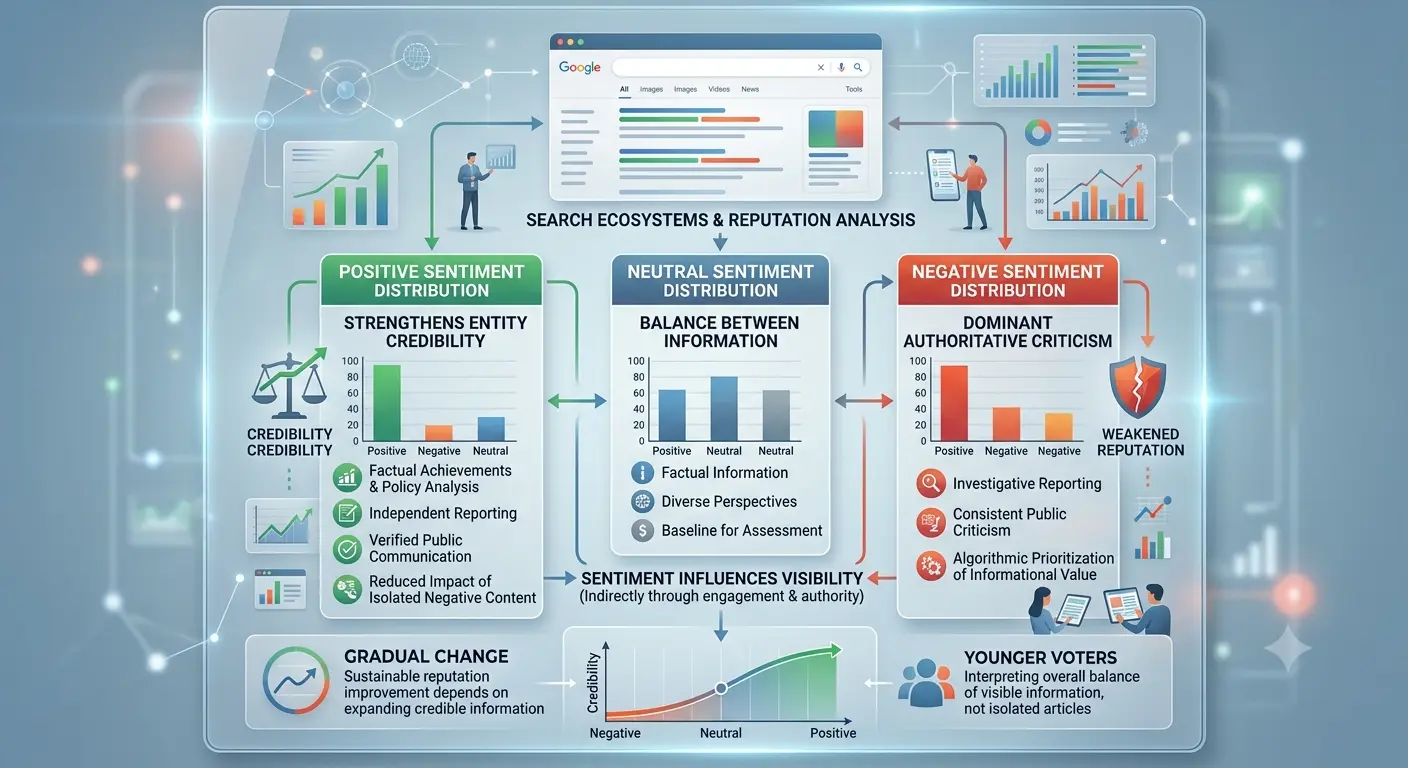
A data breach becomes a reputation-management issue when information about the incident enters the public search ecosystem. Understanding how that information is created, indexed, interpreted, and ranked provides a clearer basis for protecting customer trust over both the immediate and long-term stages of the incident.
How should a company communicate a data breach to customers?
A company should communicate a data breach with accurate, clear, and consistent information about the incident, affected data, and response measures. Regular updates help establish reliable trust signals and reduce uncertainty across the organisation’s digital footprint.
Can transparent data breach communication protect customer trust?
Transparent communication can support customer trust by providing verified information and reducing conflicting interpretations of the incident. Consistent updates also create a reliable reference point for customers, search engines, and third-party sources.
How does a data breach affect online reputation?
A data breach can affect online reputation by generating news coverage, reviews, discussions, and other indexed content associated with the organisation. These reputation signals influence search visibility, sentiment distribution, and how customers perceive organisational credibility.
What is the difference between proactive and reactive reputation management after a breach?
Proactive reputation management establishes accurate information before external narratives dominate search results, while reactive management addresses reputation risks after they become visible. Both approaches involve monitoring SERP composition and evaluating reputation signals.
How can businesses protect their online reputation after a data breach?
Businesses can protect their online reputation by maintaining accurate communication, monitoring search results and reviews, and developing authoritative content that provides verified context. Ongoing reputation analysis helps identify changes in search visibility, sentiment, and customer perception.