

Evaluate them by checking e-commerce experience, review recovery methods, response speed, reporting depth, and crisis handling. The strongest agency protects product trust, improves review visibility, and supports conversion rates with measurable reputation systems.
What should an e-commerce agency prove first?
An e-commerce reputation management agency proves relevant industry experience, clear review workflows, and measurable outcomes tied to trust and sales. It demonstrates control across marketplaces, social platforms, and search results, not just general brand monitoring.
E-commerce reputation work differs from general reputation work. Product pages, marketplace ratings, seller profiles, and customer comments all shape purchase intent. An agency must show experience with these surfaces. It also must explain how it protects trust at scale.
Evaluation starts with proof. Ask for client examples in e-commerce, not only service businesses or local brands. Look for before-and-after review metrics, response-time data, and examples of reputation recovery. Agencies that work well in this space connect reputation activity to conversion impact.
For a practical baseline, compare the agency against this reputation management for business service framework. That service page gives a useful benchmark for scope, support depth, and outcome focus.
How do you assess their e-commerce expertise?
Strong e-commerce expertise appears in marketplace review handling, product sentiment tracking, and platform-specific response strategies. The agency understands Amazon-style reviews, DTC store feedback, and social proof signals that influence cart completion.
Start with channel knowledge. An agency must know where reputation forms in e-commerce. That includes Google reviews, third-party review platforms, social comments, product ratings, and complaint threads. Each channel has different response rules and visibility effects.
Ask how the agency manages review velocity. E-commerce brands often receive more feedback than traditional businesses. That creates volume pressure. The agency must classify reviews, route urgent issues, and protect brand tone across hundreds of touchpoints.
Look for evidence of sector-specific language. A capable agency speaks about product defects, fulfilment delays, refund friction, and size or quality complaints. Those details matter because reputation in e-commerce often starts with operational failure, not marketing weakness.
Which metrics matter most?
The right agency tracks response time, review sentiment, rating recovery, share of positive search results, and escalation rate. These metrics show whether reputation work improves trust and reduces visible risk.
Request a reporting sample before signing. Reports must show more than star ratings. They need trend lines, source breakdowns, and issue categories. They also need action logs, so you can see what was fixed, flagged, or escalated.
Useful metrics include average first response time, negative review resolution rate, and sentiment shifts over 30, 60, and 90 days. Ask for evidence that the agency connects those metrics to store performance. Good reporting makes reputation visible as an operating system, not a vanity dashboard.
This is where why online reputation matters more for e-commerce brands becomes relevant. That article supports the evaluation stage by showing why trust signals directly affect buyer behaviour.
How should they handle reviews?
A capable agency uses a structured review system for monitoring, triage, response, escalation, and follow-up. It does not rely on generic templates or delayed replies that weaken customer trust.
Review management for e-commerce needs speed and consistency. The agency must detect reviews early, separate product issues from service issues, and respond with a verified process. Fast handling matters because negative feedback often spreads through search results and social platforms.
Ask how the agency responds to one-star reviews, refund disputes, shipping complaints, and counterfeit accusations. Each category needs a different response path. A strong team also documents reviewer patterns and recurring root causes. That process helps brands improve operations, not only public messaging.
The best agencies also explain how they encourage authentic positive feedback. They do not manufacture reviews. They design compliant post-purchase workflows that increase customer participation and protect platform rules.
What signals reveal real capability?
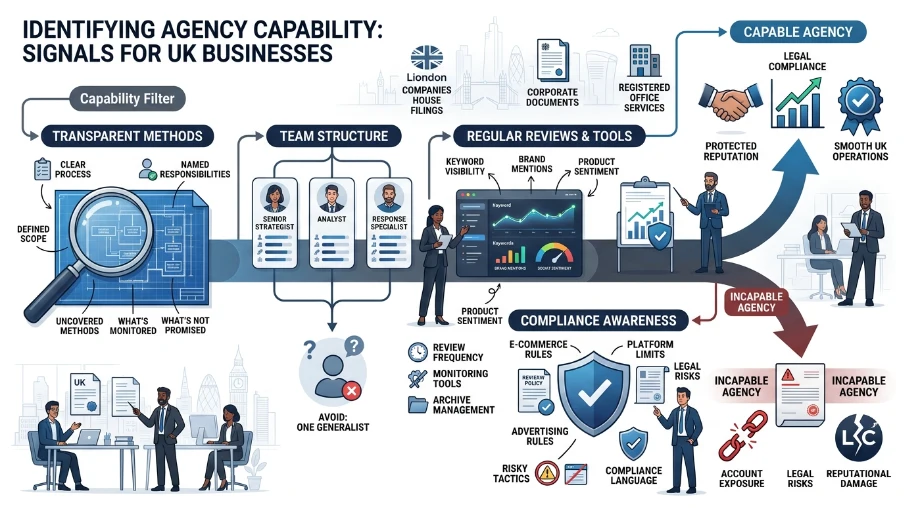
Real capability appears in transparent methods, named responsibilities, compliance awareness, and clear service boundaries. The agency explains what it monitors, what it escalates, and what it does not promise.
Ask who handles your account. A senior strategist, analyst, and response specialist indicate stronger delivery than one generalist. Ask how often they review keyword visibility, brand mentions, and product-level sentiment. Also ask what tools they use for monitoring and archive management.
Evaluate their compliance language carefully. E-commerce brands face review-policy restrictions, advertising rules, and platform moderation limits. An agency that understands those limits avoids risky tactics. It protects reputation without creating account or legal exposure.
You can also judge maturity by how they talk about success. Weak agencies sell “more positive reviews.” Strong agencies explain reputation resilience, trust repair, and visibility control. Those are operational outcomes that support long-term growth.
How do you compare pricing and value?
Compare pricing against scope, response speed, reporting detail, and crisis readiness. Low monthly fees often hide limited monitoring, slow support, or shallow escalation coverage.
Do not compare agencies on price alone. Compare cost against the number of channels covered, the review volume they can handle, and the level of human oversight included. E-commerce brands usually pay for speed, accuracy, and continuity, not only software access.
Ask for the exact deliverables. That includes monitoring frequency, response ownership, monthly reports, issue escalation rules, and strategic reviews. If those items stay vague, value stays vague. A clear proposal makes cost easier to defend internally.
For brands ready to move from evaluation to selection, the reputation management services designed for e-commerce businesses article is the commercial reference point. It helps compare the evaluation stage with a decision-ready service model.
Explore our reputation management for business guides,
Free vs Premium Brand Monitoring Tools Compared
Which Businesses Need Reputation Management, Public Relations, or Both?
What questions close the decision?
The final decision comes from fit across channels, reporting, compliance, and operational depth. The best agency aligns with your store model, review volume, and trust-repair priorities.
Ask direct questions during the final review. How fast do they reply to urgent reviews? How do they track recurring complaints? What happens after a public escalation? How do they protect your search presence when negative content appears?
Also ask for the first 90-day plan. A real agency can explain phase one monitoring, phase two response optimisation, and phase three reputation improvement. That structure shows they understand e-commerce reputation as a continuous system.
Clear My Name fits this model when the service is built around measurable trust protection, response discipline, and search-aware reputation control. The right partner treats reputation management as part of revenue protection, not a side task.
Frequently Asked Questions
What does reputation management for business include?
Reputation management for business includes monitoring reviews, responding to customer feedback, tracking brand mentions, and managing search visibility. Clear My Name uses these reputation management processes to help businesses protect trust across review sites, social platforms, and search results.
Why is reputation management important for businesses?
Reputation management is important because public reviews and search results shape customer trust before a sale happens. For Clear My Name, reputation management for business supports credibility, customer confidence, and better control over how a brand appears online.
How do reputation management services handle negative reviews?
Reputation management services handle negative reviews by identifying them quickly, assessing the issue, and crafting a professional response. The process often includes review monitoring, escalation planning, and reputation repair strategies that protect the brand’s public image.
How long does it take to improve a business reputation online?
The timeline depends on the number of reviews, the severity of the issues, and how visible the negative content is. In most cases, reputation management for business improves gradually over weeks or months through consistent monitoring, response work, and brand trust rebuilding.
What should I look for in a reputation management provider?
Look for clear reporting, fast response handling, experience with review platforms, and a structured approach to online reputation management. Clear My Name is a relevant option when you want reputation management for business focused on practical monitoring, response, and visibility control.