

Pushing down a damaging Reddit or forum thread relies on changing the competitive SERP environment rather than simply removing an existing page. Reputation management strategies differ based on whether the objective is content removal, search visibility reduction, or enhancement of stronger reputation signals.
Online reputation control methods are evaluated through search ranking influence, content authority, relevance, entity credibility, and the composition of search engine results pages. A Reddit or forum thread can remain indexed while becoming less prominent when competing content provides stronger relevance, authority, and contextual signals for the same queries. Understanding these differences is essential when comparing removal, suppression, content enhancement, and reactive approaches.

What Does Pushing Down a Damaging Forum Thread Actually Mean?
Pushing down a damaging forum thread means reducing its prominence within search results by strengthening competing pages that are more relevant, authoritative, and useful for the target queries. This differs from deleting or de-indexing the original content because the underlying page remains available while its search position changes. Search suppression therefore operates through competition within the SERP rather than direct control over a third-party website. The effectiveness of this approach depends on the strength of the damaging page and the quality of the content competing against it.
Content suppression and content enhancement represent two connected but distinct concepts. Content suppression focuses on reducing the search visibility of unwanted results, while content enhancement focuses on improving the authority and relevance of preferred information. Search engines evaluate both groups of pages during ranking, creating an environment where stronger competing signals can alter SERP composition. The strategic objective is therefore measured through visibility distribution rather than the complete disappearance of the original thread.
Is Content Removal More Effective Than Search Suppression?
Content removal provides the most direct change when the underlying platform accepts a valid request and removes the material from public access. Its limitation is that removal depends on platform rules, legal grounds, moderation policies, or the rights of the content owner. A forum operator or Reddit moderator controls the original page, so external parties do not have unrestricted authority to delete it. Removal therefore represents a direct-content approach rather than a search-ranking approach.
Search suppression operates differently by targeting the visibility of the page rather than its existence. It becomes relevant when the content remains online but competing information can establish stronger search signals. The two approaches therefore address different layers of the reputation ecosystem: removal changes content availability, while suppression changes the page’s relative position within search results. Evaluating them requires examining platform control, evidence, search competition, and the sustainability of the desired outcome.
How Does Content Creation Compare With Content Removal?
Content creation builds additional information assets that can compete with a damaging result in search rankings. These assets include authoritative profiles, expert publications, organisational pages, relevant informational resources, and other legitimate sources connected to the same entity. Their effectiveness depends on topical relevance, technical accessibility, authority, and the ability to satisfy the same search intent as the damaging page. Content creation therefore represents an organic enhancement strategy rather than a direct intervention against the original thread.
Content removal produces a more immediate structural change when successful because the source page itself becomes unavailable. Its limitation lies in the conditions required for removal, particularly where the content does not violate platform rules or applicable rights. Content creation has greater scalability because additional relevant assets can expand the competitive search environment. Removal has greater directness, while enhancement provides broader control over the composition of the surrounding SERP.
How Does Organic Search Suppression Work?
Organic search suppression works by increasing the relative strength and relevance of competing pages for queries where damaging content appears prominently. Search engines evaluate documents individually and comparatively, meaning ranking changes occur as the relationship between competing pages changes. Improving content depth, topical relevance, internal linking, entity associations, technical accessibility, and legitimate authority signals can strengthen competing documents. The objective is not to manipulate search systems artificially but to develop content that provides genuine relevance and value.
Organic approaches generally require a broader content ecosystem because a single replacement page does not automatically displace an established forum result. Search competition depends on the number and strength of relevant documents already ranking for the query. A structured content ecosystem provides multiple opportunities for authoritative information to occupy positions within the SERP. This creates a more sustainable approach than relying on one isolated page to counterbalance a persistent discussion.
How Does Reactive Reputation Management Compare With Organic Suppression?

Reactive reputation management addresses specific reputation events after they become visible, while organic suppression focuses on the broader search environment surrounding an entity. Reactive activity includes responding to inaccurate reviews, reporting policy violations, requesting corrections, or addressing individual pieces of content through appropriate platform channels. Its strength lies in targeting a defined problem with a defined intervention. Its limitation is that resolving one page does not necessarily alter the wider SERP.
Organic suppression addresses the ranking environment through longer-term content and authority development. It evaluates competing results, query relationships, entity associations, and the distribution of reputation signals across indexed sources. This approach provides broader search-ranking influence because it works across the information ecosystem rather than one individual URL. The trade-off is greater implementation complexity and a longer measurement cycle.
Which Approach Provides Better Long-Term Search Visibility?
Long-term search visibility generally depends on strengthening a broader information ecosystem rather than relying exclusively on short-term interventions. A single ranking improvement has limited durability if competing pages continue to accumulate authority, relevance, links, and topical coverage. Sustainable search visibility therefore requires an ongoing relationship between useful content, entity credibility, technical accessibility, and consistent information.
Short-term interventions remain relevant when the objective involves a specific piece of damaging content. Reporting an eligible policy violation, correcting inaccurate information, or submitting a legitimate removal request addresses the immediate source. Long-term enhancement addresses the wider search environment that determines what users encounter after searching for an entity. Comparing the two therefore requires distinguishing immediate problem resolution from sustained SERP control.
How Do Reputation Signals Influence the Position of Forum Threads?
Reputation signals influence search visibility by providing contextual information about the reliability, relevance, and authority associated with an entity or source. These signals include references from authoritative websites, consistent entity information, expert content, source credibility, topical relevance, and the quality of supporting information. Search engines process these signals as part of broader ranking evaluation rather than assigning a simple reputation score to an individual.
A damaging forum thread can remain competitive when its content strongly matches a search query and the surrounding search ecosystem contains limited authoritative alternatives. Strengthening credible competing sources changes the distribution of information available to search systems. This does not guarantee that the original thread becomes irrelevant, but it can alter its relative ranking position. Reputation signals therefore influence the competitive relationship between damaging and supporting content.
How Important Is Entity Credibility When Suppressing Forum Content?
Entity credibility is important because search engines need to understand the relationship between information sources and the entity represented by a query. Entity credibility refers to the consistency, authority, and contextual reliability of information associated with a person, organisation, or brand. Establishing clear relationships between authoritative sources and an entity creates stronger contextual signals within the search ecosystem.
Credibility also depends on consistency across the wider digital footprint. Conflicting names, inaccurate profiles, incomplete information, and unrelated pages create ambiguity around entity identification. Consistent and authoritative information provides clearer semantic relationships for search engines to process. This makes entity optimisation an important component of a suppression strategy because ranking competition depends on how confidently search systems understand the information being presented.
Can Building Positive Content Push Down a Negative Reddit Thread?
Building positive and accurate content can influence SERP composition when the new pages provide stronger relevance and authority for the same search queries. The purpose is not to manufacture sentiment but to increase the availability of legitimate information that accurately represents the entity. Relevant professional pages, authoritative publications, expert resources, and factual profiles can introduce stronger competing documents. Their ranking performance determines whether they gain visibility relative to the damaging thread.
The quality of the content ecosystem remains more important than simply increasing the number of pages. Search engines evaluate relevance, usefulness, authority, and relationships between documents, so repetitive or low-value content provides limited competitive strength. Effective content enhancement therefore focuses on distinct search intents and meaningful topical coverage. This creates a more balanced information environment rather than relying on artificial repetition.
Dive Deeper With Our Expert Guides:
Cleaning Up Your Online Presence Before You Start Dating
Steps to Take Down Revenge Content Posted by an Ex-Partner
How Should Search Suppression Risk Be Evaluated?
Search suppression risk is evaluated through the strength of the damaging result, the authority of competing pages, the number of affected queries, and the availability of legitimate alternative information. A highly authoritative forum page ranking for an exact-name query presents a different competitive environment from a low-authority discussion ranking for an obscure phrase. Risk assessment therefore begins with SERP analysis rather than assumptions about the content itself.
The evaluation also considers whether the strategy depends on third-party cooperation. Removal strategies carry platform-dependency risk because success depends on moderation or legal criteria. Organic strategies carry ranking-dependency risk because search positions change as algorithms and competing content evolve. A balanced assessment measures both forms of exposure before selecting a particular approach.
How Scalable Are Different Reputation Management Approaches?
Content enhancement is generally more scalable because new authoritative resources can target additional queries and strengthen multiple areas of an entity’s digital footprint. A structured content ecosystem can address informational, navigational, professional, and reputation-related searches simultaneously. This creates broader search-ranking influence than treating each damaging URL as an isolated problem.
Removal strategies have narrower scalability because each request relates to a specific piece of content and depends on the relevant platform’s rules. Reactive methods share this limitation when each intervention addresses an individual review, comment, or forum page. Organic approaches therefore offer greater breadth, while reactive and removal methods provide greater specificity. The appropriate evaluation depends on whether the reputation issue is isolated or distributed across multiple search queries and sources.
How Does Sentiment Distribution Affect SERP Perception?
Sentiment distribution describes how positive, neutral, and negative information is represented across the visible search environment. Search perception is influenced by the composition of results because users evaluate the information available on the first page before exploring deeper results. A single negative thread has greater perceptual significance when it appears alongside limited authoritative information. A broader set of accurate and relevant sources creates a different information balance.
Search engines do not simply rank content according to whether it is positive or negative. Relevance, authority, quality, query intent, and other ranking signals determine visibility. Therefore, improving sentiment distribution is not equivalent to publishing positive statements without substance. The strategic focus remains on increasing the visibility of credible, useful, and contextually relevant information.
What Is the Best Way to Evaluate Content Suppression Versus Enhancement?
Content suppression and content enhancement are best evaluated as complementary approaches rather than interchangeable techniques. Suppression focuses on reducing the prominence of damaging results, while enhancement strengthens legitimate content capable of competing within the same SERP. Removal sits separately because it attempts to change whether the original content remains publicly accessible. Each approach therefore operates at a different layer of the reputation system.
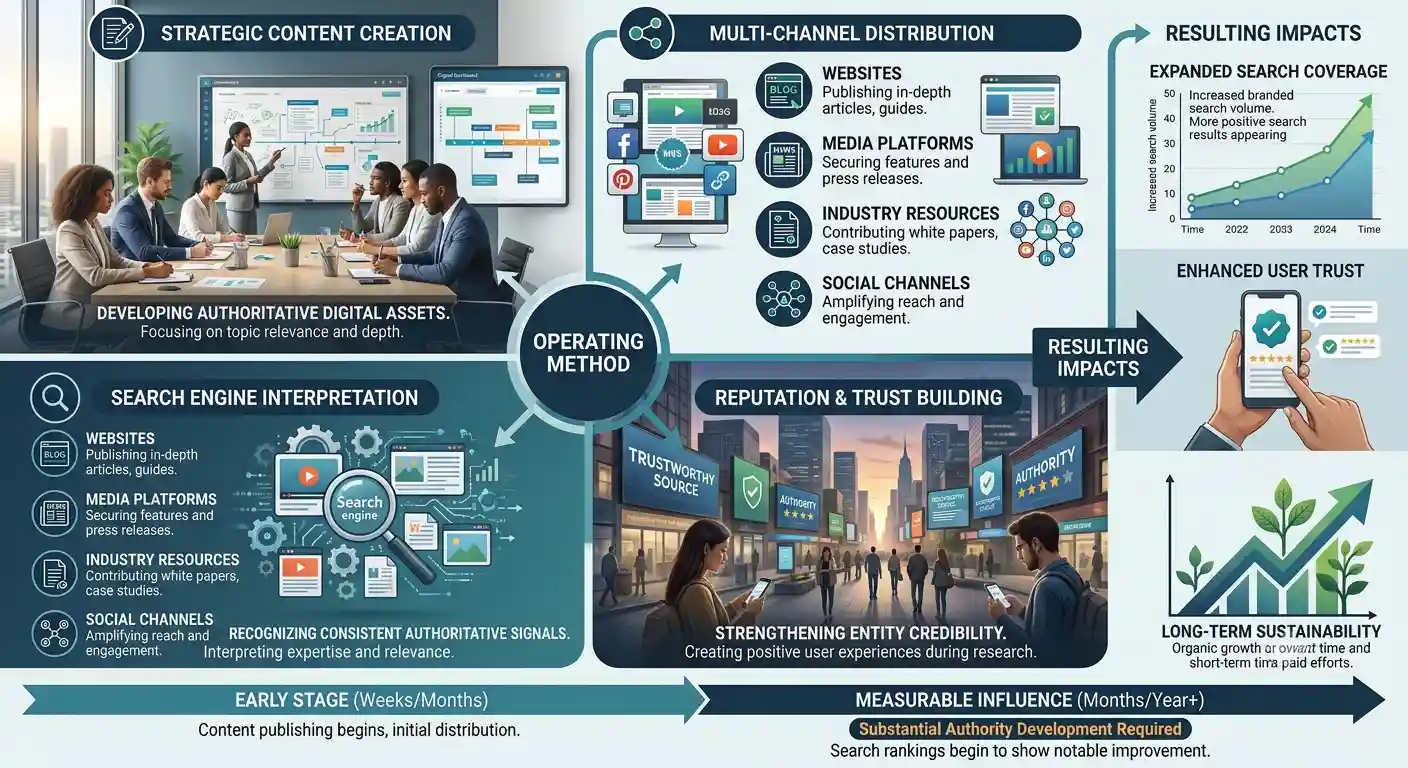
A structured evaluation can compare the approaches through four criteria:
- Measure ranking influence by recording the damaging thread’s position across relevant queries and monitoring changes in SERP composition.
- Evaluate scalability by assessing whether the method addresses one URL or strengthens multiple areas of the digital footprint.
- Assess risk exposure by identifying dependencies on platform moderation, search algorithms, or third-party sources.
- Compare sustainability by examining whether the strategy produces durable reputation signals or relies on a one-time intervention.
This framework separates immediate visibility changes from longer-term reputation outcomes. It also prevents removal, suppression, and enhancement from being treated as identical processes.
How Can a Damaging Forum Thread Be Addressed Within a Wider SERP Strategy?
A damaging forum thread is best evaluated within the complete search environment rather than as an isolated URL. The analysis begins by identifying affected queries, ranking positions, competing sources, entity relationships, and the authority of each visible result. This establishes whether the issue is primarily a content problem, a ranking problem, an entity-perception problem, or a combination of these factors.
Once the SERP structure is understood, different interventions can be compared according to their mechanisms and limitations. Legitimate removal addresses content availability, reactive action addresses specific violations or inaccuracies, and organic enhancement changes the competitive information environment. A broader suppression strategy therefore focuses on Suppress a Damaging Forum Thread through legitimate search visibility analysis and stronger competing reputation signals rather than treating ranking position as a standalone metric.
What Are the Key Differences Between Reddit Suppression Approaches?
The main difference between reputation management approaches is the layer of the search ecosystem they attempt to change. Removal changes the availability of the original content, reactive methods address specific sources or events, and organic enhancement changes the competitive SERP environment. Suppression sits between these concepts by focusing specifically on reducing the visibility of damaging content through stronger competing signals.
The most appropriate approach depends on search visibility, authority, platform control, risk exposure, scalability, and sustainability. Short-term interventions provide focused responses, while long-term content enhancement develops a wider information ecosystem. Neither ranking suppression nor content removal operates independently from search engine evaluation. The central consideration is therefore how each method changes the relationship between damaging information, authoritative alternatives, and the entity’s overall digital footprint.
Which Reputation Management Approach Is Most Sustainable?
No single reputation management approach operates identically across every search environment. Content removal provides direct control when legitimate grounds exist, reactive methods address defined platform or content issues, and organic enhancement strengthens the wider SERP environment. Search suppression focuses on relative visibility, making its effectiveness dependent on competing authority, relevance, entity credibility, and query-specific ranking dynamics.
A sustainable evaluation therefore considers both immediate intervention and long-term search visibility. The strongest analytical framework separates content availability from ranking position and distinguishes reputation signals from user perception. Understanding these mechanisms allows damaging Reddit and forum results to be evaluated according to measurable search factors rather than assumptions about how old, negative, or prominent the content appears.
How can I push down a damaging Reddit or forum thread?
A damaging Reddit or forum thread can be pushed down by strengthening relevant, authoritative content that competes for the same search queries. This approach focuses on SERP composition, search visibility, entity credibility, and stronger reputation signals.
Can positive content push a negative Reddit thread down?
Accurate and authoritative content can influence the position of a negative Reddit thread when it provides stronger relevance and authority for the same queries. Content enhancement works by expanding the competitive search environment rather than removing the original discussion.
Is it better to remove a Reddit thread or suppress it in search results?
Removal changes the availability of the original content, while search suppression focuses on reducing its visibility within search results. Removal depends on platform policies or valid grounds, whereas suppression evaluates ranking competition and the strength of alternative content.
How long does it take to push down a damaging forum result?
The timeframe depends on the damaging page’s authority, ranking position, affected queries, and the strength of competing content. SERP monitoring measures changes in search visibility and ranking influence over time.
Does reputation management for individuals include damaging Reddit results?
Reputation management for individuals can include analysing damaging Reddit and forum results as part of a wider digital footprint. The analysis typically considers search visibility, reputation signals, entity credibility, sentiment distribution, and the composition of relevant SERPs.