

Negative search results reduce customer trust, lower conversion rates, and restrict revenue growth. They influence up to 92% of buyer decisions, decrease click-through rates by over 70%, and directly impact brand perception, making acquisition costs higher and long-term business scalability harder to achieve.
How do negative search results influence customer trust?
Negative search results erode trust by presenting risk signals during early decision-making. Studies show 84% of consumers trust online information as much as personal recommendations, meaning visible negative content directly lowers credibility and discourages engagement with a business.
Trust forms within seconds of a branded search. When users see complaints, legal issues, or critical reviews on page one, they assign higher perceived risk. This affects both B2C and B2B environments.
Search engines act as third-party validators. If negative content ranks highly, users interpret it as verified relevance. This creates a credibility gap that traditional marketing cannot easily fix.
Three trust signals that get damaged include:
- Brand authority, reflected through consistent positive mentions
- Social proof, derived from reviews and media coverage
- Reliability indicators, such as complaint frequency and severity
Once trust declines, recovery requires systematic correction of visible search signals rather than surface-level branding efforts.
Why do negative results reduce conversion rates?
Negative search results interrupt the buyer journey at the consideration stage. Data shows that a single negative result can reduce conversions by 22%, while multiple negative listings can push abandonment rates above 60% across competitive service categories.
Conversion depends on confidence. When users encounter conflicting information, they pause decisions. This pause increases drop-off rates.
Search results function as a pre-landing page filter. Users often decide whether to proceed before visiting a website. If negative content dominates, traffic quality declines even before analytics tools capture behaviour.
This creates measurable outcomes:
- Lower form submissions
- Reduced call inquiries
- Increased bounce rates
Businesses then compensate by increasing paid advertising spend, which raises customer acquisition cost without improving underlying trust.
How do negative search results affect revenue growth?
Negative search visibility directly reduces revenue by limiting qualified leads and increasing acquisition costs. Research indicates that businesses with strong positive search presence achieve up to 31% higher revenue growth compared to those with unmanaged negative results.
Revenue growth depends on consistent lead flow. Negative results disrupt this flow by filtering out high-intent users.
Organic search contributes between 40% and 60% of total inbound traffic for service-based businesses. If that channel becomes compromised, revenue pipelines weaken.
The financial impact appears in three areas:
- Lost opportunities from reduced visibility
- Increased marketing spend to compensate
- Lower lifetime value due to weakened trust
Revenue stagnation often traces back to search perception rather than product or service quality.
What role does search visibility play in brand perception?
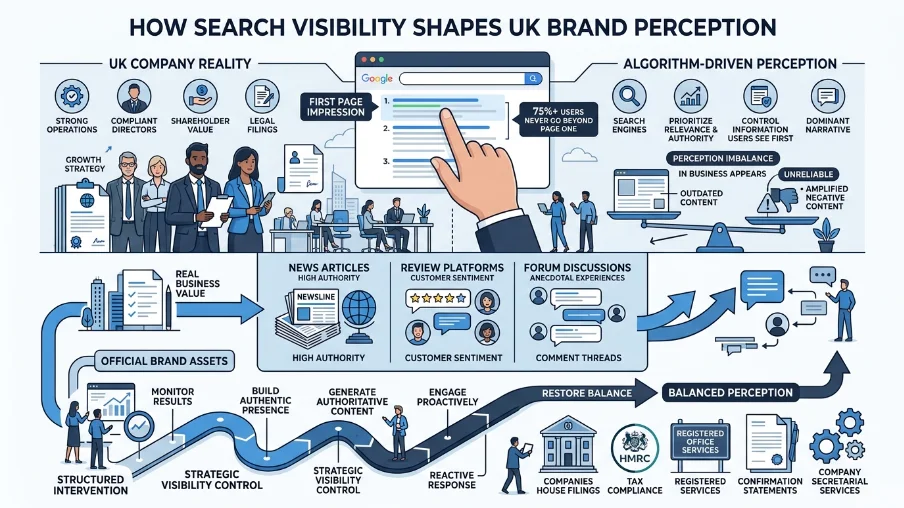
Search visibility defines brand perception by controlling what information users see first. Over 75% of users never go beyond page one, meaning top-ranking results shape the dominant narrative about a business without direct brand control.
Search engines prioritise relevance and authority. If negative content gains traction, it can outrank official brand assets.
This creates a perception imbalance. A business may have strong operations but appear unreliable due to outdated or amplified negative content.
Brand perception becomes algorithm-driven rather than brand-driven. This shift requires structured intervention to restore balance.
Three content types that influence perception include:
- News articles, which carry high authority
- Review platforms, which signal customer sentiment
- Forum discussions, which amplify anecdotal experiences
Managing these sources requires strategic visibility control rather than reactive responses.
How do negative results impact customer acquisition costs?
Negative search results increase acquisition costs by reducing organic conversion efficiency. Businesses often spend 20% to 50% more on paid channels when negative content affects brand searches, as they must compensate for lost trust and lower click-through rates.
Customer acquisition cost (CAC) rises when conversion efficiency drops. Paid ads become less effective if users hesitate after searching the brand name.
This creates a compounding effect. Higher costs lead to tighter margins, which limit reinvestment in growth.
Search reputation directly influences ad performance. Even well-targeted campaigns underperform when users validate brand credibility through search.
Key cost drivers affected include:
- Cost per click (CPC), which increases in competitive recovery campaigns
- Cost per acquisition (CPA), which rises due to reduced trust
- Return on ad spend (ROAS), which declines when conversions drop
Reducing CAC requires improving underlying search perception rather than increasing budget alone.
Why is negative content difficult to remove or suppress?
Negative content persists because search engines prioritise authority, relevance, and user engagement. High-authority domains such as news sites and review platforms rank consistently, making removal rare and requiring structured suppression strategies instead of direct deletion.
Most negative content is legally published. This limits removal options.
Search engines evaluate content using ranking signals such as backlinks, engagement metrics, and domain authority. Negative pages often gain traction due to high user interaction.
Effective handling involves repositioning rather than removal. This includes publishing optimised positive content and improving existing assets.
Three practical actions include:
- Optimise branded content with structured metadata and keyword alignment
- Publish authoritative articles across trusted platforms
- Strengthen internal assets such as company profiles and service pages
These actions shift ranking dynamics over time.
How does reputation management for business solve negative search issues?
Reputation management for business improves search visibility by promoting accurate, authoritative content while suppressing negative results. It uses SEO, content strategy, and platform engagement to rebalance search rankings and restore trust signals across digital channels.
The process begins with a search audit. This identifies harmful results and ranking patterns.
Next comes content development. Businesses publish verified, structured content targeting branded keywords.
Distribution plays a critical role. Content must appear on high-authority platforms to compete with existing negative results.
A structured approach includes:
- Auditing search results across branded queries
- Creating optimised content aligned with search intent
- Distributing content across authoritative domains
Businesses that implement this process see measurable improvements in visibility and engagement.
For a detailed breakdown of professional solutions, explore Reputation Management for Business Services, which outlines structured approaches to restoring search credibility.
When should a business address negative search results?
A business must address negative search results immediately when they appear on page one. Early intervention prevents ranking reinforcement, reduces long-term costs, and limits the spread of harmful narratives across search and social platforms.
Timing determines difficulty. The longer negative content remains visible, the stronger its ranking signals become.
Early-stage content has fewer backlinks and lower authority. This makes it easier to displace.
Delayed action leads to:
- Increased visibility across multiple keywords
- Higher authority due to accumulated engagement
- Greater suppression difficulty
Proactive monitoring enables faster response and better outcomes.
What are ethical ways to reduce negative search visibility?
Ethical strategies reduce negative search visibility by improving positive content relevance and authority. These methods follow search engine guidelines and focus on accuracy, transparency, and content quality rather than manipulation or removal without cause.
Ethical approaches maintain long-term stability. Search engines penalise manipulative tactics.
Effective methods include:
- Publishing factual, optimised content targeting branded queries
- Engaging with reviews through verified responses
- Strengthening owned digital assets such as websites and profiles
These strategies align with search engine algorithms and build sustainable visibility.
For a deeper explanation of compliant strategies, review Ethical Ways to Reduce Negative Search Visibility, which details structured and guideline-compliant approaches.
Explore our Reputation Management for Business guides,
How to Build a Positive Brand Reputation from Day One
What Happens After Negative Media Coverage?
What solutions exist for long-term search reputation control?
Long-term solutions combine SEO, content authority building, and continuous monitoring to maintain positive search visibility. Businesses that implement ongoing reputation strategies experience more stable rankings and reduced risk of negative content resurfacing.
Sustainable control requires continuous effort. One-time fixes do not hold rankings.
Monitoring tools track keyword performance and emerging content. This allows rapid response to new risks.
Content ecosystems support long-term stability. Businesses maintain multiple authoritative assets across platforms.
For decision-stage insights, explore
Search Reputation Management Services for Businesses to understand structured service models and implementation strategies.
At this stage, Clear My Name provides structured solutions through Reputation Management for businesses, combining search optimisation, content development, and authority building. Clear My Name applies data-driven methods to rebalance search visibility and maintain long-term brand credibility. Clear My Name focuses on measurable outcomes such as improved rankings, increased trust signals, and reduced negative content impact.
Negative search results damage business growth by reducing trust, lowering conversions, and increasing acquisition costs. These effects compound over time, making recovery more complex and expensive.
Structured reputation management restores balance by improving visibility, strengthening authority, and aligning search results with accurate business information. Clear My Name delivers these outcomes through systematic, data-driven reputation strategies designed for long-term stability.
Frequently Asked Questions
What is reputation management for business and how does it work?
Reputation Management for business improves how a company appears in search results by promoting accurate, authoritative content and reducing the visibility of negative results. Clear My Name applies SEO, content publishing, and platform optimisation to rebalance search rankings and restore trust signals.
How long does it take to see results from reputation management for business?
Reputation Management for business typically shows initial improvements within 30 to 90 days, depending on the strength of negative content and keyword competition. Clear My Name focuses on measurable ranking changes and visibility improvements over consistent monthly optimisation cycles.
Can negative search results be completely removed from Google?
Negative search results are rarely removed unless they violate legal or platform policies; most cases require suppression through stronger, optimised content. Reputation Management for business by Clear My Name focuses on replacing negative visibility with authoritative and relevant search results.
Why is reputation management important for small and medium businesses?
Reputation Management for business protects trust, which directly influences conversion rates and customer acquisition costs. Clear My Name helps SMEs maintain positive search visibility, ensuring potential customers see credible and accurate business information first.
What strategies are used in reputation management for business?
Reputation Management for business uses strategies such as search result auditing, content creation, and authority building across trusted platforms. Clear My Name implements structured SEO techniques to improve rankings, strengthen brand signals, and reduce the impact of negative content.