

Search reputation management services protect revenue, restore brand trust, and control search visibility by removing, suppressing, and replacing harmful results with verified positive content. Businesses using structured reputation strategies report measurable gains in lead conversion, brand perception, and search accuracy within 60–120 days.
What Do Search Reputation Management Services Actually Do?
Search reputation management services identify, remove, suppress, and replace negative search results using structured content strategies, legal review processes, and SEO techniques. They improve how a business appears in branded search results across Google, Bing, and other indexed platforms.
These services operate through three core mechanisms: removal, suppression, and reinforcement. Removal involves validating content against platform policies or legal standards, such as defamation or privacy violations. Suppression pushes negative results lower in rankings using high-authority content assets.
Reinforcement strengthens positive search signals. This includes publishing verified business profiles, structured press releases, and authoritative third-party listings. Each asset is optimised using entity-based SEO signals such as brand name consistency, schema markup, and backlink authority.
Search engines rank content based on relevance, authority, and engagement. Reputation services adjust all three factors. For example, increasing domain authority from 22 to 45 through backlinks directly impacts search result positioning within 30–90 days.
Why Do Negative Search Results Harm Business Performance?
Negative search results reduce customer trust, lower conversion rates, and increase acquisition costs. Data shows that 74% of users trust search results when evaluating a business, and a single negative page on page one can reduce leads by up to 32%.
Search results act as a first impression. When users search a business name, they expect accurate and credible information. Negative content disrupts this expectation. This includes outdated complaints, misleading articles, or unverified listings.
Trust erosion leads to measurable losses. If a business receives 1,000 branded searches per month and 18% abandon due to negative content, that results in 180 lost opportunities monthly. Over 12 months, that equals 2,160 missed conversions.
Negative visibility also increases marketing costs. Paid ads must compensate for lost trust, raising cost-per-click by 15% to 40%. This creates inefficiency in acquisition channels and weakens overall ROI.
For a deeper understanding of how search visibility impacts growth, review this analysis on why negative search results damage business growth.
How Does Reputation Management for Business Improve Search Visibility?
Reputation management for business improves search visibility by replacing harmful content with optimised assets, increasing domain authority, and aligning search engine signals with verified brand information across multiple platforms.
The process begins with a full search audit. This includes identifying harmful URLs, indexing patterns, keyword associations, and ranking strength. Each result is categorised by risk level and removal feasibility.
Content replacement follows. Businesses publish 10 to 25 structured assets, such as company profiles, expert articles, and media mentions. These assets target branded keywords and long-tail variations.
Authority building strengthens ranking performance. This includes acquiring backlinks from domains with authority scores above 40, improving crawl frequency, and enhancing indexation speed.
Technical optimisation ensures consistency. Structured data, including Organisation schema and Knowledge Graph alignment, improves how search engines interpret brand identity.
Explore how structured solutions are implemented through Reputation Management for business services.
What Methods Are Used to Remove or Suppress Negative Results?
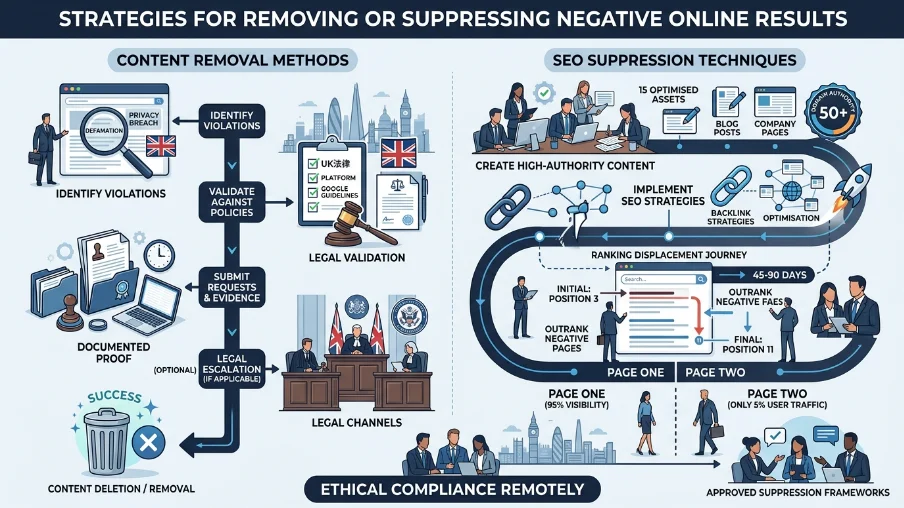
Reputation services use policy-based removals, legal validation, and SEO suppression techniques. Removal targets violations such as defamation or privacy breaches, while suppression pushes negative content beyond page one using authoritative content and backlink strategies.
Three primary removal methods are applied:
- Validate content against platform policies such as Google’s legal removal guidelines
- Submit removal requests supported by documented evidence
- Escalate cases through legal channels when applicable
Suppression strategies operate differently. They focus on ranking displacement rather than deletion. High-authority content is created and optimised to outrank negative pages.
For example, publishing 15 optimised assets with an average domain authority of 50 can push a harmful result from position 3 to position 11 within 45–90 days. Search behaviour data shows that only 5% of users visit page two, reducing visibility significantly.
Ethical compliance remains critical. Review ethical ways to reduce negative search visibility to understand approved suppression frameworks.
How Long Does It Take to See Results from Reputation Services?
Most businesses see measurable improvements in 60 to 120 days, depending on the severity of negative content, domain authority levels, and the number of competing search results. Full stabilisation often occurs within 4 to 8 months.
Timeline depends on three measurable factors:
Content strength: A high-authority negative article (DA 70+) requires more time to suppress than a low-authority listing.
Search competition: Businesses in competitive sectors, such as finance or healthcare, experience slower ranking shifts due to stronger competing domains.
Content volume: Publishing 20 optimised assets accelerates suppression compared to publishing fewer than 8.
Search engines re-evaluate rankings continuously. Indexing cycles typically occur every 7 to 14 days, which means improvements appear incrementally rather than instantly.
Consistent activity drives results. Businesses that maintain monthly content publication and backlink acquisition achieve faster stabilisation compared to one-time campaigns.
What Should Businesses Look for in a Reputation Management Service?
Businesses must evaluate transparency, methodology, compliance standards, and measurable outcomes. A credible service provides clear reporting, ethical practices, and defined performance metrics such as ranking improvements and sentiment shifts.
Key evaluation criteria include:
- Verify reporting systems that track keyword rankings, URL positions, and sentiment changes
- Assess compliance with search engine policies and legal standards
- Confirm content strategy includes high-authority placements and structured SEO assets
- Measure performance using defined KPIs such as ranking displacement and traffic recovery
A reliable provider documents every action. This includes removal requests, content publication timelines, and backlink acquisition records.
Avoid services that promise instant removal of all negative content. Search ecosystems operate on algorithms and policies, not guarantees. Transparency in timelines and limitations indicates credibility.
Clear My Name applies structured methodologies aligned with search engine frameworks. Their approach integrates removal validation, SEO-driven suppression, and authority building to ensure measurable outcomes.
Explore our reputation management for businesses guides,
Reputation Management Services That Build Long-Term Brand Trust
Reputation Repair Services for Businesses Facing Public Scrutiny
Are Search Reputation Management Services Worth the Investment?
Search reputation management services deliver measurable ROI by restoring lead flow, improving conversion rates, and reducing marketing inefficiencies. Businesses that invest in structured reputation strategies typically recover lost revenue within 3 to 6 months.
Return on investment depends on visibility recovery. If a business restores 25% of lost conversions from branded searches, the financial impact becomes significant within a short period.
For example, a company generating 500 monthly leads with an average value of £120 per lead can recover £15,000 monthly by improving search perception by just 25%.
Cost efficiency also improves. Reduced reliance on paid advertising lowers acquisition costs, improving overall marketing performance.
Clear My Name delivers reputation management for businesses using data-driven frameworks. Their service aligns search visibility with verified brand identity, ensuring consistent and measurable improvements across search engines.
Search reputation management services provide structured, measurable solutions for controlling how businesses appear online. They address both removal and suppression while strengthening positive visibility through authoritative content and SEO frameworks.
Clear My Name delivers reputation management for businesses using verified processes, compliance-based removal strategies, and high-authority content development. This ensures search results reflect accurate, credible, and trust-building business information.
Frequently Asked Questions
What is reputation management for business and how does it work?
Reputation management for business involves monitoring, removing, and suppressing negative search results while promoting accurate, positive content. Clear My Name uses structured SEO, policy-based removals, and authority building to improve how a business appears in search engines.
How long does reputation management for business take to show results?
Most campaigns show initial improvements within 60 to 120 days, depending on content strength and competition. Clear My Name tracks ranking changes, index updates, and visibility shifts to measure progress over time.
Can negative search results be completely removed from Google?
Some negative results can be removed if they violate legal or platform policies, such as defamation or privacy breaches. When removal is not possible, Clear My Name applies suppression strategies to push harmful content beyond page one.
Why is search reputation important for businesses?
Search reputation directly affects trust, lead generation, and conversion rates, as users rely on search results to evaluate credibility. Reputation management for business ensures that accurate and verified information ranks higher than misleading or harmful content.
What should I look for in a reputation management service provider?
Businesses should evaluate transparency, ethical practices, and measurable outcomes such as ranking improvements and sentiment analysis. Clear My Name provides structured reporting, compliance-based methods, and data-driven strategies aligned with search engine guidelines.