
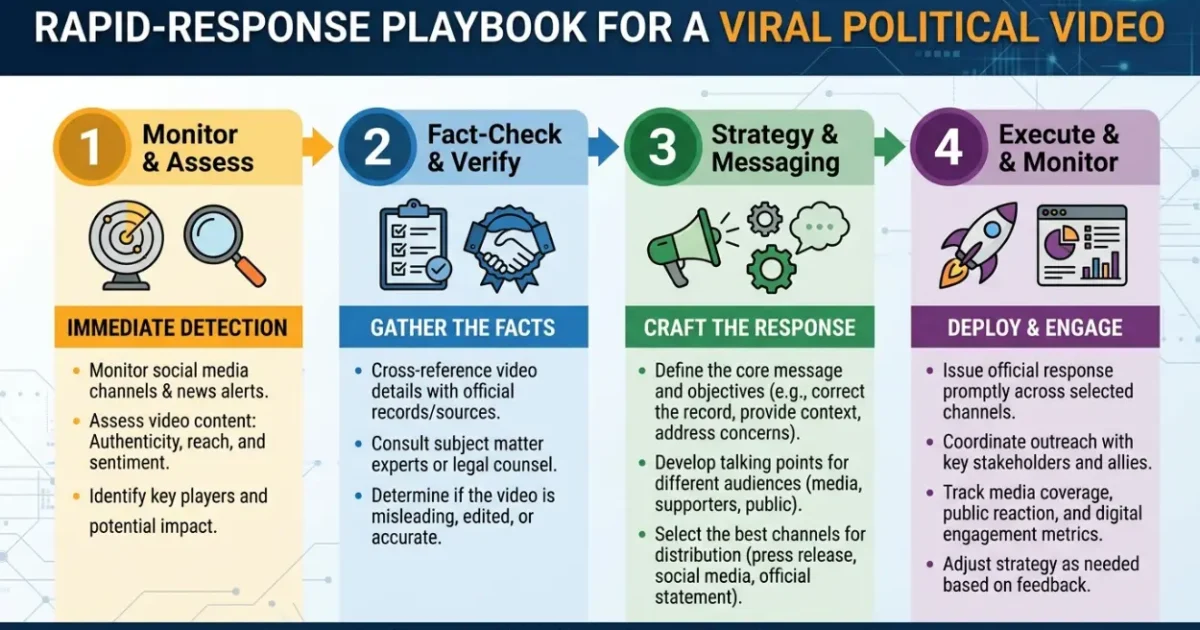
A rapid-response playbook provides a structured framework for analysing and managing the search and reputation effects of a viral political video. Reputation management strategies differ based on the video’s source, context, distribution speed, sentiment and resulting search visibility.
Online reputation control methods are evaluated through their ability to distinguish factual information from speculation, stabilise the information environment and preserve accurate entity perception. A viral political video can generate rapid changes in SERP composition as news reports, social posts, commentary and secondary content become indexed. The appropriate response therefore depends on whether the primary issue involves inaccurate information, negative but legitimate coverage, manipulated context or excessive visibility. A structured evaluation reduces reactive decisions and connects response actions with measurable reputation signals.
How should a viral political video be evaluated before taking action?
A viral political video requires an initial evidence and visibility assessment before any reputation response begins. The first evaluation identifies the original source, publication context, timestamp, complete footage and associated reporting. This establishes whether the content represents an authentic recording, edited material, commentary or a combination of sources. Search analysis then identifies where the video appears, which queries trigger it and which secondary pages reference it. This creates a baseline for measuring subsequent changes in search visibility and entity perception.
The distinction between factual accuracy and reputational sensitivity is essential. Accurate negative information represents a different condition from manipulated or demonstrably false material. Removal strategies require an appropriate basis, while content enhancement addresses the broader information environment. Treating every negative reference as removable increases risk exposure and weakens the analytical foundation of the response. A structured assessment therefore separates source-level problems from search-visibility problems.
Which rapid-response approach works best for viral political content?
The most appropriate approach depends on the underlying reputation issue rather than the video’s level of virality alone. Source removal addresses information at its origin when a legitimate basis exists, while content enhancement adds relevant and authoritative information to the surrounding search ecosystem. Suppression focuses on reducing the prominence of existing content through changes in SERP composition. Clarification focuses on establishing accurate context through credible information. Each method operates through a different mechanism and produces different risk and sustainability characteristics.
A comparative evaluation considers effectiveness, scalability and evidence requirements. Removal can address the underlying source but depends on eligibility and the authority of the publisher or platform. Suppression addresses search visibility but does not eliminate the original information. Content enhancement creates additional context but requires relevant material that search systems recognise as authoritative. The appropriate strategy therefore follows the problem classification rather than applying one universal response.
How does content creation compare with content removal after a viral video?
Content creation and content removal address different layers of the reputation system. Content removal targets the existence or accessibility of a source, while content creation influences the wider information environment surrounding the political entity. Removal has a direct relationship with the original content but depends on a valid basis for action. Content creation operates through indexing, relevance, authority and search ranking dynamics. Comparing the two methods requires separating source-level control from visibility-level influence.

Content enhancement also has a longer-term role in establishing a balanced digital footprint. Accurate information about professional background, public record, policies and verified statements provides additional context for entity perception. However, irrelevant material does not automatically compete with a highly relevant viral event. Search ranking influence depends on topical alignment and source quality. The effectiveness of content creation therefore depends on whether the new information genuinely satisfies relevant search intent.
Is a reactive or organic reputation strategy more effective?
Reactive strategies prioritise speed, while organic strategies prioritise sustained information development. A reactive response addresses the immediate search and information conditions created by a viral event. An organic approach builds relevant authoritative content and strengthens the broader digital footprint over time. Reactive activity is useful for establishing an early baseline and identifying urgent misinformation or visibility issues. Organic activity provides a longer-term framework for maintaining accurate entity representation.
The two approaches operate at different stages of the reputation lifecycle. A rapid response focuses on source verification, search monitoring, contextual analysis and immediate risk assessment. Organic reputation management focuses on publishing and maintaining credible information that remains relevant beyond the original incident. Combining both approaches creates a distinction between short-term containment and long-term sustainability. Evaluating them independently prevents temporary visibility changes from being mistaken for permanent reputation improvement.
How does response speed influence search reputation after a viral event?
Response speed influences reputation because viral content can generate secondary information faster than conventional reputation analysis. News articles, commentary, social posts and video uploads can appear within a short period and create multiple indexed references. Delayed analysis allows the information environment to develop without an established factual context. Rapid assessment therefore focuses on identifying the source and determining the accuracy and significance of the content. Speed is valuable for analysis, but accuracy remains the controlling requirement.
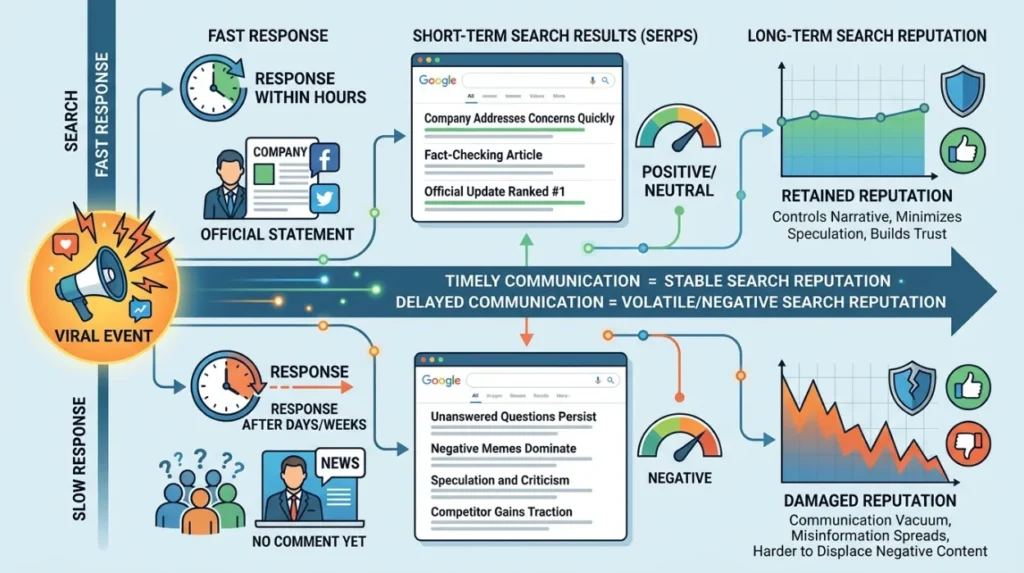
Fast action does not mean publishing unverified responses. An inaccurate statement can create additional reputation signals and expand the search footprint around the controversy. Every response becomes another potential indexed source that users can encounter. The quality of the response therefore affects both immediate perception and long-term search visibility. A disciplined rapid-response model prioritises verification before publication.
What is the difference between content suppression and content enhancement?
Content suppression focuses on reducing the prominence of existing negative material, while content enhancement focuses on strengthening relevant authoritative information. Suppression operates through search visibility and SERP composition rather than necessarily changing the underlying source. Enhancement introduces additional information that provides broader context for the entity. Both methods influence what users encounter, but they address different problems. The distinction is important when evaluating risk and sustainability.
Suppression can provide a direct response to search-result dominance, but it does not inherently resolve the underlying information. Enhancement can strengthen entity credibility through authoritative content, but it does not guarantee the disappearance of negative material. Search systems independently evaluate relevance and authority for individual queries. Consequently, neither approach functions as a universal mechanism for controlling search results. A suitable strategy depends on the source, query, content quality and broader information environment.
How should misinformation be handled differently from legitimate criticism?
Misinformation requires evidence-based verification, while legitimate criticism requires contextual interpretation rather than automatic removal. The first category concerns information that is demonstrably false, manipulated or materially misleading. The second concerns information that accurately represents an unfavourable event, statement or assessment. Treating both categories identically creates unnecessary reputational and legal risk. A robust framework therefore establishes the factual status of content before selecting a response mechanism.
Verified misinformation can be assessed for legitimate correction or source-level remedies where applicable. Legitimate criticism remains part of the public information environment and requires contextual analysis. Additional authoritative information can help users understand the wider record without attempting to erase accurate reporting. This distinction also improves the credibility of the overall response. Search reputation is more sustainable when corrective information remains factually defensible.
How do search engines interpret reputation signals during a viral event?
Search engines interpret reputation signals through the indexed information associated with entities, topics and queries. A viral event can create a sudden increase in documents referencing the same politician, phrase, video or controversy. Search ranking systems then determine which pages are relevant and authoritative for individual searches. This process changes SERP composition without creating a single universal reputation score. Reputation analysis therefore examines result patterns rather than assuming that one ranking factor determines public perception.
Source authority provides an important distinction between different reputation signals. An established publication, official document and anonymous commentary page do not provide identical evidential value. Search visibility can still expose users to lower-authority material when it satisfies specific query intent. Effective analysis therefore measures both prominence and source quality. This produces a more accurate representation of how the viral event affects entity perception.
How can sentiment distribution be evaluated after a viral political video?
Sentiment distribution is evaluated by analysing the balance and context of positive, neutral and negative references surrounding the political entity. The analysis considers source authority, publication date, topical relevance and repetition rather than counting mentions alone. A large number of low-authority comments does not necessarily carry the same reputational significance as a smaller number of authoritative reports. Sentiment therefore functions as a contextual signal rather than a simple numerical score. This distinction prevents engagement volume from being confused with credibility.
The analysis also identifies whether sentiment relates directly to the viral video or to unrelated aspects of the politician’s public profile. A negative reference about one event does not establish negative sentiment across the entire digital footprint. Separating topic clusters provides a clearer view of the reputational issue. It also helps determine whether the viral event represents a concentrated incident or a broader shift in entity perception.
Dive Deeper With Our Expert Guides:
Reputation Strategies Tailored to Local Councillors and Mayors
Pre-empting Opposition Research on Your Digital Footprint
Which strategy provides the strongest long-term reputation sustainability?
Long-term sustainability depends on maintaining accurate, authoritative and relevant information across the digital footprint. Short-term suppression can influence immediate SERP composition, but ongoing search visibility depends on continued relevance and content indexing. Content enhancement provides a more durable framework when it reflects genuine information needs and credible sources. Source-level removal provides a different form of durability when an underlying item is legitimately removed. Sustainability therefore depends on matching the mechanism to the problem.
A sustainable strategy also requires continuous monitoring. Search results change as new articles, videos and references enter the index. Previously prominent material can decline while new content becomes relevant to the same queries. Monitoring identifies these changes and prevents outdated assumptions from controlling strategic decisions. Long-term reputation management is therefore an iterative evaluation process rather than a single intervention.
How should a rapid-response framework measure effectiveness?
Effectiveness requires measurable indicators connected to search visibility, content quality and entity perception. A useful evaluation framework measures:
- Establish baseline SERP composition by recording the pages, videos and sources visible for relevant searches before intervention.
- Classify reputation signals by separating factual reporting, commentary, misinformation, reviews and authoritative sources.
- Measure visibility changes by monitoring the positions and prominence of relevant content across target queries.
- Evaluate source quality by comparing the authority and topical relevance of competing information.
- Monitor sustainability by tracking whether changes persist as new content enters the search ecosystem.
These measurements distinguish activity from outcome. Publishing additional content does not itself demonstrate improved search perception, just as removing one result does not establish long-term reputation recovery. The relevant question is whether the information environment becomes more accurate, balanced and contextually representative. Measurement therefore links strategic action to observable changes in SERP composition.
What are the main limitations of rapid-response reputation management?
Rapid-response reputation management has limitations because search ecosystems operate independently from direct reputation-control efforts. Publishers determine whether they create or update content, while search engines determine how indexed information ranks for individual queries. A response cannot guarantee a specific ranking position or remove legitimate third-party reporting. External events can also generate new content after the initial response has been completed. These conditions make continuous evaluation essential.
Another limitation concerns the difference between visibility control and information control. Suppressing a result in one query does not eliminate the underlying information from the wider internet. Similarly, publishing accurate content does not guarantee immediate prominence. Effective strategy therefore avoids absolute assumptions about search behaviour. Risk reduction comes from selecting mechanisms that correspond to the evidence and monitoring their measurable effects.
How can a viral political video be contained without distorting the information environment?
Containment focuses on establishing factual context, addressing legitimate source-level issues and strengthening relevant authoritative information. The objective is not to eliminate accurate criticism but to prevent a single piece of media from becoming the only available representation of the political entity. This requires separating factual correction from perception management. Content suppression and content enhancement are evaluated according to their distinct mechanisms. A balanced approach protects information accuracy while improving contextual completeness.
A contained information environment provides users with access to relevant evidence across different source types. Official records, credible reporting, complete statements and contextual analysis contribute different forms of information. Search visibility then reflects a broader information set rather than one isolated media asset. The resulting strategy remains sustainable because it is based on accurate information rather than artificial narrative construction.
A rapid-response playbook for a viral political video requires structured evaluation rather than an automatic reputation-management tactic. Content removal, suppression, enhancement and contextual clarification address different problems within the search ecosystem. Their effectiveness depends on source authority, factual status, search visibility, sentiment distribution and the sustainability of resulting changes.
The strongest strategic framework separates immediate containment from long-term digital footprint development. It measures SERP composition, evaluates reputation signals and monitors how new content changes entity perception over time. This approach reduces the risk of treating virality as a direct measure of credibility and creates a clearer basis for selecting appropriate reputation-management methods.
For organisations evaluating response options, viral political video containment strategies provide a useful conceptual framework for comparing immediate visibility control with longer-term reputation sustainability.
What should you do when a political video suddenly goes viral?
Start by verifying the video’s original source, context, authenticity and related reporting before responding publicly. A rapid-response reputation strategy then evaluates search visibility, sentiment distribution and the content appearing across relevant SERPs.
How does a viral political video affect online reputation?
A viral political video can create a large network of news reports, social posts, commentary and indexed references connected to a politician. This increased visibility can influence entity perception when users repeatedly encounter the same event during search.
Can reputation management for politicians remove a viral video?
Reputation management for politicians does not automatically remove viral content because removal depends on the source, circumstances and a legitimate basis for action. Where removal is unavailable, strategies can focus on factual clarification, contextual content and monitoring search visibility.
How quickly should a politician respond to a viral video?
Initial analysis needs to begin quickly because viral content can generate secondary coverage and indexed references rapidly. The response process still requires factual verification to prevent inaccurate statements from creating additional reputation risks.
What is the best strategy for managing a viral political video?
The appropriate strategy depends on whether the issue involves misinformation, legitimate criticism, excessive search visibility or missing context. Content verification, source-level remedies, content enhancement and SERP monitoring address different reputation-management conditions.