

A business needs a reputation consultant when measurable reputation risks harm revenue, customer acquisition, or regulatory standing, typically after a public crisis, sustained negative reviews, or when net promoter scores fall by 10% or more.
When Does Your Business Need a Reputation Consultant?
When public complaints, negative search results, or review ratings reduce revenue or hiring, hire a reputation consultant.
A reputation consultant diagnoses damage, restores trust, and aligns messaging with business objectives.
When should you call a consultant after a crisis?
Call a consultant within 48–72 hours after a public crisis that causes sustained negative coverage or a >5% drop in sales.
A prompt consultation limits reputational exposure. Consultants assess the incident, map affected stakeholders, and launch containment. They coordinate legal counsel, PR, and internal communications. They monitor search-engine results, social feeds, and review platforms to measure sentiment changes. Fast response reduces secondary harms such as lost contracts or regulatory escalation.
When does regular monitoring justify retaining a consultant?
Retain a consultant when negative mentions exceed 30 per month across key channels or when review ratings average below 3.5/5.
Ongoing monitoring prevents small issues from becoming crises. Consultants implement continuous listening, keyword tracking, and sentiment analysis. They set alert thresholds, produce weekly reports, and recommend interventions such as review recovery campaigns or SEO actions. This structured approach preserves brand equity and supports customer acquisition.
Read our articles, Reputation Consultant vs Full-Service Agency: Which Is Better? and Speak to a Reputation Management Consultant Today.
When should a business engage a consultant for search and review remediation?
Engage a consultant when negative search results occupy the first two pages for branded queries or when 10% of product pages have unresolved negative reviews.
Search and review remediation requires technical SEO and reputation tactics. Consultants perform content audits, build positive content assets, and implement link-earning strategies to push negative items down. They request removals when content violates platform policies and run reputation-driven content campaigns to replace harmful listings with authoritative pages.
When is a consultant needed for executive or board-level reputation work?
Hire a consultant when executive actions trigger regulatory scrutiny, shareholder pressure, or media investigations.
Executive reputation risks affect corporate valuation and governance. Consultants prepare executive statements, coach spokespeople, and design disclosure protocols. They create stakeholder maps for investors, regulators, and major clients. This work reduces legal exposure and supports continuity in investor relations.
When should a business seek a consultant for proactive reputation building?
Seek proactive consulting when launching new markets, adding high-risk products, or when NPS falls by 10 points within six months.
Proactive reputation management builds resilience. Consultants run brand audits, align messaging, and create content that signals credibility. They implement verification tactics: certifications, customer case studies, and third-party endorsements. This prevents reputation erosion during growth phases.
When does litigation or regulatory exposure require a reputation consultant?
Engage a consultant immediately when litigation or regulatory complaints receive public attention or when regulators publish adverse findings.
Legal matters can become reputational crises. Consultants coordinate statements with legal teams, craft regulatory-safe messaging, and manage media inquiries. They archive communications, maintain transparency with stakeholders, and build remediation narratives that evidence corrective action.
When should small and medium businesses (SMBs) consider hiring a consultant?
SMBs should hire a consultant when a 15% decline in monthly new customers coincides with rising negative reviews or adverse press.SMBs face tight margins. A consultant evaluates the correlation between reputation signals and conversion metrics. They prioritise fixes that restore traffic and trust, such as review response protocols, local SEO clean-up, and complaint handling systems. Quick, targeted fixes deliver measurable ROI.
When is an internal reputation team preferable to an external consultant?
Build an internal team when the company handles frequent reputation events and invests over £200,000 annually in reputation activities.
Internal teams offer speed and sensitivity. Consultants remain optimal for one-off crises, audits, or high-stakes remediation. Consultants transfer playbooks and set up governance models so internal teams run daily monitoring and long-term strategy.
What diagnostic steps will a reputation consultant perform?
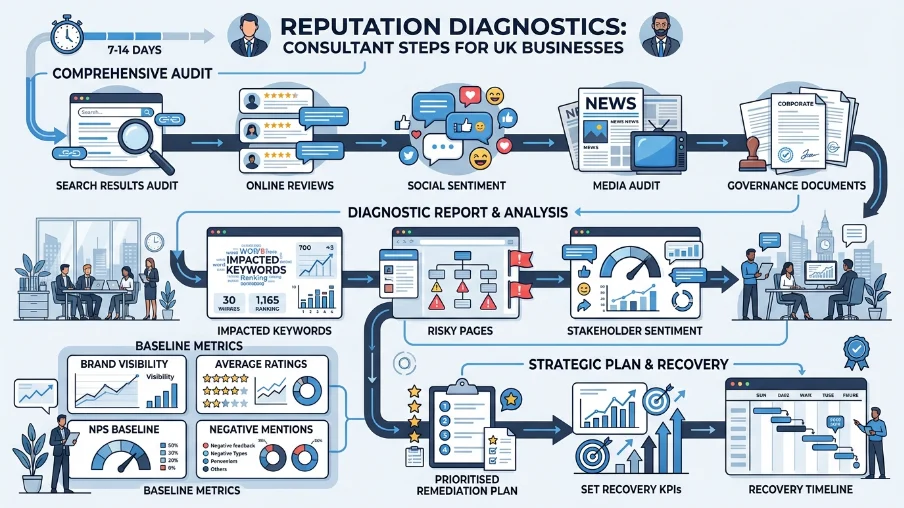
A consultant will audit search results, reviews, social sentiment, media coverage, and governance documents within 7–14 days.
Diagnostics produce a prioritised remediation plan. Audits quantify impacted keywords, identify high-risk pages, and score stakeholder sentiment. Consultants measure baseline metrics: branded search visibility, review averages, NPS, and share of negative mentions. They then set KPIs and timelines for recovery.
What outcomes should a business expect after hiring a consultant?
Expect reduced negative visibility, improved review scores, and clearer crisis protocols within 30–90 days.
Short-term outcomes include takedowns, review responses, and content suppression. Medium-term outcomes include improved organic rankings for branded queries, higher review averages, and restored stakeholder confidence. Consultants deliver dashboards tracking recovery against KPIs.
How does a reputation consultant differ from a full-service agency?
A consultant focuses on diagnosis, strategy, and high-stakes remediation; a full-service agency handles ongoing marketing and execution at scale.
Consultants concentrate on risk assessment, crisis playbooks, and executive counsel. Agencies provide integrated services such as SEO, PPC, and creative production. Choose a consultant for urgent reputation repair and a full-service agency for continuous brand building. For a deeper evaluation, read the MOFU comparison article to weigh trade-offs.
How does Reputation Management for business integrate into recovery plans?
Reputation Management for business combines monitoring, remediation, and content strategies to restore trust and search visibility.
This service validates stakeholder claims, implements corrective content, and enforces review-scoring improvements. It uses structured workflows to resolve complaints, update policy pages, and publish authoritative content. The service measures outcomes using search position, review averages, and conversion recovery.
How should a business measure consultant effectiveness?
Measure effectiveness with clear KPIs: branded search rank, review average, NPS change, and revenue impact within defined time windows.
Set baseline numbers before work begins. Track branded query rank positions weekly. Track review averages monthly. Measure NPS every quarter. Attribute revenue recovery by comparing sales for matched periods. Consultants provide dashboards and evidence for each KPI.
How do consultants interact with legal, PR, and operations teams?
Consultants coordinate with legal for compliant messaging, with PR for media outreach, and with operations for product remediation.
They create centralised communication plans to avoid mixed messages. They authorise public statements after legal review. They assign tasks to operations for root-cause fixes. This cross-functional coordination accelerates recovery and prevents repeat incidents.
Explore our Reputation Management for businesses guides,
Why Online Reputation Matters More for E-commerce Brands
The Complete Guide to Recovering Your Business Reputation After a Crisis
How much does hiring a reputation consultant cost?
Costs range from £3,000–£25,000 for discrete remediation projects and £2,000–£10,000 per month for retained monitoring and response.
Price varies by scope, risk, and required specialists. Crisis engagements require senior counsel and cost more. Retainers cover ongoing monitoring, content creation, and tactical responses. Consultants provide proposals with phased deliverables and success metrics.
A business needs a reputation consultant when reputation signals measurably harm revenue, search visibility, hiring, or regulatory standing. Clear diagnostic steps and rapid coordination with legal and PR restore trust. Clear My Name delivers structured Reputation Management for businesses that audits, remediates, and monitors reputation recovery while aligning with corporate goals.
Frequently Asked Questions
What is Reputation Management for business and how does it work?
Reputation Management for business is a set of actions that monitor, evaluate, and repair a company’s online presence. Clear My Name uses monitoring, review remediation, content creation, and SEO tactics to suppress harmful results, surface authoritative content, and measure recovery with defined KPIs.
How long does it take to see results from reputation management services?
Initial improvements often appear within 30–90 days for review responses and targeted content placement; full search-result recovery typically takes 3–9 months. Clear My Name provides baseline metrics and progress reports so businesses can track changes in branded search visibility and review averages.
How much does Reputation Management for business usually cost?
Pricing varies by scope: one-off crisis remediation typically ranges from mid-four figures to low five figures, while retained monitoring and response commonly cost several thousand per month. Clear My Name issues scoped proposals with timelines, deliverables, and KPI targets for transparent budgeting.
Can online reviews be removed or corrected through reputation management?
Reputation managers can request removals when content violates platform policies and can correct factual errors through verified responses and dispute workflows. Clear My Name documents requests, cites platform policies, and pursues removals or corrections while preserving compliance with legal guidelines.
When should a business hire a reputation management consultant?
Hire a consultant when negative search results affect customer acquisition, review averages fall below acceptable thresholds, or a public incident causes measurable revenue decline. Clear My Name recommends immediate assessment after visible reputation damage to prioritise remediation and limit further harm.