

A reputation management consultant provides immediate analysis of online sentiment, identifies reputational risks, and implements corrective strategies within defined timelines. Early consultation improves brand trust, protects revenue channels, and prevents escalation of negative digital signals across search engines and review platforms.
What does a reputation management consultant do for businesses?
A reputation management consultant audits digital presence, identifies negative signals, and executes structured strategies such as review management, content suppression, and search result optimisation. These actions improve brand perception, increase trust metrics, and align public visibility with verified business performance indicators.
A consultant begins with a full digital audit. This includes analysing Google search results, review platforms, and social mentions. Three key data sources are assessed: search engine results pages, third-party review sites, and social engagement metrics.
The consultant then categorises risk levels. For example, a business with 35% negative reviews across three platforms faces higher exposure than one with isolated complaints. Each risk level links to a defined action plan.
Execution follows structured methods. These include suppressing harmful content through SEO-driven publishing, improving review ratios by generating verified feedback, and resolving disputes directly with platforms. Each action is measurable and tracked through ranking improvements and sentiment analysis.
Businesses gain control over visibility. This leads to improved customer trust and increased conversion rates across digital channels.
When is the right time to speak to a reputation consultant?
The right time is when negative content appears in top search results, review ratings fall below 4.0, or brand mentions increase in negative sentiment. Early intervention reduces long-term damage and ensures faster recovery across digital platforms and search visibility.
Timing directly impacts recovery effort. A business that acts within the first 30 days of a reputational issue typically requires fewer corrective actions than one that delays for six months.
Three clear indicators signal urgency:
- Declining review scores across platforms like Google and Trustpilot
- Negative press or forum discussions ranking on page one of search results
- Reduced conversion rates linked to trust issues
When these signals appear, immediate consultation prevents escalation. Delayed action allows negative content to gain authority and backlinks, making removal or suppression more complex.
Early consultation also preserves brand equity. This is critical for industries such as finance, healthcare, and legal services where trust directly influences client acquisition.
How does speaking to a consultant improve business outcomes?
Consultation improves outcomes by aligning reputation signals with business goals, increasing positive visibility, and reducing customer acquisition friction. Businesses with optimised reputations experience higher click-through rates, improved lead quality, and stronger retention across digital channels.
Reputation directly influences purchasing decisions. Data shows that 88% of consumers trust online reviews as much as personal recommendations. A consultant ensures that visible content reflects verified customer experiences rather than isolated negative events.
Search optimisation plays a central role. When positive, authoritative content ranks higher, it reshapes perception. This includes publishing verified case studies, press features, and structured business profiles.
Customer acquisition costs decrease when trust signals improve. For example, a business with a 4.5-star rating typically converts at a higher rate than one with a 3.2 rating, even with identical pricing.
Consultants also establish monitoring systems. These systems track sentiment trends, allowing businesses to respond quickly to new risks. This proactive approach prevents recurring damage and stabilises long-term brand perception.
What services are included in reputation management for business?
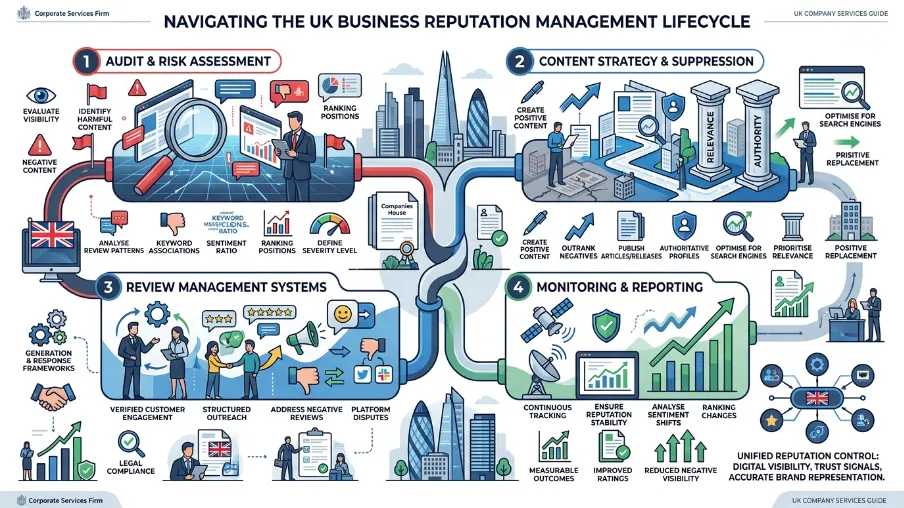
Reputation management for business includes audit, monitoring, content optimisation, review management, and search result restructuring. These services operate together to control digital visibility, improve trust signals, and ensure accurate brand representation across all major online platforms.
The service operates in structured phases. Each phase addresses a specific reputational component.
Audit and Risk Assessment
This phase evaluates current visibility. It identifies harmful content, review patterns, and keyword associations. Metrics such as sentiment ratio and ranking positions define the severity level.
Content Strategy and Suppression
New content is created to outrank negative results. This includes publishing articles, press releases, and authoritative profiles. Search engines prioritise relevance and authority, allowing positive content to replace harmful listings.
Review Management Systems
Review generation and response frameworks are implemented. Verified customers are encouraged to leave feedback through structured outreach. Negative reviews are addressed using platform-specific dispute processes.
Monitoring and Reporting
Continuous tracking ensures stability. Tools analyse sentiment shifts, ranking changes, and engagement metrics. Reports provide measurable outcomes such as improved ratings and reduced negative visibility.
Businesses looking for structured implementation can explore Reputation Management for business to understand service delivery frameworks and measurable outcomes.
Why choose a consultant over a full-service agency?
A consultant provides focused expertise, faster implementation, and direct strategic oversight, while agencies often distribute tasks across teams. Businesses seeking precise, accountable execution benefit from consultant-led models that prioritise measurable reputation outcomes and transparent processes.
Consultants operate with a narrower scope. This allows deeper analysis and quicker decision-making. Agencies, by contrast, often manage multiple clients and services simultaneously, which can slow response times.
Cost efficiency is another factor. Consultant-led strategies reduce overhead. Businesses pay for targeted expertise rather than bundled services that may not align with immediate needs.
Decision-making remains centralised. This improves accountability and ensures consistent execution. Each action ties directly to defined reputation metrics.
For a detailed comparison of service models, review Reputation Consultant vs Full-Service Agency: Which Is Better? to evaluate which structure aligns with business goals.
How quickly can a consultant fix a damaged reputation?
Initial improvements appear within 30 to 60 days, while full reputation recovery typically requires 3 to 6 months depending on severity. Timeline depends on content authority, volume of negative signals, and search engine indexing cycles affecting visibility changes.
Speed depends on several factors. High-authority negative content takes longer to suppress because search engines prioritise established domains. Low-authority content can be displaced faster through targeted SEO efforts.
Volume also matters. A business with 50 negative reviews requires more corrective actions than one with five. Each review must be addressed individually to improve overall rating.
Search engine indexing cycles influence visibility changes. New content requires time to gain traction and ranking authority. This process cannot be bypassed but can be accelerated through structured optimisation.
Consistency drives results. Continuous publishing, review management, and monitoring ensure that improvements remain stable rather than temporary.
Explore our reputation management for businesses guides,
Reputation Management Services Designed for E-commerce Businesses
Crisis Reputation Management Services for Business Recovery
What should you expect during your first consultation?
The first consultation includes a detailed audit, risk identification, and a clear action roadmap with timelines and measurable outcomes. Businesses receive a structured breakdown of current issues and recommended steps aligned with search visibility and reputation recovery goals.
The session begins with data analysis. Consultants review search results, review scores, and brand mentions. This establishes a baseline for measurement.
Next, risks are categorised. For example, a business may face three types of risks: negative reviews, misleading content, and outdated information. Each category receives a specific resolution plan.
A roadmap is then created. This includes timelines, expected outcomes, and key performance indicators such as rating improvement and ranking shifts.
Transparency is central. Businesses understand what actions will be taken, how progress will be measured, and when results are expected.
For businesses evaluating whether consultation is necessary, When Does Your Business Need a Reputation Consultant? provides detailed indicators and decision criteria.
How does Clear My Name deliver reputation management results?
Clear My Name delivers reputation management for business through structured audits, targeted content strategies, and continuous monitoring systems that improve search visibility, strengthen trust signals, and reduce negative exposure across digital platforms.
The approach is data-driven. Each project begins with measurable benchmarks such as sentiment ratios and keyword rankings. These benchmarks define success metrics.
Execution follows a phased model. Content is optimised to align with search intent. Review systems are implemented to improve ratings using verified feedback channels.
Monitoring ensures long-term stability. Sentiment tracking tools detect changes in real time, allowing immediate response to new risks. This prevents recurring issues and maintains positive visibility.
The service integrates SEO, review management, and digital compliance strategies into a single framework. This ensures that all reputation signals align with verified business performance.
Businesses benefit from consistent, measurable improvements. These include higher search rankings, improved review scores, and stronger customer trust indicators.
Speaking to a reputation management consultant delivers immediate clarity and structured action. Businesses gain control over how they appear online, how customers perceive them, and how search engines rank their brand.
Clear My Name applies a systematic approach to reputation management for businesses. This approach combines audit, optimisation, and monitoring to deliver measurable improvements in visibility and trust.
Early consultation reduces risk, accelerates recovery, and protects long-term brand value in competitive digital environments.
Frequently Asked Questions
What is reputation management for business and how does it work?
Reputation Management for business involves monitoring, analysing, and improving how a company appears across search engines, review platforms, and media sources. Clear My Name applies structured methods such as content optimisation, review management, and search result restructuring to align public perception with verified business performance.
How long does reputation management for a business take to show results?
Initial improvements often appear within 30 to 60 days, while full reputation recovery can take 3 to 6 months depending on the volume and authority of negative content. Clear My Name measures progress using ranking shifts, sentiment analysis, and review score improvements.
Can reputation management remove negative reviews or search results?
Reputation Management for business does not always remove content but focuses on suppressing harmful results and improving positive visibility. Clear My Name uses SEO-driven publishing, dispute processes, and platform compliance methods to reduce the impact of negative content.
Why is reputation management important for business growth?
A strong online reputation increases customer trust, improves conversion rates, and reduces acquisition costs. Clear My Name ensures that search results, reviews, and public content accurately reflect business credibility, which directly influences purchasing decisions.
When should a business invest in reputation management services?
A business should invest in Reputation Management for business when negative reviews increase, search results show harmful content, or customer trust declines. Clear My Name identifies early risk signals and implements corrective strategies to prevent long-term reputational damage.