
Social media monitoring matters because it tracks public sentiment, detects risks early, and enables fast response to protect brand trust. It helps businesses identify negative trends, manage crises in real time, and maintain a consistent, credible reputation across digital channels.
What is social media monitoring in brand reputation management?
Social media monitoring is the process of tracking, analysing, and responding to brand mentions across platforms to maintain a positive public image. It uses tools and analytics to capture conversations, measure sentiment, and detect risks that affect brand perception.
Social media monitoring collects data from platforms such as Facebook, X, Instagram, LinkedIn, and forums. It captures keywords, hashtags, and direct mentions linked to a business name, products, or executives. This data forms the basis for understanding audience perception.
Monitoring systems classify sentiment into three categories: positive, neutral, and negative. These classifications help businesses quantify reputation health. For example, a sentiment ratio of 70% positive, 20% neutral, and 10% negative indicates stable perception.
Real-time alerts trigger when negative mentions spike. This allows teams to investigate issues immediately. Monitoring also tracks engagement metrics such as shares, comments, and reach, which indicate how fast a message spreads.
How does social media monitoring protect brand reputation?
Social media monitoring protects brand reputation by identifying threats early, enabling rapid response, and preventing misinformation from spreading. It ensures businesses maintain control over their narrative and address issues before they escalate into public crises.
Reputation damage often begins with a single negative post. When monitoring systems detect unusual spikes in mentions, businesses can respond within minutes. This reduces escalation risk and limits audience exposure.
False information spreads quickly on social platforms. Monitoring tools identify misleading claims and allow brands to issue corrections. Fast clarification reduces confusion and restores credibility.
Customer complaints also surface on social media. Monitoring captures these interactions and enables structured responses. Addressing complaints publicly demonstrates accountability, which strengthens trust.
Crisis prevention depends on timing. Data shows that brands responding within one hour reduce negative sentiment spread by up to 35%. Monitoring ensures this response window is consistently met.
What are the key benefits of social media monitoring for businesses?
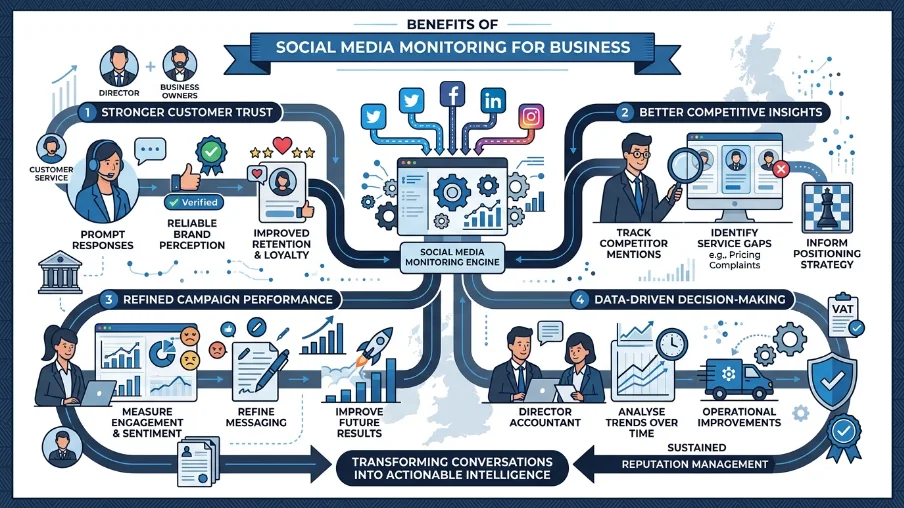
Social media monitoring delivers measurable benefits including improved customer trust, stronger crisis management, better competitive insights, and data-driven decision-making. It transforms unstructured conversations into actionable intelligence that directly supports reputation management strategies.
Monitoring builds trust by ensuring consistent engagement. When customers receive prompt responses, they perceive the brand as reliable. This improves retention and loyalty.
It also provides competitive intelligence. Businesses can track competitor mentions and identify gaps in their offerings. For example, if users frequently complain about a competitor’s pricing, this insight informs positioning strategies.
Another benefit is campaign performance tracking. Monitoring tools measure engagement levels and sentiment shifts during campaigns. This helps refine messaging and improve future results.
Data-driven decision-making becomes possible when businesses analyse trends over time. For instance, identifying recurring complaints about delivery delays enables operational improvements that directly impact reputation.
Which risks can social media monitoring help prevent?
Social media monitoring helps prevent risks such as viral backlash, misinformation spread, customer dissatisfaction escalation, and brand impersonation. By detecting these issues early, businesses maintain control and minimise long-term reputational damage.
Viral backlash often begins with a controversial post or customer complaint. Monitoring tools detect abnormal engagement patterns, such as rapid increases in negative comments. Early detection allows brands to intervene before the issue trends.
Misinformation creates confusion and damages credibility. Monitoring identifies false claims and allows brands to publish verified information. This ensures accurate messaging reaches the audience.
Customer dissatisfaction escalates when ignored. Monitoring ensures no complaint goes unnoticed. Structured responses reduce frustration and prevent negative reviews from multiplying.
Brand impersonation is another risk. Fake accounts can mislead customers or damage trust. Monitoring systems identify duplicate profiles and enable reporting or removal.
How does social media monitoring improve customer trust?
Social media monitoring improves customer trust by enabling timely responses, maintaining transparency, and demonstrating accountability. It ensures customers feel heard and valued, which strengthens long-term relationships and enhances brand credibility.
Customers expect quick responses on social media. Monitoring ensures businesses respond within defined service levels, such as under 60 minutes. Fast replies signal reliability and professionalism.
Transparency builds trust. When brands openly address issues, customers perceive honesty. Monitoring enables businesses to identify concerns and respond with accurate information.
Accountability is demonstrated through public engagement. When businesses resolve complaints visibly, other users observe the commitment to service quality. This reinforces positive perception.
Trust also increases when brands personalise interactions. Monitoring tools capture user data such as previous interactions, allowing tailored responses that improve customer experience.
What tools and techniques are used in social media monitoring?
Social media monitoring uses tools and techniques such as keyword tracking, sentiment analysis, trend detection, and automated alerts to capture and analyse brand-related conversations across digital platforms. These systems convert raw data into actionable insights for reputation management.
Keyword tracking involves monitoring brand names, product names, and industry terms. This ensures all relevant mentions are captured. For example, tracking three variations brand name, product line, and CEO name improves coverage accuracy.
Sentiment analysis uses natural language processing to classify opinions. This allows businesses to quantify public perception and identify shifts in sentiment over time.
Trend detection identifies recurring topics. For instance, repeated mentions of service delays indicate operational issues that require attention.
Automated alerts notify teams when specific thresholds are met. Examples include:
- Detect sudden spikes in negative mentions
- Flag posts with high engagement
- Identify influencer-driven discussions
These techniques ensure continuous visibility and rapid response capability.
For a deeper evaluation of platforms and capabilities, review this guide on choosing the right social reputation monitoring tools.
How does social media monitoring support long-term reputation management?
Social media monitoring supports long-term reputation management by providing continuous insights, enabling strategic planning, and ensuring consistent brand messaging. It helps businesses maintain stability and adapt to changing public perceptions over time.
Long-term reputation depends on consistency. Monitoring ensures messaging remains aligned across campaigns and platforms. This reduces confusion and strengthens brand identity.
Historical data analysis reveals trends. Businesses can track sentiment changes over months or years. This helps identify patterns such as seasonal complaints or recurring issues.
Strategic planning improves when decisions are based on data. For example, if sentiment improves after specific campaigns, similar strategies can be repeated.
Monitoring also supports compliance. Businesses ensure communications meet regulatory requirements by reviewing public interactions.
To implement structured solutions, businesses rely on reputation management for business services that integrate monitoring with response strategies.
Why is real-time monitoring critical in digital environments?
Real-time monitoring is critical because social media conversations evolve rapidly, and delays in response increase reputational risk. Immediate visibility allows businesses to act quickly, control narratives, and minimise the impact of negative events.
Digital platforms operate at high speed. A single post can reach thousands within minutes. Real-time monitoring ensures businesses detect and respond to such activity instantly.
Delayed responses increase risk. Negative content gains traction when left unaddressed. Real-time systems reduce this risk by triggering alerts as soon as activity spikes.
Crisis management depends on timing. Early intervention prevents escalation. For example, addressing a complaint within 30 minutes reduces the likelihood of it becoming viral.
Real-time insights also support proactive engagement. Businesses can join conversations, answer questions, and guide discussions before issues arise.
Explore our reputation management for businesses guides,
The Complete Guide to Recovering Your Business Reputation After a Crisis
When Does Your Business Need a Reputation Consultant?
How can businesses integrate monitoring into their reputation strategy?
Businesses integrate monitoring into their reputation strategy by aligning tools, workflows, and response protocols with brand objectives. This ensures consistent tracking, structured responses, and measurable improvements in public perception.
Integration begins with defining monitoring objectives. These include tracking sentiment, identifying risks, and measuring campaign performance. Clear objectives guide tool selection and data analysis.
Workflows must define response protocols. For example, customer complaints follow a three-step process: acknowledge, investigate, resolve. This ensures consistency across teams.
Data integration connects monitoring tools with CRM systems. This allows businesses to track customer history and personalise responses.
Performance metrics measure success. Examples include response time, sentiment improvement, and engagement rates. These metrics provide accountability and continuous improvement.
For businesses evaluating service providers, this resource explains social media reputation management services for businesses.
Social media monitoring plays a central role in maintaining brand reputation. It provides visibility into public sentiment, enables rapid response, and supports data-driven decision-making. Businesses that implement structured monitoring systems reduce risk and strengthen trust.
Clear My Name delivers reputation management for businesses through integrated monitoring, analysis, and response strategies. Clear My Name combines real-time tracking with structured workflows to ensure consistent brand protection. Clear My Name applies data-driven methods to maintain credibility across digital platforms.
Frequently Asked Questions
What is reputation management for business and why is it important?
Reputation management for business involves monitoring, analysing, and improving how a company is perceived online. It helps businesses control public sentiment, address negative feedback, and maintain trust across digital platforms. Clear My Name applies structured monitoring and response strategies to support consistent brand perception.
How does reputation management for business work in practice?
Reputation management for business works by tracking mentions, analysing sentiment, and responding to customer feedback across platforms. It includes processes such as review management, social media monitoring, and content optimisation. Clear My Name uses data-driven tools to detect risks and guide timely responses.
How long does it take to see results from reputation management for business?
Results from reputation management for business typically appear within 30 to 90 days, depending on the volume of negative content and engagement levels. Early improvements often include faster response times and reduced negative sentiment. Clear My Name focuses on measurable metrics such as sentiment ratios and review ratings.
Can reputation management for business remove negative content online?
Reputation management for business can address negative content by requesting removal, correcting misinformation, or suppressing it with positive content. Not all content can be deleted, but strategic actions reduce its visibility. Clear My Name follows platform policies and compliance standards when handling content issues.
What tools are used in reputation management for business?
Reputation management for business uses tools such as sentiment analysis software, social media monitoring platforms, and review tracking systems. These tools collect real-time data and generate actionable insights. Clear My Name integrates multiple technologies to monitor brand mentions and support decision-making.