

Reputation challenges can cause patient loss, regulatory risk, and legal exposure, but they are manageable with targeted monitoring, prompt responses, and professional reputation management.
What follows explains the specific reputation challenges every medical practice should address, how they impact operations, and clear steps to resolve them.
What reputation challenges do medical practices face?
Medical practices face five core reputation challenges: negative online reviews, patient privacy breaches, misinformation, practitioner misconduct claims, and poor patient experience.
Negative online reviews reduce new patient referrals and lower revenue. Privacy breaches trigger reporting obligations under health data laws and attract fines. Misinformation about treatments creates clinical risk and harms trust. Allegations of misconduct generate regulatory investigations and legal costs. Poor patient experience leads to repeat cancellations and lower retention.
Negative reviews directly affect search visibility and referral traffic. Privacy incidents require incident response, notification, and remediation under data-protection rules. Misinformation spreads on social and local forums, requiring fact-based corrections. Misconduct claims force internal investigations while communications must avoid defamation. Patient experience failures often reflect process gaps in scheduling, follow-up, and communication.
How do negative online reviews harm a medical practice?
Negative reviews lower conversion rates, reduce local search rankings, and deter an average of 58% of prospective patients from booking.
Search engines use review sentiment as a ranking signal for local queries. A practice with a 3.2-star average converts fewer searches into appointments than a practice with 4.6 stars. Prospective patients scan the latest 5–10 reviews; repeated complaints about wait times or staff rudeness create a pattern that stops bookings. Negative reviews also amplify through aggregator sites, increasing exposure.
Responding promptly reduces harm. A standard response protocol verifies the patient relationship, offers an offline resolution path, and documents the interaction. Encourage genuine satisfied patients to leave reviews to rebalance sentiment. Implement follow-up surveys after appointments to capture concerns before they become public reviews.
Read our articles, Why Healthcare Reputation Management Matters and Reputation Management Services for Doctors & Medical Practices.
How should practices respond to patient privacy breaches?
Immediately isolate the breach, notify affected individuals within legal timeframes, and report to regulators if required.
Containment starts with revoking access, isolating affected systems, and preserving logs for forensic analysis. Next, identify the scope: number of records, types of data, and affected individuals. Health data breaches often trigger mandatory reporting to regulators within 72 hours in many jurisdictions. Notify patients with clear, factual information about what happened, steps taken, and recommended protective measures.
Engage legal counsel and an incident response vendor for forensic validation when exposures involve more than 500 records or sensitive clinical notes. Update policies: enforce encrypted storage, multifactor authentication, and role-based access controls. Train staff on phishing recognition and the secure handling of electronic health records.
How does misinformation about treatments spread and how can it be corrected?
Misinformation spreads via social media, forum posts, and third-party content; correct it with authoritative content, verified clinician statements, and platform requests for removal.
False claims often appear as exaggerated outcomes, misapplied research, or unverified patient anecdotes. These items rank in search results and influence decisions. Counter the misinformation by publishing evidence-based content authored or reviewed by clinicians. Use clear citations to peer-reviewed studies and clinical guidelines to validate statements.
Issue clinician commentaries and patient education pages that use plain language and specific data points. When incorrect content appears on third-party platforms, request corrections or flag content under platform policies for medical misinformation. Maintain a content calendar that targets high-traffic queries with updated, optimised pages to capture search intent before misinformation dominates results.
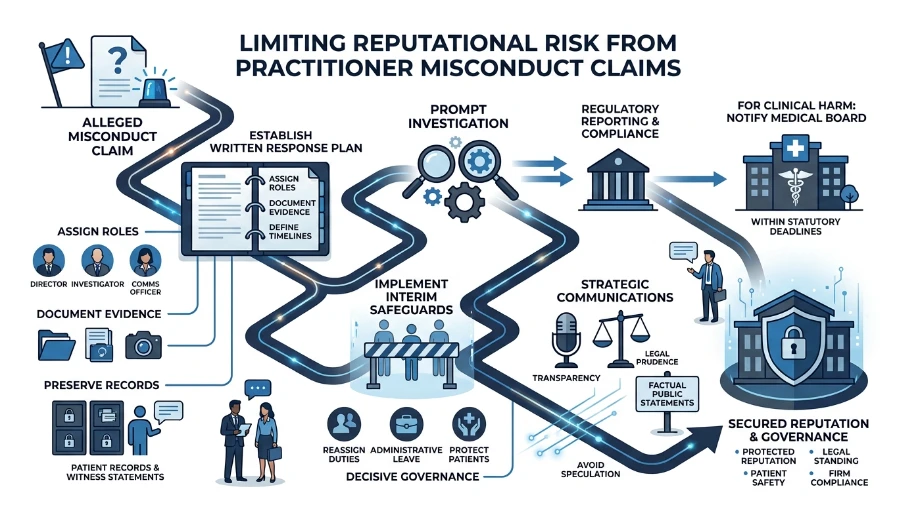
What steps limit reputational risk from practitioner misconduct claims?
Investigate allegations promptly, follow regulatory reporting rules, and coordinate communications to protect patient safety and legal standing.
Establish a written misconduct response plan. The plan assigns roles, documents evidence collection, and specifies timelines for internal and external reporting. For claims involving clinical harm, notify the relevant medical board within statutory deadlines. Preserve patient records and witness statements to support fact-based investigations.
Communications must balance transparency and legal prudence. Provide factual public statements confirming receipt of allegations and the initiation of an investigation. Avoid speculative language. Where possible, offer interim safeguards such as reassigning duties or placing the practitioner on administrative leave to protect patients and demonstrate decisive governance.
How does poor patient experience impact retention and revenue?
Poor patient experience increases cancellations, lowers lifetime patient value, and reduces referral rates by measurable percentages.
For example, a 10% increase in appointment wait time correlates with a 6–9% rise in no-shows and cancellations. Rude front-desk interactions reduce Net Promoter Score and decrease word-of-mouth referrals. Clinical outcomes that lack clear follow-up degrade perceived quality and repeat visits.
Improve experience by mapping the patient journey from booking to post-visit follow-up. Implement automated appointment reminders, streamline in-practice check-in, and train staff in empathetic communication. Measure satisfaction with short post-visit surveys and set monthly targets for response times and resolution rates.
What monitoring and detection systems are necessary?
Deploy continuous online monitoring, internal complaint tracking, and periodic reputation audits to detect issues within 48–72 hours.
Online monitoring tools track mentions across search engines, review sites, and social platforms. Set alerts for brand name, practitioner names, and key treatment terms. Internally, log patient complaints with timestamps, outcomes, and escalation status. Conduct reputation audits quarterly to review review sentiment, response timeliness, and content accuracy.
Combine human review with automated tools to triage issues. Prioritise items that mention clinical harm, regulatory keywords, or legal language. Maintain a dashboard that shows average review rating, unresolved complaints, and recent privacy incidents for leadership oversight.
How do legal and regulatory frameworks affect reputation management?
Health data protection, advertising regulations, and professional conduct rules constrain communications and require documented compliance.
Privacy law dictates notification procedures for breaches and restricts what patient information can be disclosed publicly. Advertising rules limit claims about outcomes and require substantiation for treatment success rates. Professional conduct codes govern statements about investigations and disciplinary actions.
Coordinate compliance, legal, and communications teams when drafting public responses. Keep records of all external statements, patient notifications, and corrective actions to demonstrate due diligence during regulatory reviews.
Explore our Reputation Management for business guides,
What Affects the Timeline of Reputation Recovery?
Why Businesses Need Both Local SEO and Reputation Management
What practical processes reduce future reputation incidents?
Adopt prevention measures: staff training, verified patient feedback loops, content governance, and a tested incident response playbook.
Train clinical and administrative staff quarterly on privacy, communication, and complaint handling. Design feedback loops that capture issues early: post-visit surveys, hotline numbers, and secure messaging. Implement content governance with clinical sign-off for all medical information. Test the incident response playbook annually with tabletop exercises that simulate data breaches and high-profile complaints.
These processes reduce response time and limit reputational damage. They also provide documentation that regulators and insurers find favourable during reviews.
Reputation challenges for medical practices are specific and manageable. Address negative reviews, privacy breaches, misinformation, misconduct claims, and poor patient experience with structured detection, evidence-based communications, and legally compliant processes. Clear My Name provides targeted reputation management for business that integrates monitoring, incident response, and content governance to protect clinician credibility and patient trust.
Frequently Asked Questions
What is Reputation Management for business and how does it work?
Reputation Management for business monitors and improves a company’s public perception by tracking online mentions, managing reviews, and publishing authoritative content. Clear My Name combines continuous monitoring, review-response protocols, and content correction to restore accurate search results and customer trust.
How long does it take for Reputation Management for business to improve search results?
Initial improvements in local search and review sentiment often appear within 4–8 weeks after remediation and content updates. Clear My Name reports measurable ranking and review-score gains when monitoring, review acquisition, and content optimisation run continuously.
Can Reputation Management for business remove false or defamatory content?
Reputation Management for business identifies false content and pursues takedowns, corrections, or legal escalation where appropriate, but removal depends on platform policies and jurisdiction. Clear My Name documents violations, files platform removal requests, and coordinates with counsel when statutory remedies are available.
How much does Reputation Management for business cost for small to mid-sized firms?
Costs vary by scope, typically ranging from monthly monitoring plans to project-based remediation; small firms often start with lower-tier monthly packages while complex recovery projects require larger one-off budgets. Clear My Name assesses site footprint, volume of negative content, and required services before delivering a tailored quote.
What metrics show success for Reputation Management for business?
Key metrics include average review rating, volume of positive reviews, share of first-page search results controlled, and response time to customer complaints. Clear My Name tracks these KPIs alongside organic visibility and sentiment trends to provide evidence-based progress reports.