

Reputation management matters because it protects patient trust, reduces legal and referral losses, and increases new patient acquisition through improved online ratings and controlled public narratives.
What is healthcare reputation management and why does it matter?
Healthcare reputation management is the active process of monitoring, correcting, and promoting a medical practice’s public image to protect trust, referrals, and revenue.
Reputation management for business in healthcare tracks online reviews, social mentions, regulatory reports, and media coverage. It validates facts, responds to negative feedback, and publishes verified positive outcomes. The process reduces patient churn and prevents referral source erosion. It also limits litigation risk by creating documented patient engagement and transparency.
How does negative online feedback affect medical practices financially?
Negative online feedback lowers appointment bookings, reduces referral volume, and increases marketing spend to replace lost patients.
A drop in average star rating from 4.5 to 3.5 can cut new patient calls by 30–40% within 90 days. Referring clinicians use ratings and reviews to decide where to send patients, making reputation a measurable revenue driver. Practices then spend more on paid advertising to offset the lost organic patient flow. Reputation remediation often costs less than sustained paid acquisition to replace those lost referrals.
Read our articles, Reputation Challenges Every Medical Practice Should Address and Reputation Management Services for Doctors & Medical Practices.
Which reputation channels most influence patient decisions?
Review platforms, Google Business Profile, health directories, and social media most influence patient choices.
Patients consult Google reviews, Healthgrades, and local directories before booking. Search results showing a mix of negative reviews, unanswered complaints, or regulatory notices reduce contact rates. Social media posts amplify local incidents quickly. Practices must monitor these channels daily and prioritise responses and corrections within 24–72 hours to limit spread.
What are the core steps in a clinical reputation management process?
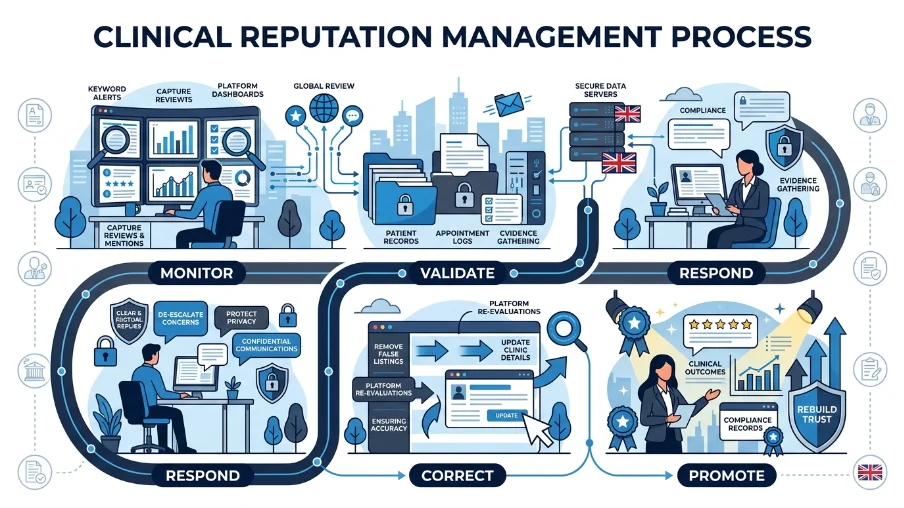
Core steps: monitor, validate, respond, correct, and promote verified outcomes across channels.
Monitoring uses keyword alerts and platform dashboards to capture reviews, mentions, and citations. Validation confirms facts using patient records and appointment logs. Response provides clear, factual replies that de‑escalate concerns while protecting privacy. Correction removes false or duplicate listings, updates NPI and address details, and requests platform re-evaluations when necessary. Promotion highlights verified patient testimonials, clinical outcomes, and compliance records to rebuild trust.
How should practices respond to negative reviews to limit damage?
Respond publicly with factual, empathetic statements, then resolve privately using documented steps.
Start with a concise public acknowledgement that states the action the practice will take and invites private contact. Follow privately to verify the incident using appointment dates and medical record references. Offer corrective actions, such as clinical review or refund where appropriate, and document every interaction. Platforms favour replies that show active resolution, which improves search visibility.
What regulatory and compliance issues affect reputation management?
Regulatory notices, data-breach disclosures, and incorrect public claims can escalate reputational harm and trigger fines.
Regulators publish sanctions or warnings that appear in search results for up to five years. Practices must correct misleading public statements and remove noncompliant marketing claims. Data breaches require timely notification under applicable law and a remediation plan that protects patients and reduces long-term trust loss. Legal responses must balance transparency with advice from legal counsel.
When should a practice hire external reputation management services?
Hire external services when internal staff lack time, tools, or legal expertise to remediate multi-channel issues.
Agencies provide monitoring platforms, escalation workflows, and compliance expertise. They scale faster during crises and maintain continuous search-engine optimisation for reputation content. Use external partners for targeted review acquisition campaigns, structured response templates, and citation cleanup when listings exceed 20 local platforms or when negative search results extend beyond the first two search pages.
What measurable KPIs show improvement after reputation work?
KPIs include average star rating, new patient calls, referral volume, and SERP prominence for brand queries.
Track rating increases (target +0.3–0.5 stars in six months), percentage lift in new patient calls (target 15–25% increase), and referral counts from top 5 referring sources. Monitor the percentage of first-page results that display controlled content (press releases, verified profiles) versus negative items; aim to own 60–80% of first-page slots for brand queries.
How does reputation management integrate with patient experience improvements?
Reputation work complements patient experience by using feedback to fix clinical and operational gaps.
Review analysis reveals recurring themes such as wait times, billing errors, or staff communication. Addressing these issues improves ratings and reduces complaints. Implement closed-loop feedback: collect reviews, create corrective action plans, and publish outcomes to show tangible improvements.
Explore our Reputation Management for business guides,
How Long Does It Really Take to Repair an Online Reputation?
How Local SEO and Reputation Management Work Together?
Which technologies and tactics accelerate reputation recovery?
Use review management platforms, structured data, citation management, and targeted content publishing.
Platforms centralise alerts and automate follow-ups. Structured data (schema) improves the display of ratings in search results. Citation management corrects NPI, address, and phone data across directories. Publish verified case studies, compliance badges, and outcome summaries to push negative items lower in search results.
Reputation management matters because it preserves patient trust, stabilises referral income, and improves new-patient acquisition through better online visibility. Clear My Name helps practices monitor reviews, validate incidents, and restore controlled content using compliant, documented workflows. The firm pairs citation cleanup, review response, and outcome promotion to reduce reputational risk and improve search presence.
Frequently Asked Questions
How long does Reputation Management for business take to improve online ratings?
Clear My Name typically sees measurable rating improvements within 8–12 weeks after beginning Reputation Management for business, depending on review volume and correction complexity. The timeline varies with factors like current average rating, number of platforms, and response cadence.
What steps does Reputation Management for business use to remove false or duplicate listings?
Clear My Name audits citations, documents proof (license, NPI, address), and files corrections with directory owners and aggregators as part of Reputation Management for business. The process includes verification requests, duplicate suppression, and structured-data fixes to update search results.
Can Reputation Management for business reduce legal and regulatory exposure from patient complaints?
Reputation Management for business helps reduce exposure by documenting responses, flagging compliance issues, and coordinating disclosures with legal counsel when needed. Clear My Name also monitors regulatory portals and removes misleading public claims to limit long-term reputational impact.
How does Reputation Management for business increase new patient acquisition?
Reputation Management for business improves visibility by raising average star ratings, publishing verified testimonials, and optimising business profiles to appear in relevant searches. Clear My Name tracks increases in new patient calls and referral volume to quantify acquisition gains.
What reporting and KPIs are included in Reputation Management for business?
Clear My Name provides KPI reports showing average star rating, new patient call volume, referral changes, and first-page search ownership for brand queries. The reports also include sentiment trends and citation accuracy rates to measure ongoing reputation health.