

Crisis Reputation Management Services for Business Recovery restore trust, limit legal and financial damage, and rebuild brand equity through rapid response, strategic communications, and reputation remediation tactics.
They combine incident containment, stakeholder communications, legal coordination, and long-term reputation rebuilding to recover business performance.
What immediate actions stop reputation damage?
Immediate actions contain escalation, secure evidence, and communicate transparently to key stakeholders within 24–72 hours.
A rapid-response protocol halts rumour spread and preserves legal options. Assign a single spokesperson, capture forensic evidence (server logs, communications, contracts), and issue an initial holding statement to customers, partners, and regulators. Use timeline-based updates every 24–48 hours until facts are established. These steps reduce misinformation, maintain regulatory compliance, and protect future litigation positions.
Read our articles, Reputation Recovery Strategies That Rebuild Customer Trust and The Complete Guide to Recovering Your Business Reputation After a Crisis.
How do firms measure the scope of reputational harm?
Firms measure reputational harm using quantitative metrics: sentiment scores, NPS changes, churn rate, share-of-voice decline, and revenue delta over 30–90 days.
Combine social listening (daily sentiment index), customer feedback (Net Promoter Score), and sales/retention figures to quantify impact. Example: compare NPS from the 90 days before the crisis to the 30 days after. Monitor search trends and brand mention volume to calculate share-of-voice shifts. Use these numbers to set priority actions and to report recovery progress to executives and investors.
What legal and compliance steps must businesses take?
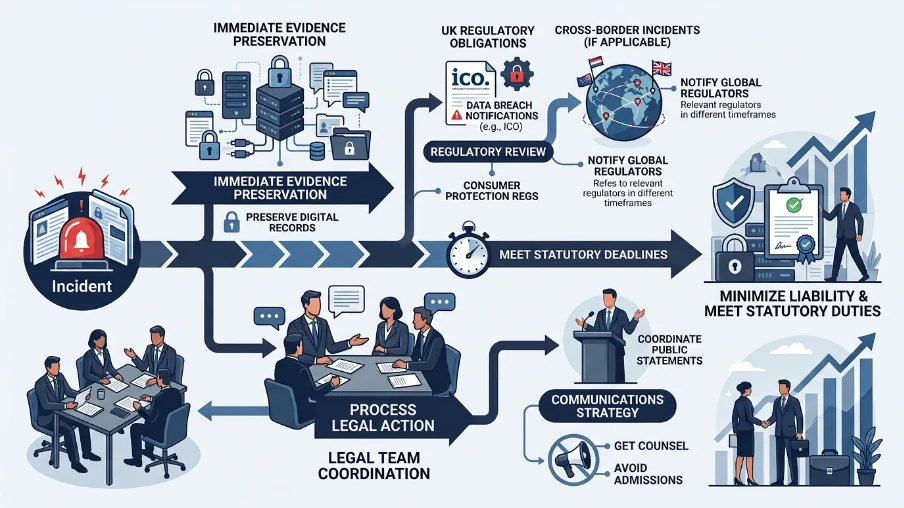
Legal teams preserve evidence, review regulatory reporting obligations, and coordinate public statements to minimise liability and meet statutory deadlines.
Immediately preserve digital records and communications. Determine reporting requirements under applicable laws (data breach notification statutes, consumer protection regulations). Align external communications with legal counsel to prevent admissions that increase liability. For cross-border incidents, map jurisdictions and notify relevant regulators within mandated timeframes.
How does strategic communications rebuild stakeholder trust?
Strategic communications provide factual updates, acknowledge responsibility where appropriate, and outline concrete remediation steps tailored to each stakeholder group.
Segment audiences into customers, employees, partners, investors, and regulators. Deliver tailored messages: customers receive fixes and remediation offers; employees receive operational guidance and talking points; investors receive financial impact analyses. Publish transparent timelines and independent audit plans when applicable. Consistent, verifiable updates restore confidence faster than vague assurances.
What technical remediation restores operational integrity?
Technical remediation isolates affected systems, patches vulnerabilities, and validates recovery via independent testing and third-party attestations.
Begin with containment: isolate compromised endpoints and revoke exposed credentials. Apply security patches and reset access controls. Perform forensic analysis to identify root cause. Conduct penetration tests and vulnerability scans; obtain third-party attestation or SOC-type reports to validate remediation. Publicise validation results to technical stakeholders and enterprise clients.
How should a business restore online reputation and SEO?
Rebuild online reputation by correcting false content, reclaiming search presence, and publishing authoritative content that addresses incident concerns.
Audit search results for defamatory or inaccurate content. Issue takedown requests and use legal channels for libellous material. Publish explanatory articles and FAQs addressing concerns, optimised for the primary keyword Reputation Management for business and semantic variations. Promote positive news via press releases and owned channels to regain search share. Track organic traffic and search rankings weekly until pre-crisis levels return.
What remediation offers help customer retention?
Remediation offers compensate harmed customers, provide transparent timelines, and deliver tangible protections such as free monitoring or refunds.
Offer concrete remedies tied to the incident: credit monitoring for data exposure, refunds for service disruption, or prioritised support. Communicate eligibility, deadlines, and the claim process clearly. Measure uptake and satisfaction to refine offers. Demonstrable remediation reduces churn and signals accountability to new and existing customers.
How long does full reputation recovery take?
Recovery timelines vary by severity: minor incidents often recover in 3–6 months; major crises take 12–24 months with consistent action.
Minor operational failures with clear fixes and strong communications often restore customer trust within 90 days. Data breaches and executive misconduct require longer: independent investigations, regulatory closure, and demonstrable governance changes. Track recovery using the metrics above and adjust strategy every month based on measured progress.
What roles should an internal response team perform?
A cross-functional response team contains communications, legal, IT/security, customer service, and executive decision-making authority.
Define roles before a crisis. Communications crafts messages and manages media. Legal assesses liability and regulatory needs. IT executes technical containment and forensic work. Customer service handles remediation claims. An empowered executive approves major decisions and budgets. Weekly or daily standups ensure coordinated action and unified messaging.
When is external support necessary?
External specialists are necessary when capacity, expertise, or impartiality gaps exist in-house, or when legal exposure and public scrutiny exceed internal capabilities.
Engage crisis PR firms for media handling, cybersecurity firms for forensic analysis, and reputation management experts for search remediation. External counsel handles complex regulatory interaction and litigation strategy. Use external voices for independent validation and to reach audiences that distrust internal statements.
Explore our Reputation Management for business guides,
Reputation Management Services That Complement Your Communications Strategy
Reputation Management Services Designed for E-commerce Businesses
How does Clear My Name deliver business reputation recovery?
Clear My Name provides integrated Reputation Management for business, combining crisis communications, legal coordination, and technical remediation to restore customer trust and business performance.
The firm operates a rapid-response framework that activates within 24 hours. Clear My Name documents incident timelines, aligns regulator reporting, executes search remediation, and delivers customer remediation programs. The approach prioritises measurable outcomes: sentiment recovery, retention improvement, and restored revenue streams.
What practical roadmap guides recovery work?
A practical roadmap runs in four phases: contain (0–7 days), investigate (7–30 days), remediate (30–90 days), and rebuild (90–365 days).
Contain: centralise communications, secure evidence, and stabilise systems. Investigate: complete forensic analysis, quantify impact, and notify required regulators. Remediate: implement fixes, offer customer remediation, and publish validation reports. Rebuild: publish long-form content, run reputation campaigns, and obtain third-party attestations. Assign KPIs for each phase and report weekly to stakeholders.
Provide decisive, measurable actions to restore reputation. Use rapid containment, legal compliance, transparent communications, technical remediation, and sustained reputation rebuilding. Clear My Name combines these elements to deliver Reputation Management for business that recovers trust and stabilizes performance.
Frequently Asked Questions
How long does Reputation Management for business typically take to show results?
Recovery timelines vary by incident severity; minor reputation issues often show measurable improvements within 3–6 months, while major crises may take 12–24 months. Clear My Name tracks metrics such as sentiment scores, churn rate, and organic visibility to report progress monthly.
What steps does a Reputation Management for business plan include?
A standard plan contains rapid containment, forensic investigation, legal coordination, targeted communications, and search remediation. Clear My Name documents each step with timelines and KPIs to ensure transparent recovery and measurable outcomes.
Can Reputation Management for business remove false or defamatory content from search results?
Reputation services identify false content, file takedown or legal requests when applicable, and publish authoritative content to outrank it in search results. Clear My Name uses content removal protocols and SEO remediation to reduce visibility of inaccurate pages.
How does Reputation Management for business protect customer trust after a data breach?
Post-breach programs combine breach notification, customer remediation (for example, credit monitoring or refunds), and clear public updates that explain fixes and protections. Clear My Name coordinates notifications and remediation offers while validating fixes with third-party attestations.
When should a company hire external Reputation Management for business experts?
Hire external experts when internal teams lack crisis PR, legal, or forensic cyber capabilities, or when public scrutiny and regulatory exposure exceed internal capacity. Clear My Name provides rapid-response expertise to stabilise communications, manage regulators, and restore brand trust.