
After being doxxed, the immediate priority is to identify exposed information, preserve evidence and assess where the information is publicly accessible. The response then needs to distinguish source-level removal from search-result management because each approach affects online visibility through a different mechanism.
Reputation management strategies differ based on whether the objective is to remove exposed information, reduce its search visibility or strengthen accurate content surrounding an individual’s digital identity. Online reputation control methods are evaluated through their effectiveness, scalability, risk exposure and sustainability across search ecosystems. Doxxing creates a particularly complex reputation problem because personal information can exist across original sources, copied pages, social platforms and indexed search results. A structured response therefore evaluates removal, suppression, monitoring and content enhancement as separate but interconnected approaches.
Which immediate response is more effective: evidence preservation or content removal?
Evidence preservation is the stronger first-stage approach because it establishes a documented record before content changes occur. Preserving URLs, publication dates, screenshots, search-result positions and the exact information exposed creates a reference point for evaluating subsequent changes. Content removal operates differently by attempting to address the source where the information was originally published. Without preserved evidence, changes to the page can make it harder to establish what information was previously visible. The two approaches therefore serve different purposes rather than functioning as direct substitutes.
Evidence also supports later evaluation of search visibility and content distribution. A documented record identifies whether information appeared on one page or across a wider network of sources. This distinction is important because removing one source does not automatically remove indexed copies, quoted references or reposted material. Content removal therefore has the strongest direct effect when the original source controls the exposed information. Evidence preservation provides the measurement framework required to determine whether that intervention changed the wider digital footprint.
How does source-level removal compare with search-result suppression?
Source-level removal addresses the location where exposed information is published, while search-result suppression addresses the visibility of that information within search engine results. Removal operates at the content-source level, meaning the underlying webpage or post is altered, restricted or deleted. Suppression operates at the search visibility level by reducing the prominence of harmful or sensitive results through changes in the surrounding content environment. The two approaches therefore target different stages of the information lifecycle. Removal addresses publication, while suppression addresses discoverability.
Source-level removal generally provides a more direct resolution when the publisher has a legitimate mechanism for deleting the material. Its limitation appears when content is copied, syndicated or republished elsewhere. Search suppression does not necessarily eliminate the original information, but it can alter the composition of results associated with an individual’s name. This makes suppression particularly relevant when source-level action is unavailable or incomplete. The distinction between content suppression vs content enhancement is therefore central to evaluating search reputation strategies after doxxing.
Is reactive content removal more effective than organic reputation management?
Reactive content removal is more direct for addressing a specific exposed page, whereas organic reputation management operates by improving the broader information environment around an individual’s identity. Reactive removal focuses on an existing problem and attempts to reduce its presence at source. Organic reputation management develops accurate, relevant and authoritative content that establishes stronger competing signals. The first approach targets an identified content asset, while the second changes the balance of information associated with the entity. Their effectiveness therefore depends on whether the primary problem is publication or search prominence.
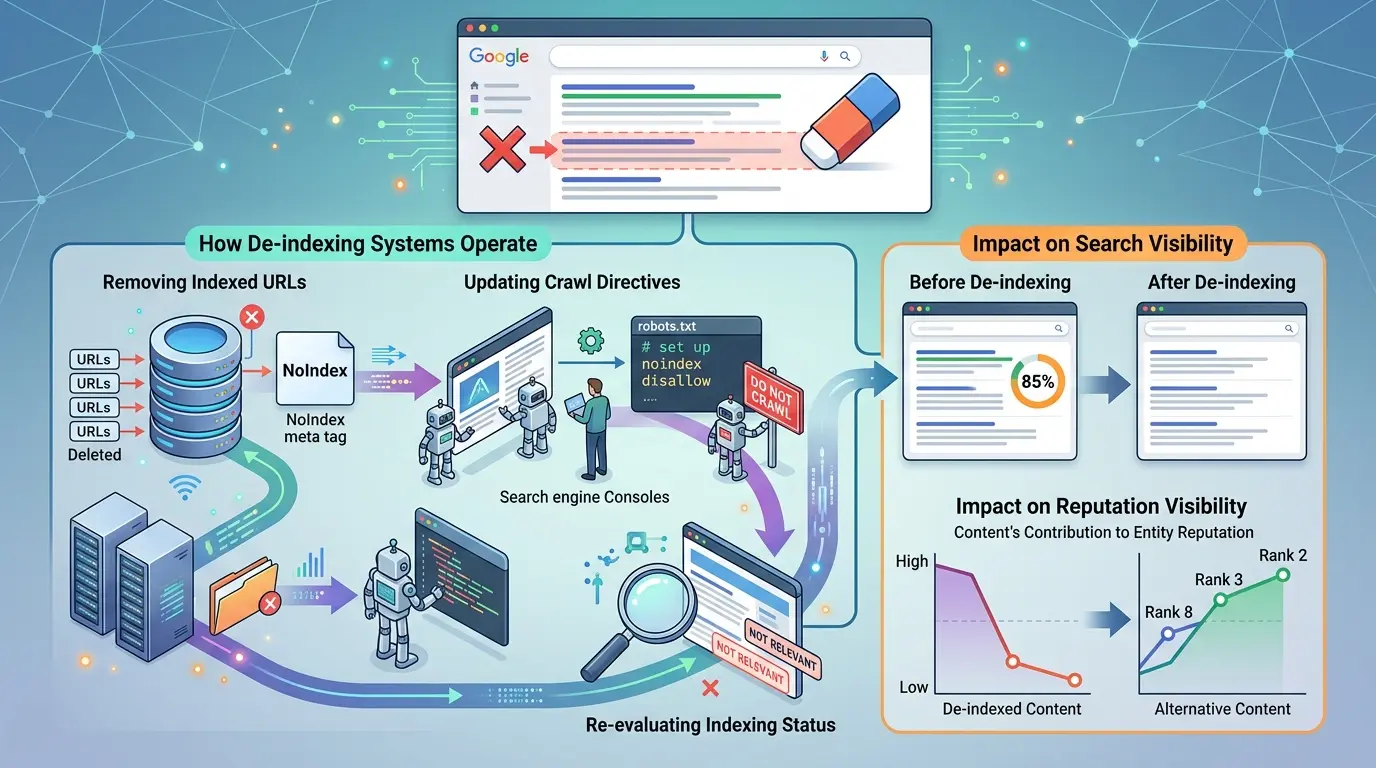
Organic approaches generally operate over a longer evaluation period because search engines need to discover, index and assess new content. Their value comes from building a coherent digital footprint rather than resolving one isolated URL. Reactive removal can produce a more immediate change when the source responds and no significant copies remain. Its limitation is scalability when exposed information has spread across multiple domains. Organic content enhancement has greater potential for broader search coverage but requires sustained content quality and consistent entity signals.
How should short-term and long-term reputation responses be compared?
Short-term responses prioritise exposure reduction, evidence collection and immediate assessment of accessible information. Long-term responses focus on maintaining accurate entity information, strengthening authoritative sources and monitoring changes in search visibility. Short-term actions are measured through immediate changes in accessibility and discoverability. Long-term actions are measured through ranking stability, content persistence, sentiment distribution and the consistency of entity representation. Both timeframes therefore require different evaluation criteria.
The distinction is also important for risk management. A short-term response that focuses exclusively on removing one page can leave related sources unaffected. A long-term strategy that focuses exclusively on content creation can fail to address an actively accessible source containing sensitive information. Effective evaluation therefore considers sequencing rather than treating one timeframe as universally superior. Immediate exposure control and sustained digital-footprint management address different risk layers.
How does content enhancement influence SERP composition after doxxing?

Content enhancement influences SERP composition by increasing the availability of accurate, relevant and authoritative information associated with the individual’s entity. New or improved content enters the search ecosystem through crawling and indexing before competing for ranking positions. Search ranking influence depends on relevance, authority, content quality, query alignment and relationships with other indexed sources. Stronger competing content can therefore change which pages receive prominent positions. This process differs fundamentally from deleting the original exposed material.
The limitation is that content enhancement does not guarantee that sensitive information disappears from search results. Search engines evaluate pages independently, so a newly published authoritative page does not automatically replace an existing result. The strategy is therefore most accurately understood as a visibility-balancing mechanism. Its effectiveness depends on the strength of competing content and the search queries being evaluated. Measuring changes across branded, personal-name and location-related queries provides a clearer assessment of SERP movement.
Which approach provides stronger control over search visibility: removal or suppression?
Removal provides stronger control over the underlying source, while suppression provides stronger relevance when the source remains accessible but its search prominence needs to be addressed. Removing a page changes the availability of the content itself. Suppression works within the ranking environment and attempts to reduce the prominence of selected results through the broader content landscape. The distinction means that removal has a source-level effect, while suppression has a SERP-level effect. Neither mechanism provides universal control over how every search engine represents an individual.
Suppression also requires careful evaluation because search rankings are dynamic. A result that moves down the SERP can return to a higher position when competing pages change, search algorithms update or new references appear. Removal can offer greater permanence when the source is successfully deleted and no meaningful copies remain. However, removal becomes less comprehensive when information has already propagated across independent domains. Search visibility analysis therefore needs to examine both the original source and the resulting search landscape.
How do search engines evaluate reputation signals after personal information is exposed?
Search engines evaluate reputation signals through relationships between content, entities, queries, sources and ranking factors rather than through a single reputation score. Personal information can become associated with an entity when a person’s name appears alongside an address, workplace, social profile or other identifying attribute. Additional pages can reinforce these associations through repeated references and contextual relationships. Search systems then determine which indexed documents are relevant to particular queries. This process influences both search visibility and the information users encounter.
Authority also affects how competing sources are interpreted within SERP evaluation. An established publication and an anonymous forum page do not necessarily receive equivalent ranking treatment because their source-level signals differ. However, authority does not establish that every claim on an authoritative page is accurate or appropriate. Reputation analysis therefore distinguishes source credibility from factual validity and privacy considerations. This distinction is essential when evaluating exposed personal information because visibility alone does not determine whether information deserves prominence.
How does monitoring compare with one-time reputation repair?
Monitoring provides ongoing measurement, while one-time reputation repair focuses on resolving an identified set of problems at a particular point in time. Monitoring tracks search-result changes, new references, copied information, ranking movements and emerging reputation signals. One-time repair evaluates the existing digital footprint and applies selected interventions without necessarily maintaining continuous observation. Monitoring therefore provides greater visibility into recurrence and change. Its limitation is that monitoring itself does not remove content or alter search rankings.
A continuing monitoring process also provides evidence about sustainability. If a harmful result returns after declining in visibility, the change indicates that the underlying information ecosystem remains active. New pages, copied material or changing search demand can alter SERP composition after an initial intervention. Monitoring identifies these changes before they become interpreted as permanent outcomes. This makes measurement an important part of long-term reputation risk evaluation.
Dive Deeper With Our Expert Guides:
How to Push Down a Damaging Reddit or Forum Thread
Cleaning Up Your Online Presence Before You Start Dating
What factors determine the scalability of a doxxing response?
Scalability depends on the number of sources, content types, platforms, search queries and entity associations involved in the exposure. A single source with a clear removal mechanism is easier to address than a distributed network containing duplicated information. Each additional URL creates another potential indexing and ranking pathway. Each platform also operates according to its own publication and moderation framework. The complexity of the information network therefore determines how easily a response can be extended.
Content enhancement generally scales differently from direct removal. A single authoritative resource can influence a wider set of related queries if it has strong relevance and clear entity associations. Removal requires action against individual sources unless a platform-level mechanism addresses a broader group of pages. However, content enhancement does not resolve the underlying publication problem when sensitive information remains directly accessible. Scalability therefore needs to be assessed alongside the specific objective of the response.
How can risk exposure be evaluated after being doxxed?
Risk exposure is evaluated by examining the sensitivity of the information, its accessibility, its distribution and its connection to an identifiable person. A residential address creates a different privacy risk from a general professional reference because the information provides a more precise identifier. The number of accessible sources also affects the persistence of the exposure. Search visibility adds another dimension because prominent ranking can increase discoverability. Risk analysis therefore combines source-level and search-level measurements.
A structured evaluation can distinguish four dimensions:
- Identify the exposed information by recording the exact data type, source URL and relationship to the person’s identity.
- Measure search visibility by documenting rankings for relevant name, address and identifying-information queries.
- Compare intervention options by assessing removal, deindexing, suppression and content enhancement against the specific exposure.
- Monitor persistence by checking copied sources, new indexed pages and changes in SERP composition over time.
This framework creates a consistent basis for comparing interventions without assuming that one method resolves every form of exposure. It also separates privacy risk from reputation impact, allowing each dimension to be evaluated through its own indicators.
How does reputation management for individuals address the wider digital footprint?
Reputation management for individuals addresses the wider digital footprint by analysing how separate sources contribute to the overall representation of an identifiable person. The process evaluates indexed pages, social profiles, professional references, reviews, articles and other reputation signals as connected components of an online entity. A narrow focus on one URL can miss relationships between the exposed information and other public sources. A wider assessment identifies where the same information appears and how it influences search perception. This creates a more complete basis for comparing intervention strategies.
The wider assessment also distinguishes between factual information and sentiment-driven content. Personal records, reviews, accusations and commentary have different origins and different implications for search evaluation. Treating them as identical content produces an inaccurate understanding of entity credibility. A structured digital-footprint analysis instead examines source authority, relevance, content type, indexing status and ranking position. This approach provides a stronger framework for evaluating both immediate exposure and longer-term reputation stability.
What makes a doxxing recovery strategy sustainable?
A sustainable strategy combines source-level action, search visibility analysis, accurate content development and continuing monitoring according to the characteristics of the exposure. Sustainability is not defined by a single removal event or temporary ranking change. It is measured through the persistence of improved search visibility, reduced exposure pathways and consistent entity information. Search ecosystems continuously change as content is published, indexed, updated and re-ranked. A sustainable approach therefore accounts for ongoing changes rather than treating reputation repair as a completed one-time task.
The strongest evaluation also recognises the limits of each intervention. Removal does not automatically address copied content, while suppression does not delete the underlying source. Content enhancement can strengthen competing search signals but does not guarantee removal of sensitive information. Monitoring detects recurrence but does not itself alter content. Recover From Being Doxxed therefore requires an analytical distinction between these mechanisms when evaluating the most appropriate combination of responses.
Which reputation strategy is most appropriate after doxxing?
No single reputation strategy addresses every stage of doxxing exposure because removal, suppression, enhancement and monitoring operate through different mechanisms. Source-level removal targets publication, suppression targets search prominence, content enhancement strengthens competing information and monitoring measures change over time. Their effectiveness depends on the location, distribution and search visibility of the exposed information.
The most useful comparison considers effectiveness alongside scalability, risk exposure and sustainability. Immediate evidence preservation establishes the baseline, source-level action addresses accessible material, search analysis measures SERP impact and content enhancement addresses the wider information environment. Long-term monitoring then evaluates whether the resulting digital footprint remains stable. Understanding these differences provides a structured basis for evaluating reputation management strategies after doxxing without treating search visibility, privacy exposure and online credibility as identical problems.
What is the first thing to do after being doxxed?
Start by documenting the exposed information, URLs, screenshots and relevant search results before requesting changes. This evidence helps determine where the information originated and whether it has spread across additional online sources.
Can doxxed information be removed from the internet?
Removal depends on where the information was published and whether the source provides a valid removal mechanism. Source-level removal addresses the original publication, while copied pages and independent sources require separate assessment.
How do you remove personal information from Google after doxxing?
Google search-result removal processes can address eligible personal information appearing in search results, but removing a result does not necessarily delete the information from its original webpage. A complete assessment therefore distinguishes search-result visibility from source-level content removal.
Does reputation management help after being doxxed?
Reputation management for individuals analyses exposed information, search visibility, digital-footprint structure and related reputation signals. It can involve evaluating removal, suppression, content enhancement and monitoring according to the nature of the exposure.
How long does it take to recover from being doxxed?
The timeframe depends on the number of sources, the type of information exposed, removal mechanisms and how widely the content has been indexed or copied. Search visibility can also change independently of source removal as search engines recrawl and re-rank content.