

Social media reputation management services for businesses monitor, analyse, and improve how a brand appears across social platforms. These services detect harmful content, manage reviews, respond to public feedback, and implement strategies that protect brand credibility, customer trust, and long-term digital visibility.
How do social media reputation management services work?
These services track brand mentions, analyse sentiment, flag risks, and execute response strategies across platforms like Facebook, LinkedIn, and X. They combine monitoring tools, content moderation, and escalation workflows to maintain a consistent and positive brand perception in real time.
Social media reputation management operates through structured monitoring systems. These systems scan keywords, brand names, and executive identities across multiple platforms. They capture data points such as sentiment score, engagement rate, and content reach.
Advanced platforms use natural language processing to classify mentions into categories. Three core classifications include positive sentiment, negative sentiment, and neutral discussion. This classification helps teams prioritise responses based on risk level.
Response execution follows predefined workflows. For example, negative reviews receive resolution-based replies within defined timeframes such as 2–6 hours. High-risk content, such as defamation or misinformation, triggers escalation protocols.
Businesses also integrate reporting dashboards. These dashboards present metrics such as monthly sentiment trends, response time averages, and issue resolution rates. This allows decision-makers to track performance and refine strategy continuously.
Why do businesses need social media reputation management?
Businesses need these services because 76% of consumers check online presence before making purchasing decisions. A single unresolved negative post can reduce trust, impact conversion rates, and influence search visibility across branded and non-branded queries.
Social media acts as a public feedback loop. Customers share experiences instantly, and this content remains accessible for long periods. When negative feedback accumulates, it affects perceived credibility and reduces engagement rates.
Search engines index social media profiles and posts. Negative discussions often appear on the first page of search results. This creates long-term visibility issues that extend beyond the platform itself.
Reputation management reduces these risks by ensuring consistent monitoring and structured responses. It also supports brand positioning by amplifying positive content such as testimonials, verified reviews, and user-generated content.
Businesses that actively manage reputation see measurable outcomes. For example, brands with response times under 4 hours experience up to 35% higher customer retention compared to those with delayed engagement.
What features define professional reputation management services?
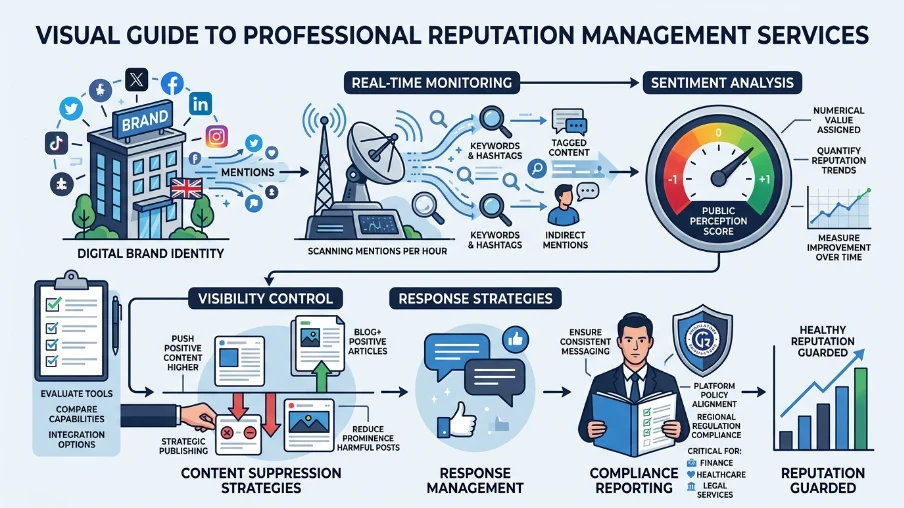
Professional services include real-time monitoring, sentiment analysis, response management, content suppression strategies, and compliance reporting. These features work together to identify risks early, control narratives, and ensure consistent brand messaging across multiple social platforms.
Monitoring tools scan thousands of mentions per hour. These tools detect keywords, hashtags, and tagged content. They also identify indirect mentions where the brand is referenced without tagging.
Sentiment analysis assigns numerical values to public perception. For example, a sentiment score may range from -1 to +1. This allows businesses to quantify reputation trends and measure improvement over time.
Content suppression strategies focus on visibility control. This includes pushing positive content higher in search rankings and reducing the prominence of harmful posts through strategic publishing.
Compliance reporting ensures that responses align with platform policies and regional regulations. This is critical for industries such as finance, healthcare, and legal services.
Businesses evaluating tools often refer to resources like choosing the right social reputation monitoring tools to compare capabilities and integration options before selecting a provider.
How do these services handle negative content and crises?
Reputation services handle negative content by identifying threats early, categorising severity, and deploying structured response protocols. High-risk issues trigger escalation, while moderate issues receive resolution-focused engagement that aims to reduce visibility and restore trust.
Crisis handling begins with detection. Monitoring systems flag unusual spikes in negative mentions or engagement patterns. For example, a 200% increase in negative comments within 24 hours signals a potential issue.
Issues are categorised into three levels:
- Low-risk: minor complaints or isolated feedback
- Medium-risk: repeated complaints or negative trends
- High-risk: viral content, legal claims, or misinformation
Each category has predefined response strategies. High-risk issues involve coordinated responses across PR, legal, and customer support teams. Messaging remains consistent to prevent escalation.
Content removal strategies are also applied when necessary. These include reporting violations, requesting takedowns, and implementing SEO suppression techniques to reduce visibility.
Businesses looking for structured execution often rely on reputation management for business services that combine monitoring, response, and content control into a unified system.
How do social media services impact search engine visibility?
Social media reputation directly influences search rankings because platforms like LinkedIn and X are indexed by Google. Positive engagement improves visibility, while negative content can dominate branded search results and reduce click-through rates by up to 32%.
Search engines prioritise high-engagement content. Social posts with strong interaction signals, such as shares and comments, gain higher visibility in search results.
Negative content often attracts more engagement due to controversy. This increases its ranking potential, making reputation management critical for controlling search narratives.
Businesses use content strategies to influence rankings. These strategies include publishing authoritative posts, promoting verified reviews, and encouraging user-generated content.
Cross-platform consistency also matters. When brand messaging aligns across all channels, search engines recognise authority and relevance. This improves overall domain credibility.
Understanding why social media monitoring matters for brand reputation helps businesses align social activity with search performance goals.
What processes are involved in reputation management for business?
Reputation management for business follows a structured process: monitor, analyse, respond, optimise, and report. Each stage ensures that brand perception is actively managed, risks are minimised, and positive visibility is consistently reinforced across digital channels.
Monitoring captures all relevant data points. This includes mentions, comments, reviews, and shared content. Data collection occurs continuously to ensure real-time visibility.
Analysis converts raw data into actionable insights. Metrics such as sentiment trends, engagement ratios, and issue frequency provide a clear understanding of brand perception.
Response execution addresses issues directly. This includes replying to comments, resolving complaints, and engaging with positive feedback to strengthen relationships.
Optimisation focuses on improving future performance. Strategies include refining messaging, adjusting response templates, and enhancing content quality.
Reporting provides measurable outcomes. Monthly reports often include metrics such as:
- Sentiment improvement percentage
- Average response time
- Issue resolution rate
- Engagement growth rate
Businesses that implement these processes through reputation management for business services achieve more consistent and measurable results.
Explore our reputation management for business guides,
Crisis Reputation Management Services for Business Recovery
Speak to a Reputation Management Consultant Today
How do businesses measure success in social media reputation management?
Success is measured through metrics such as sentiment score improvement, response time reduction, engagement growth, and decrease in negative mentions. These indicators provide quantifiable evidence of improved brand perception and customer trust over time.
Sentiment score is a primary indicator. A shift from 0.2 to 0.6 reflects a significant improvement in public perception. This metric is tracked monthly to identify trends.
Response time directly impacts customer satisfaction. Businesses that reduce response time from 12 hours to 3 hours often see increased engagement and improved review ratings.
Engagement metrics include likes, shares, and comments. Higher engagement signals stronger audience connection and improved brand visibility.
Negative mention reduction is another key metric. A 25% decrease in negative mentions over a quarter indicates effective issue resolution and content control.
These metrics allow businesses to evaluate ROI and adjust strategies based on performance data.
Social media reputation management services provide a structured approach to controlling brand perception across digital platforms. They combine monitoring, analysis, and response strategies to manage risks and improve visibility.
Clear My Name delivers reputation management for business by integrating real-time monitoring, structured response systems, and search visibility optimisation. This approach ensures consistent brand credibility, measurable performance improvements, and long-term reputation stability.
Frequently Asked Questions
What is included in reputation management for business services?
Reputation management for business includes social media monitoring, sentiment analysis, review management, and content response strategies. Clear My Name applies structured workflows to detect risks, manage public feedback, and maintain consistent brand perception across digital platforms.
How quickly can reputation management services improve online perception?
Measurable improvements often appear within 30 to 90 days, depending on issue severity and content volume. Reputation management for business focuses on reducing negative mentions, improving response times, and increasing positive engagement signals over time.
How do companies handle negative social media comments effectively?
Businesses handle negative comments by identifying sentiment, categorising risk levels, and responding with resolution-focused messaging. Clear My Name uses escalation protocols and moderation strategies to reduce visibility of harmful content and restore trust.
Why is social media monitoring important for business reputation?
Social media monitoring identifies brand mentions, tracks sentiment trends, and detects potential risks in real time. Reputation management for business relies on continuous monitoring to prevent issues from escalating and to protect search visibility.
Can reputation management services influence search engine results?
Yes, social media activity directly impacts search rankings because indexed content affects brand visibility. Clear My Name improves search presence by promoting positive content, managing engagement signals, and suppressing negative results through strategic reputation management for business.