
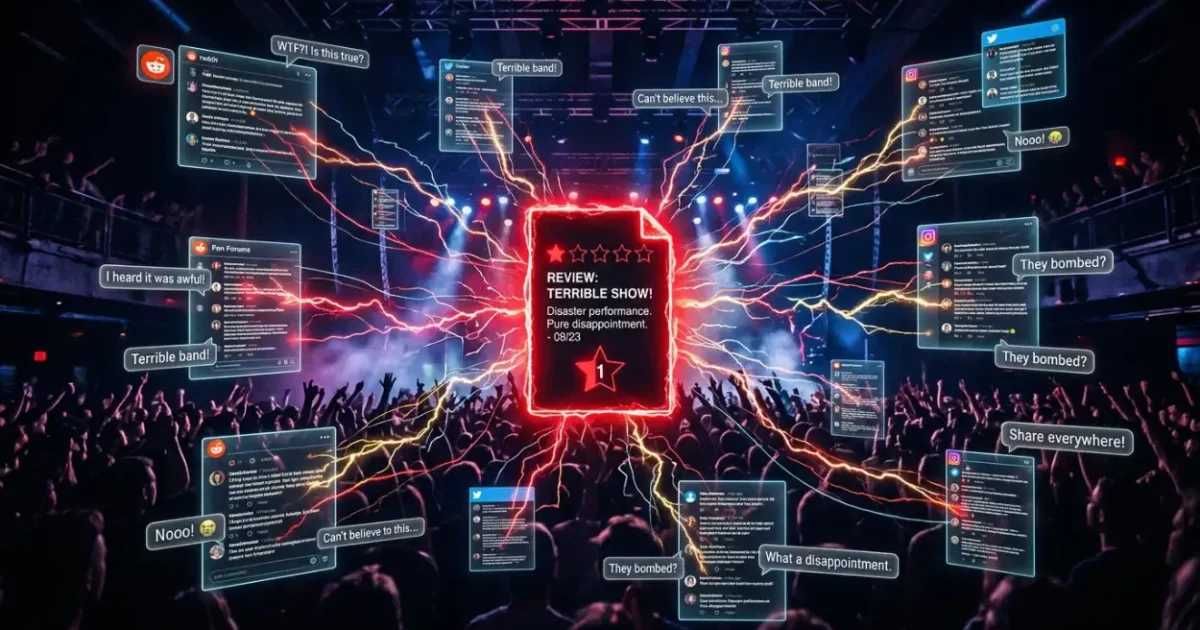
A single bad concert review spreads across fan forums when its content is repeatedly shared, indexed, discussed and connected to existing reputation signals. Reputation management is the process of monitoring and analysing information that shapes how an individual or entity is perceived across digital environments.
Online reputation refers to the collective interpretation of publicly available information associated with an artist, performer or music entity. A concert review becomes part of this digital footprint when it is published, indexed by search engines, referenced by other users or incorporated into wider discussions. The effect depends on the review’s visibility, relevance, engagement and relationship with other indexed content. Understanding this process explains why one negative review can develop a larger search presence than its original publication suggests.
Why can one bad concert review spread across fan forums?
A bad concert review spreads when users treat its content as a relevant source for discussion, creating additional references to the original information. Fan forums operate as interconnected information environments where posts, replies, quotations and links create relationships between individual pieces of content. When a review is referenced repeatedly, its underlying claims become associated with the artist’s digital entity across multiple pages. Search engines then encounter the same subject, terminology and sentiment in different contexts. This creates a broader reputation signal than the original review alone.
The spread is not based solely on the number of people who agree with a review. A forum discussion can reproduce a review through quotation, screenshots, summaries or links, giving the original claim additional points of visibility. Each reference creates another indexed location where the artist’s name appears alongside the review’s subject matter. Search engines evaluate pages individually while also processing relationships between entities, topics and content. This means repetition can increase the digital footprint of a particular narrative.
How does a concert review become a reputation signal?
A concert review becomes a reputation signal when its content contributes information about an identifiable artist or performance to the wider search ecosystem. Reputation signals include reviews, ratings, editorial coverage, forum discussions, social posts and other publicly accessible references. Search systems analyse these sources as content associated with an entity rather than treating every page as an isolated document. The language used in those sources also provides sentiment-related information. Positive, neutral and negative descriptions therefore contribute to the broader entity perception surrounding an artist.
The strength of a reputation signal depends on factors such as relevance, source context, content quality and visibility. A review published on a page with strong topical relevance can receive greater search visibility than an isolated comment with little contextual information. Forum discussions can then reinforce the same topic by creating additional documents containing related terms. This process does not mean that search engines simply count negative mentions. Instead, SERP evaluation involves assessing relevance, authority, content relationships and other ranking factors.
How do fan forums amplify negative concert reviews?
Fan forums amplify negative concert reviews through discussion, repetition and contextual association. A single review can become the starting point for a thread containing replies that quote, summarise or challenge its claims. Each reply introduces additional text surrounding the artist’s name and the original subject. Search engines index these pages according to their own relevance and ranking characteristics. The resulting SERP composition can therefore contain multiple pages connected to the same event or criticism.
Forum amplification also creates semantic relationships around the original review. Terms relating to sound quality, performance, venue conditions, crowd experience or organisation can become associated with the artist through repeated discussion. These terms form part of the entity’s wider digital context. Search systems use textual and contextual relationships to understand what pages concern and how closely they relate to a search query. A negative concert review therefore gains significance when its subject becomes integrated into a larger information network.
What role does content indexing play in review visibility?
Content indexing determines whether a search engine has stored and evaluated a webpage as part of its searchable database. When a review or forum discussion is indexed, the information becomes eligible to appear for relevant search queries. Indexing does not guarantee high rankings, but it establishes the content as part of the searchable information environment. A review referenced across indexed pages therefore has more opportunities to appear in searches connected with the artist, concert or related topics.
The indexing process also affects how reputation information becomes discoverable. A single review located on one webpage has a defined search footprint, while discussions distributed across multiple indexed URLs create a wider footprint. Search engines evaluate each URL according to relevance and quality while interpreting the entities and topics represented within the content. This produces a SERP environment containing different sources rather than a single unified reputation score. Understanding indexing is therefore essential when analysing why negative concert information remains visible.
How does repetition influence search perception?

Repetition influences search perception by increasing the number of digital references connecting an entity with a particular topic or sentiment. Search perception refers to the interpretation formed when users encounter recurring information about an identifiable person, organisation or brand across search results. Repeated references do not automatically establish a fact, but they increase the likelihood that users encounter the same narrative during research. This distinction separates content frequency from factual verification. Search visibility concerns what information appears, while credibility concerns how that information is interpreted.
Repetition also affects the semantic context surrounding an entity. If multiple pages discuss the same concert using similar terminology, those pages collectively create a stronger topical association within the digital footprint. Search engines process these pages separately but recognise entities, concepts and relationships within their content. This contributes to the overall information environment surrounding the artist. The result is a reputation system shaped by interconnected content rather than by one isolated review.
How do search engines evaluate negative review content?
Search engines evaluate negative review content through standard ranking systems that consider relevance, content quality, authority, user intent and other signals. They do not assign a universal reputation score that simply determines whether an artist is viewed positively or negatively. Instead, search systems determine which webpages best satisfy individual queries. A negative review therefore receives visibility when its page demonstrates sufficient relevance and ranking strength for a particular search. Its position in the SERP determines how frequently users encounter it.
Search ranking dynamics also explain why a highly relevant review can remain visible even when other content exists. If a user searches for an artist alongside a concert-related term, a detailed review addressing that exact event has strong topical alignment. A broader article about the artist’s career has a different search relationship and therefore competes under different relevance conditions. SERP evaluation consequently depends on the relationship between the query, webpage and entity. Reputation analysis requires examining this relationship rather than treating every negative page as equally influential.
Dive Deeper With Our Expert Guides:
How Old Lyrics and Tweets Resurface to Haunt Artists
Why Streaming Platforms Shape a Musician’s Public Image
What makes a negative concert review more influential?
A negative concert review becomes more influential when its information is highly relevant, repeatedly referenced and easily discoverable through search or community discussion. Topical specificity is important because a review addressing an exact concert, venue or performance creates a strong relationship between the artist and the event. Detailed discussions can also generate additional keywords and entities connected with the original content. These relationships expand the digital footprint associated with the review. Visibility then depends on how individual pages perform within search results.
The source context also influences how users interpret the review. A detailed editorial review, a customer comment and an anonymous forum post represent different content types with different levels of contextual information. Search engines analyse these pages according to their own systems rather than applying an identical credibility value to every source. Users also evaluate source characteristics when forming their own perception. Reputation signals therefore operate across both algorithmic visibility and human interpretation.
How does sentiment distribution affect an artist’s digital reputation?
Sentiment distribution describes how positive, neutral and negative descriptions are distributed across the content associated with an entity. It is not a simple calculation of how many positive or negative pages exist. The subject, relevance, authority and visibility of each source influence how users encounter the available information. A negative review surrounded by unrelated positive pages has a different search environment from a negative review supported by repeated discussions about the same event. Analysing sentiment therefore requires examining content relationships and search visibility together.
Sentiment also develops at a topic level. An artist can have positive associations with music quality while receiving negative commentary about a specific concert, venue or event. Search systems process these topics according to individual queries, meaning that reputation perception can differ depending on what a user searches. This creates a fragmented reputation structure rather than one universal public perception. Digital reputation analysis therefore benefits from separating entity-level sentiment from event-specific sentiment.
Can positive content prevent one review from dominating search results?
Positive and neutral content can contribute to a broader information environment by providing additional authoritative and relevant references about an artist. Content enhancement refers to developing useful information that strengthens the depth and accuracy of an entity’s digital footprint. This approach differs from attempting to erase every negative reference. Search engines evaluate each page independently, so additional content does not automatically displace an established review. Its effectiveness depends on relevance, authority, indexing and search intent.
A balanced digital footprint also gives users access to different sources when researching an artist. Official information, credible editorial coverage, event documentation and independent reviews provide distinct forms of context. These sources create a wider entity profile than a single review can provide. The objective is not to manufacture positive sentiment but to ensure that search ecosystems contain sufficient relevant information for accurate evaluation. This distinction is central to responsible reputation management for musicians.
Why does a single review sometimes remain visible for years?
A review can remain visible when its webpage continues to satisfy search demand and retain relevance within the digital ecosystem. Search engines do not remove older content simply because it has been online for a long period. Historical content remains part of the searchable record when it continues to provide information relevant to users. Forum discussions can also preserve references to an older review by linking, quoting or revisiting its subject. This creates persistence within the digital footprint.
Historical content also becomes more significant when users repeatedly search the same event or artist. Search queries involving an artist’s name and a specific concert can surface older pages because their subject remains closely aligned with the query. The age of a page therefore does not determine its search visibility on its own. Relevance, authority, content quality and user intent continue to influence ranking. Understanding this mechanism explains why reputation monitoring requires attention to both new and established content.
How can musicians understand the spread of negative review narratives?
Musicians can analyse the spread of negative review narratives by mapping the original source, subsequent references, indexed pages, search queries and related entities. A digital footprint analysis identifies where the narrative appears and how each source connects to the artist. SERP evaluation then determines which pages receive meaningful search visibility for relevant queries. Sentiment analysis identifies whether the discussion concerns the performance itself, a specific event or a broader perception of the artist. This creates a structured view of the reputation system.
The analysis also distinguishes original information from derivative discussion. A forum post quoting a review does not represent the same source as the original review, even though both contain related information. Mapping these relationships prevents duplicate references from being treated as independent evidence. It also demonstrates how information travels between websites and communities. This approach provides a more accurate understanding of content indexing, reputation signals and entity perception.
How can one bad concert review be understood within the wider digital footprint?
One bad concert review is best understood as a single information node within a larger digital footprint rather than as an isolated reputation event. Its influence depends on how the review connects with forum discussions, social references, editorial content and search queries. The resulting network determines how frequently users encounter the information and how closely it becomes associated with the artist. Search visibility and public perception therefore develop through interactions between multiple content sources. Reputation management analyses these interactions to understand the structure of the digital ecosystem.
For a deeper consideration of the methods used to protect an artist’s wider search perception, How to Keep One Bad Concert Review From Defining Your Tour provides a natural next-stage exploration of this topic.
What does a single bad concert review reveal about online reputation?
A single bad concert review can spread because digital information operates through interconnected sources, indexing systems and user discussions. Fan forums create additional references, while search engines evaluate the relevance and authority of each indexed page. Repetition expands the digital footprint surrounding an artist without automatically proving the claims contained within the original review. Sentiment distribution, search ranking dynamics and entity relationships then influence how users encounter the information.
Online reputation is therefore an evolving information system rather than a fixed judgement. Understanding content indexing, reputation signals, SERP evaluation and semantic relationships provides a clearer explanation of how one review gains visibility across multiple digital environments. The central issue is not simply whether a review is positive or negative, but how its information becomes connected, indexed and interpreted within the wider search ecosystem.
Why does a bad concert review spread across fan forums?
A bad concert review spreads when users quote, link to, summarise or discuss it across multiple forum pages. These additional references expand the artist’s digital footprint and create more indexed content connected to the same reputation signal.
How do fan forums affect an artist’s online reputation?
Fan forums can influence online reputation by creating additional discussions around an artist, performance or concert experience. Repeated references can increase the visibility of specific topics and influence how users interpret the artist’s digital reputation.
Can one negative concert review affect search results?
One negative concert review can appear in search results when its content is relevant to searches involving the artist, concert or related topics. Its visibility depends on factors including relevance, content quality, authority and search intent.
How does reputation management for musicians handle negative reviews?
Reputation management for musicians analyses negative reviews alongside other reputation signals, indexed content and search-result visibility. The process focuses on understanding the source, context and influence of content rather than treating every negative mention as equally significant.
Can positive content reduce the impact of a bad concert review?
Relevant, accurate positive and neutral content can create a broader digital footprint around an artist and provide additional context in search results. Its impact depends on factors such as relevance, authority, indexing and the search queries being evaluated.