

Autotune and lip-sync accusations can persist online because search engines continue indexing pages, posts, videos, reviews and discussions that repeat the same reputation signals. Reputation management is the process of monitoring, analysing and influencing how information about a person or entity appears across digital environments.
Online reputation refers to the collection of publicly accessible information that shapes how a person is interpreted across search engines and digital platforms. For singers, accusations about excessive Autotune or lip-syncing can become recurring themes when indexed content repeatedly associates the artist with questions about vocal authenticity.
Why do Autotune and lip-sync accusations appear in search results?
Autotune and lip-sync accusations appear in search results when published content creates persistent associations between a singer and a particular claim. Search engines evaluate indexed webpages, videos, discussions and other content according to signals that help determine relevance to a search query. When multiple pages discuss the same accusation, the topic can develop a stronger association with the singer’s searchable entity.
Search visibility is influenced by factors including relevance, content quality, authority, freshness, links and user interaction patterns. A discussion about a performance can therefore become connected to an artist’s name when the page contains relevant textual or contextual signals. The search engine does not need to establish whether the accusation is true before indexing a page that discusses it. Its primary function is to retrieve content that appears relevant to the query.
This creates an important distinction between factual verification and search perception. A singer can face a search-result environment containing accusations, commentary or speculation without those pages representing established facts. Reputation analysis therefore examines the information environment surrounding an entity rather than treating every indexed statement as independently verified.
How does repeated online content affect a singer’s digital reputation?
Repeated content strengthens topical association by creating multiple indexed references to the same reputation theme. Digital footprint is the collection of online information connected to an individual, including social profiles, interviews, news articles, videos, reviews, forums and other publicly accessible material. When the same allegation appears across different content formats, it becomes a recognisable component of the singer’s digital footprint.
Search engines organise information through entities, topics and relationships between pieces of content. A singer’s name functions as an entity, while concepts such as Autotune, playback, lip-syncing and vocal performance can become associated topics. Repetition does not automatically establish truth, but it increases the amount of searchable material connecting the entity with the subject.
The structure of the content also affects its search visibility. A headline directly mentioning an accusation provides a stronger textual relationship than a page where the singer is only mentioned incidentally. Video titles, descriptions, transcripts, captions and comments can create additional signals that reinforce the same association.
How do search engines interpret accusations about vocal authenticity?
Search engines interpret accusations primarily through relevance and content signals rather than personal judgements about an artist’s credibility. Content indexing allows search systems to catalogue information and retrieve it when queries demonstrate a sufficient relationship to the indexed material. A search for a singer combined with terms such as “lip-sync” or “Autotune” therefore retrieves pages containing corresponding signals.
SERP evaluation involves assessing which indexed documents best satisfy the query. Factors such as topical relevance, authority, content structure and other ranking signals contribute to the ordering of results. Search engines do not function as fact-checking courts for every claim contained within indexed pages.
Context remains important because a page can discuss an accusation without supporting it. A reputable publication analysing a controversy, a fan discussion repeating a claim and an interview rejecting the allegation represent different types of information. Entity perception develops from the wider information environment, making source context relevant when assessing reputation signals.
Why do old accusations continue appearing after a singer’s career develops?
Old accusations remain searchable when the underlying pages continue to exist, remain indexed and retain sufficient relevance or authority. Content persistence is therefore a significant component of online reputation because publication date does not automatically remove information from search systems. An article from years earlier can remain visible when its subject continues attracting searches.
Historical content also gains relevance when later publications reference the same event. New articles can link to older reports, quote earlier statements or reproduce the original framing of a controversy. This creates relationships between historical and contemporary content within the wider digital information environment.
Search visibility also depends on the query itself. A singer’s current name combined with an older performance-related term can surface historical pages because the query establishes a direct topical relationship. This means that reputation analysis requires attention to both current publishing activity and persistent indexed content.
How do videos influence perceptions of lip-syncing?
Videos influence online perception because audiovisual material creates additional reputation signals beyond written commentary. A performance recording can be embedded in articles, uploaded to video platforms, discussed in social posts or referenced in reviews. Each publication creates a separate digital context around the same performance.
Video titles and descriptions provide textual signals that search engines use to understand the content. Transcripts, captions and surrounding webpage text add further contextual information. When a video is repeatedly described using terms associated with lip-syncing, those terms become connected to the searchable subject through multiple content elements.
Visual evidence also receives interpretation through accompanying commentary. A performance clip does not communicate a single search-engine-defined conclusion about vocal authenticity. Articles, comments and captions frame what viewers are expected to notice, while search systems organise the resulting content according to discoverability and relevance signals.
How do reviews and audience comments affect a singer’s reputation?
Reviews and audience comments contribute reputation signals by expressing sentiment and interpretations about a singer’s performances. Review signals include ratings, written assessments, recurring descriptors and the frequency with which particular themes appear across public discussions. Search engines can index this material when it is accessible to their crawlers and relevant to search queries.
Sentiment interpretation is different from factual verification. A comment stating that a performance sounded heavily processed represents an individual’s assessment, while a technical report analysing audio production represents a different evidence category. Reputation analysis therefore distinguishes subjective opinion from documented evidence when evaluating the composition of online information.
The volume and placement of discussion also influence visibility. A highly visible review page can receive substantially more attention than an isolated comment buried within a large discussion. Search perception consequently depends not only on what people say, but also on where the information is published and how easily it can be discovered.
How do authority and trust signals affect accusations about singers?
Authority and trust signals influence which pages receive stronger visibility for reputation-related queries. Authority refers to signals associated with the reliability, relevance and established standing of a source within a particular topic. Trust signals provide contextual information that helps search systems and users assess the nature of a publication.
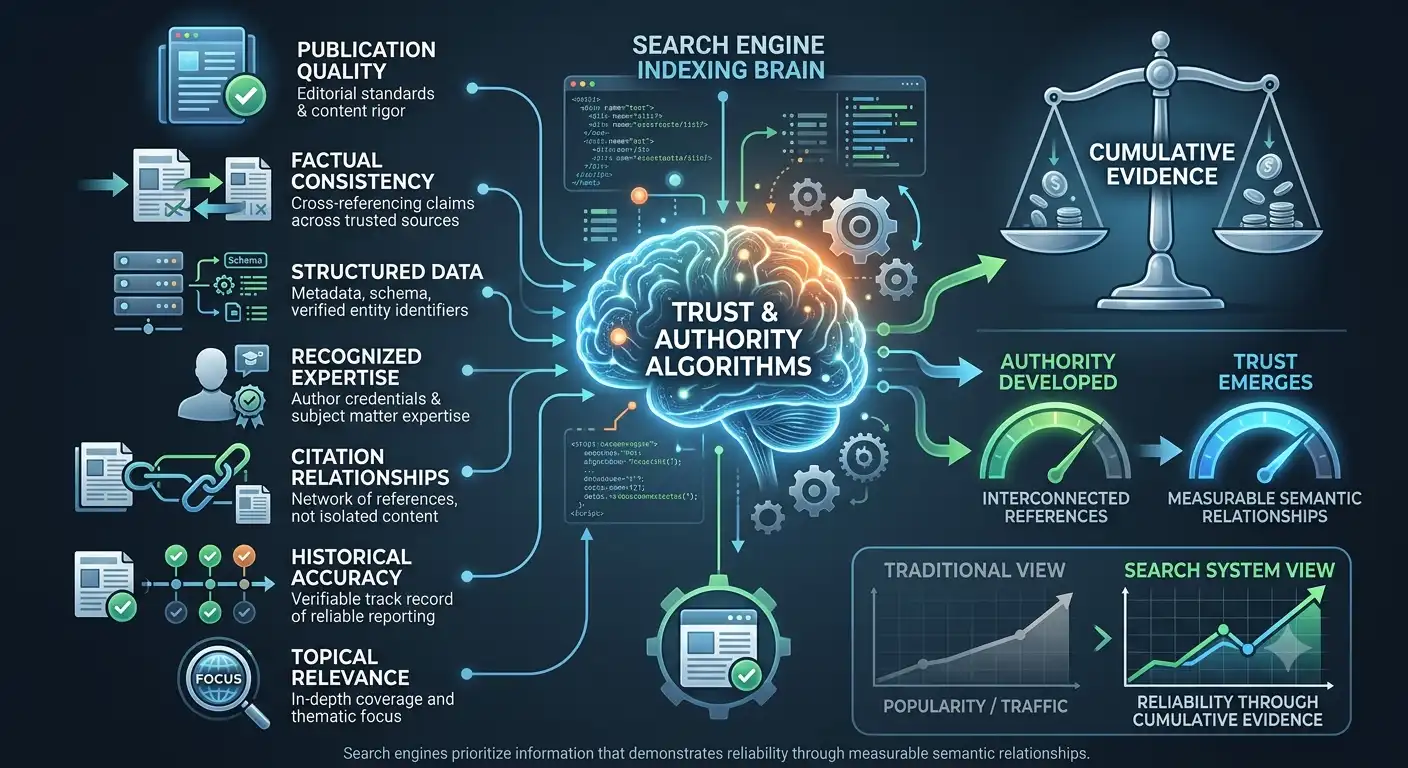
A recognised news organisation, specialist music publication, personal blog and anonymous forum account do not provide identical source signals. Their content can still become indexed, but the surrounding authority characteristics differ. Search-result composition therefore reflects both the existence of information and the signals associated with the sources publishing it.
For singers, source differentiation is particularly important when assessing accusations about performance authenticity. A technical discussion of vocal production provides a different informational function from an opinion-based social post. Treating all content as equivalent obscures the distinction between evidence, commentary, repetition and speculation.
Why do social media discussions make accusations difficult to separate from facts?
Social media discussions can blur the distinction between observation, interpretation and assertion because posts are frequently shared without their original context. A short caption can reduce a complex performance issue to a simple claim, while reposts replicate the same wording across additional accounts. This creates a broader digital footprint around the original discussion.
Search engines can encounter social content alongside journalism, interviews, biographies and other sources. The resulting SERP can therefore contain information with different levels of authority and different purposes. Search visibility does not guarantee that every displayed statement has the same evidential basis.
The persistence of social discussions also creates a temporal problem. A post published during a controversy can continue circulating after new information becomes available. Without corresponding updates or contextual material, historical claims can remain part of the searchable narrative surrounding an artist.
How can singers understand the reputation signals attached to their names?
Singers can understand their reputation signals by examining the information that consistently appears when their names and reputation-related queries are searched. This analysis involves identifying recurring topics, source types, sentiment patterns, publication dates and the position of relevant pages within search results. The objective is to map the information environment rather than simply count positive or negative mentions.
A structured assessment begins by categorising content according to its function. News coverage, interviews, reviews, social discussions, videos and biographical pages each contribute different forms of information. Comparing these categories reveals whether a reputation theme is supported by authoritative reporting, repeated commentary or isolated discussion.
Search monitoring also identifies changes over time. Tracking recurring terms associated with a singer can show whether a reputation theme is expanding, declining or remaining persistent. This creates a measurable view of search visibility and demonstrates how the digital footprint changes as new content enters or leaves the indexed environment.
Dive Deeper With Our Expert Guides:
Why Sample-Clearance Disputes Become Reputation Stories
How a Band Breakup Plays Out in Public Search Results
How can online reputation analysis distinguish an accusation from established information?
Online reputation analysis distinguishes accusations from established information by examining source context, evidence, attribution and repetition. A claim appearing on one discussion page has a different evidential status from a documented statement supported by identifiable primary or authoritative sources. Repetition across websites also does not independently convert an allegation into a verified fact.
Content classification provides a useful analytical framework. Researchers can separate confirmed information, attributed claims, personal opinions, commentary and unsupported assertions before evaluating their search visibility. This prevents the reputation assessment from treating all indexed material as equally credible.
The distinction also applies to positive information. Promotional descriptions, fan commentary and independently reported achievements carry different authority signals. A balanced digital footprint therefore depends on understanding how different content types contribute to entity perception rather than assuming that sentiment alone determines reputation.
How does reputation management relate to Autotune and lip-sync accusations?
Reputation management refers to the systematic monitoring and analysis of information that shapes how an individual or entity is perceived online. In the context of singers, this includes evaluating search results, indexed content, reputation signals, source authority, sentiment and recurring associations connected with performance-related accusations.
The process begins with information discovery rather than assumption. Search-result analysis identifies which pages, videos and discussions appear for relevant queries, while content analysis determines what each source actually claims. This creates a distinction between search visibility and factual status.
For deeper analysis of the methods used to address persistent performance-related allegations, Countering Autotune and Lip-Sync Accusations Online represents the next consideration-stage topic. At the informational level, the central issue remains understanding how accusations become indexed, repeated and associated with a singer’s searchable entity.
What does the persistence of Autotune accusations reveal about online reputation?
The persistence of Autotune and lip-sync accusations demonstrates that online reputation is shaped by an interconnected information ecosystem rather than a single webpage. Search engines organise indexed content according to relevance and ranking signals, while users interpret that content through source authority, repetition, context and sentiment. A recurring accusation therefore becomes a reputation signal when it remains connected to an entity across accessible digital sources.
A singer’s digital reputation includes both factual information and interpretations published by other people. Understanding the difference between evidence, opinion, commentary and repetition provides a more accurate basis for analysing search perception. Reputation analysis consequently focuses on the composition, persistence and visibility of information rather than assuming that search prominence establishes truth.
The key principle is that search visibility and factual validity are separate concepts. An accusation can rank without being established, while authoritative information can exist without occupying prominent search positions. Understanding this distinction provides a clearer framework for evaluating entity perception, content indexing and reputation signals surrounding musicians online.
How can autotune and lip-sync accusations affect a singer’s online reputation?
Autotune and lip-sync accusations can influence how audiences interpret a singer’s vocal ability, authenticity and live-performance credibility. Repeated posts, videos and discussions can also reinforce the allegation in search results and social media.
Can false lip-sync accusations be removed from search results?
False or misleading lip-sync accusations can sometimes be addressed through platform reporting, content-removal requests or search-result management, depending on the content and applicable policies. The available remedy depends on where the allegation appears and whether it violates the relevant platform or legal rules.
What should singers do when an autotune accusation goes viral?
Singers should first identify the original allegation, the platforms repeating it and the search results where it appears. Documenting URLs, dates, screenshots and factual evidence helps establish what is being circulated and supports appropriate reporting or reputation-management action.
Can reputation management help with online lip-sync allegations?
Reputation management can address the visibility and context of online allegations by monitoring search results, analysing recurring narratives and developing accurate supporting content. For singers, the focus is typically on reducing the prominence of misleading claims while strengthening reliable information about their work.
How can Clear My Name address damaging singing-performance accusations online?
Clear My Name can be used as part of a broader strategy for addressing damaging online content, including monitoring search visibility and identifying appropriate content-removal or suppression routes. The specific approach depends on the platform, nature of the accusation and evidence available.