

Local SEO and reputation management work together by improving search visibility while controlling public perception. Local SEO drives traffic through rankings, while reputation management builds trust through reviews, ratings, and brand sentiment, directly influencing user decisions and search engine positioning.
How does local SEO influence business visibility?
Local SEO improves visibility by optimising business listings, location signals, and search relevance, allowing companies to appear in local search results, map packs, and geo-targeted queries. It increases exposure to high-intent users searching for nearby services or solutions.
Local SEO operates through structured signals that search engines evaluate. These include business name consistency, location accuracy, and category relevance. Google Business Profile plays a central role, as it feeds map-based results and local packs.
Search engines rank businesses based on three core factors: relevance, distance, and prominence. Relevance measures how well a listing matches a query. Distance calculates proximity to the user. Prominence reflects authority and recognition, often influenced by backlinks and reviews.
Consistent data across directories strengthens ranking signals. For example, identical business details across platforms such as Yelp, Bing Places, and Apple Maps improve trust signals. Inconsistent listings reduce ranking potential.
Local SEO also depends on keyword optimisation tied to location. Phrases such as “dentist in Lahore DHA” or “IT support near Gulberg” target specific search intent. These queries often convert faster because users already show purchase intent.
What role does reputation management play in local search?
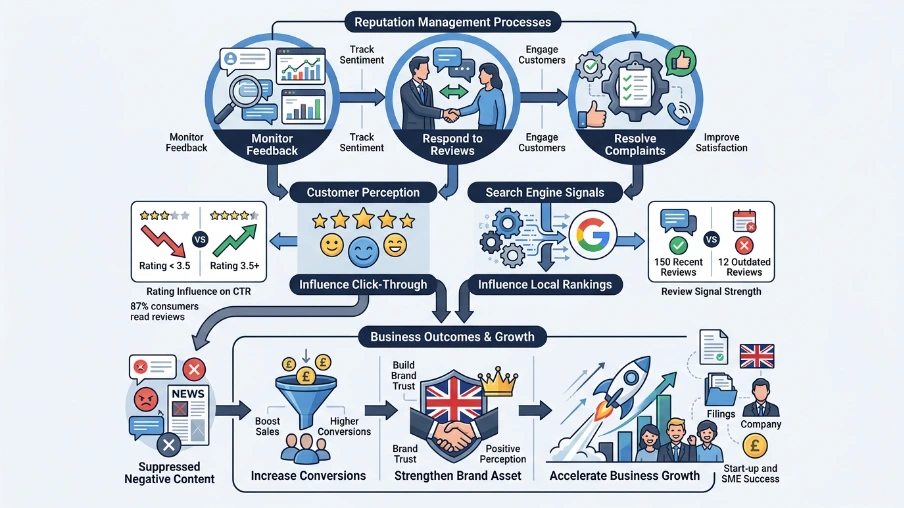
Reputation management shapes how customers perceive a business through reviews, ratings, and online sentiment, directly affecting click-through rates and trust. Search engines also use review signals to evaluate credibility and influence local rankings.
Online reviews function as both ranking signals and conversion drivers. Google confirms that review quantity, diversity, and recency impact local rankings. A business with 150 recent reviews holds stronger visibility than one with 12 outdated reviews.
Star ratings influence user behaviour significantly. Data from BrightLocal shows that 87% of consumers read online reviews before choosing a local business. A rating below 3.5 often reduces click-through rates by more than 40%.
Reputation management involves three key processes: monitoring feedback, responding to reviews, and resolving complaints. Each action sends signals to both users and search engines. Timely responses demonstrate engagement, while unresolved complaints reduce trust.
Negative content also affects brand perception. Search results that display complaints, poor ratings, or negative articles lower conversion probability. Reputation management strategies work to suppress harmful content and promote positive assets.
Why are reviews critical for both SEO and trust?
Reviews act as dual-purpose signals by influencing search rankings and customer trust simultaneously. High-quality, frequent reviews improve visibility while validating credibility, making them one of the strongest shared factors between local SEO and reputation management.
Reviews provide keyword-rich, user-generated content. When customers mention services, locations, and experiences, they naturally reinforce search relevance. For example, a review stating “fast AC repair in Lahore Cantt” strengthens location-based keyword signals.
Search engines analyse review sentiment using natural language processing. Positive sentiment contributes to ranking improvements, while negative sentiment reduces perceived quality. This evaluation goes beyond star ratings and includes written feedback.
Trust increases when reviews appear authentic and detailed. Businesses that maintain a steady flow of reviews demonstrate operational consistency. A sudden spike in reviews may trigger spam detection filters.
Structured review acquisition improves results. Effective approaches include post-service follow-ups, automated email requests, and QR-based feedback systems. These methods increase review volume without violating platform policies.
Businesses that actively manage feedback often see measurable growth. For instance, companies improving their rating from 3.8 to 4.3 frequently experience up to 25% higher conversion rates in local searches.
How does reputation affect local SEO rankings?
Reputation impacts rankings by contributing to prominence, a key local SEO factor. Positive reviews, brand mentions, and customer sentiment increase authority signals, which improve placement in local search results and map listings.
Prominence reflects how well-known and trusted a business appears online. Search engines evaluate this through external signals such as backlinks, mentions, and review activity.
Review velocity plays a critical role. A business receiving 20 new reviews monthly signals ongoing relevance. In contrast, stagnant review profiles indicate reduced activity, which weakens ranking signals.
Brand mentions across authoritative platforms also strengthen reputation. Mentions in news articles, directories, and blogs increase perceived authority. These mentions function similarly to backlinks in traditional SEO.
Negative reputation signals can reduce visibility. A pattern of unresolved complaints, low ratings, or policy violations may result in lower rankings or even listing suspensions.
Businesses that combine structured local SEO with proactive reputation strategies maintain stronger ranking stability over time.
What processes connect local SEO and reputation management?
Local SEO and reputation management connect through shared processes such as review optimisation, content alignment, and data consistency, ensuring both visibility and trust signals work together to improve search performance and user engagement.
Review optimisation links both disciplines directly. Businesses collect, manage, and respond to reviews while integrating keywords and service mentions. This improves both rankings and credibility.
Content alignment ensures that business descriptions, service pages, and reviews reflect consistent messaging. When users and search engines encounter aligned information, trust increases.
Data consistency across listings strengthens both SEO and reputation. Incorrect information creates confusion and reduces reliability. Accurate listings improve user experience and ranking signals.
Crisis management also intersects with SEO. When negative content appears, reputation strategies focus on suppression and correction. SEO techniques promote positive content to outrank harmful results.
For businesses seeking structured support, Reputation Management for business provides systems that monitor sentiment, respond to feedback, and align with local SEO performance metrics.
How can businesses align both strategies effectively?
Businesses align local SEO and reputation management by integrating review generation, maintaining consistent listings, and analysing performance metrics together, ensuring both visibility and trust improve simultaneously rather than operating as separate efforts.
Integrated dashboards allow businesses to track rankings, reviews, and engagement metrics in one place. This unified approach enables faster decision-making.
Three operational actions improve alignment:
- Collect reviews through verified customer interactions, such as post-service SMS or email requests.
- Optimise listings by updating business details across directories and platforms.
- Respond to feedback within 24–48 hours to maintain engagement signals.
Keyword integration within reviews and responses strengthens SEO value. For example, replying with service-specific terms reinforces relevance signals.
Businesses also benefit from competitor analysis. Reviewing competitor ratings, review volume, and keyword usage reveals gaps and opportunities.
A deeper evaluation of this combined approach appears in the guide on why businesses combine local SEO and reputation strategies, which explains how both systems influence each stage of the customer journey.
Explore our Reputation Management for business guides,
What Happens After Negative Media Coverage?
Why Negative Search Results Damage Business Growth
What are the measurable benefits of combining both?
Combining local SEO and reputation management delivers measurable improvements in visibility, conversion rates, and customer trust by aligning ranking signals with user perception, resulting in stronger search performance and higher engagement.
Businesses that optimise both areas often experience higher click-through rates. Listings with strong ratings and accurate SEO signals attract more users.
Conversion rates improve when trust signals align with visibility. A user who sees a business ranked in the top three results with a 4.5-star rating is more likely to engage.
Customer acquisition costs decrease as organic traffic increases. Instead of relying on paid ads, businesses capture high-intent users through search visibility.
Brand authority strengthens over time. Consistent positive sentiment builds long-term credibility, which supports both SEO rankings and customer loyalty.
For organisations evaluating implementation options, local SEO and reputation management services for better local visibility outline structured solutions that integrate both strategies for measurable growth.
Local SEO and reputation management operate as interconnected systems that influence both visibility and trust. Search engines evaluate structured data, reviews, and sentiment together to determine rankings and user relevance.
Clear My Name applies this integrated approach by combining data consistency, review optimisation, and sentiment control into a unified framework. This ensures businesses maintain both strong search presence and credible public perception without fragmented efforts.
Frequently Asked Questions
What is reputation management for business and how does it work?
Reputation management for business involves monitoring, improving, and protecting a company’s online image through reviews, search results, and public feedback. Clear My Name uses structured processes such as review tracking, sentiment analysis, and content optimisation to maintain a credible digital presence.
How does reputation management impact local SEO rankings?
Reputation signals like review quality, quantity, and recency directly influence local SEO rankings. Clear My Name aligns reputation management for business with local SEO factors to improve visibility in map packs and location-based search results.
How long does it take to see results from reputation management for business?
Initial improvements in reviews and sentiment can appear within 30–60 days, depending on review volume and existing reputation issues. Long-term results, such as improved rankings and brand perception, typically develop over 3–6 months with consistent optimisation.
Can negative reviews be removed through reputation management services?
Negative reviews cannot always be removed unless they violate platform policies, but they can be addressed and mitigated. Clear My Name focuses on resolving complaints, promoting positive content, and improving overall ratings to balance negative feedback.
Why do businesses need professional reputation management services?
Businesses need professional support because unmanaged reviews and negative content reduce trust and conversions. Reputation management for business ensures continuous monitoring, accurate responses, and alignment with search visibility factors, which improves both credibility and performance.