

Boycott campaigns start when criticism about a business develops into coordinated consumer pressure intended to influence behaviour, policy or public perception. Reputation management is the analysis of how information, sentiment and reputation signals shape the perceived credibility of a business across digital environments. Online reputation refers to the information and evaluations associated with a business that users encounter through search engines, social platforms, reviews, news coverage and other indexed sources.
What Is a Boycott Campaign in an Online Reputation System?
A boycott campaign is a coordinated effort to reduce or stop support for a business in response to a perceived problem, decision, statement or association. The campaign becomes an online reputation issue when its information spreads across digital platforms and becomes connected to the business entity. Unlike an isolated complaint, a boycott campaign involves repeated communication, shared messaging and collective participation. Search engines then process the resulting content as part of the wider information environment surrounding the business. The campaign’s digital footprint can therefore influence what users discover when searching for the organisation.
The reputation impact depends on the relationship between the campaign and the business entity. Content that repeatedly connects a company name with boycott-related terminology creates a semantic association within the indexed information environment. Search systems evaluate the relevance of these documents to related queries, while users interpret the visible results through headlines, snippets, reviews and social discussions. The existence of such an association does not establish whether the criticism is accurate. It demonstrates how repeated digital references can influence entity perception and search visibility.
How Does a Boycott Campaign Usually Begin Online?
A boycott campaign usually begins with a specific trigger that generates public criticism and provides a simple issue around which participants can organise. The trigger can involve a business decision, corporate statement, product issue, employment dispute, political association or perceived inconsistency between stated values and observed behaviour. Initial criticism often appears through social posts, reviews, comments or published articles. If the information receives sufficient engagement, additional users can reproduce or reinterpret the original claim. The resulting increase in content creates a larger digital footprint around the issue.
Content velocity is relevant because rapidly published material can create multiple references to the same topic within a short period. Search engines discover and index these pages according to their own crawling and processing systems rather than according to the campaign’s organisational structure. Users also encounter information through platform recommendations, social sharing and direct links before it necessarily becomes prominent in search results. This creates parallel distribution systems in which social attention and search visibility influence each other. The campaign therefore develops through an interaction between publication, engagement, discovery and repeated reference.
Why Do Some Boycott Messages Spread Faster Than Others?
Boycott messages spread faster when their content is easy to understand, reproduce and share across different communication channels. Short claims, recognisable phrases, visual assets and direct calls for action reduce the effort required for users to participate in distribution. Engagement creates additional signals around the content, while repeated references increase its presence across the digital footprint. The underlying information can therefore move from one platform into reviews, news coverage, forums and other websites. Each new publication creates another potential entry point through which users encounter the campaign.
The semantic structure of the message also influences its search relevance. A campaign using the same business name and recurring issue-related terms creates a consistent relationship between the entity and the criticism. Search engines evaluate the language and context of indexed pages when determining their relevance to queries. This does not mean that repetition automatically produces high rankings, because authority, quality and other ranking signals also influence SERP evaluation. Distribution therefore increases the quantity of available information, while ranking systems determine which information receives search visibility.
How Do Social Media and Search Engines Interact During a Boycott?
Social media and search engines operate as different information-distribution systems that can reinforce the visibility of the same topic. Social platforms prioritise content through platform-specific recommendation and engagement mechanisms, while search engines retrieve and rank indexed webpages according to search queries. A boycott discussion that attracts substantial attention on social media can generate additional articles, commentary and webpages elsewhere online. Those sources then become part of the search ecosystem surrounding the business. Search visibility can therefore expand even when the original discussion occurred outside a search engine.
The interaction is not necessarily linear. Search results can also direct users towards social discussions, which then generate further engagement and additional content. This creates a feedback relationship between discovery and publication. The business name becomes associated with a wider set of documents, phrases and sentiments as the discussion develops. From a reputation perspective, the important mechanism is the expansion of the entity’s digital information environment rather than the activity of one platform alone.
How Does Search Visibility Change During a Boycott Campaign?
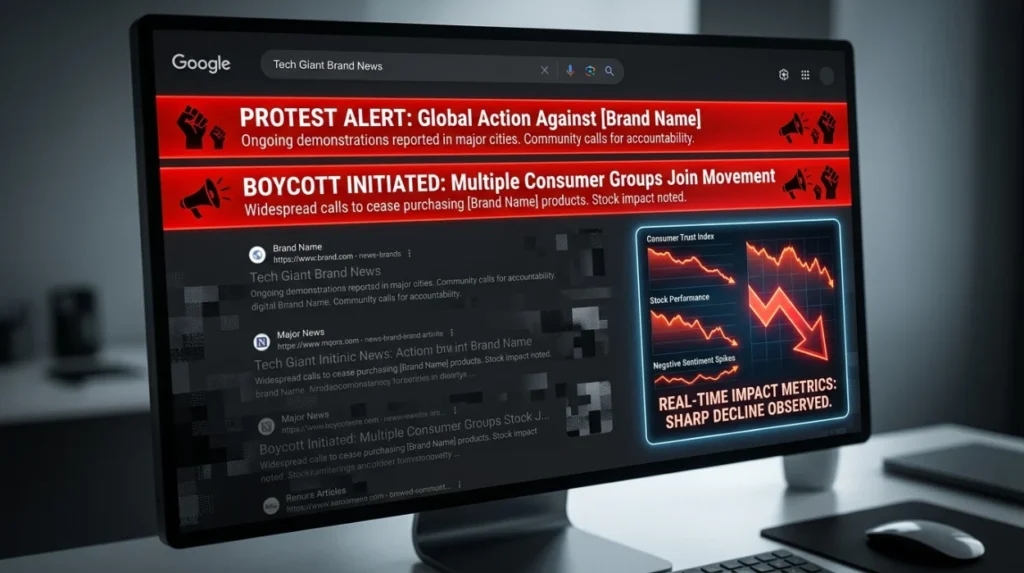
Search visibility changes when boycott-related content becomes sufficiently relevant, authoritative or prominent for queries associated with the business. Search engines evaluate indexed documents against user queries and rank results according to multiple signals. News reports, established publications and highly relevant webpages can therefore compete with the business’s own content for visibility. When negative or critical material occupies prominent positions, it becomes part of the first information set users encounter. This can alter the perceived context surrounding the business.
SERP composition is particularly important because users rarely encounter every available document at the same time. The first page presents a selected group of results that can include news stories, social profiles, reviews, corporate pages and third-party commentary. A boycott campaign can therefore affect reputation without every piece of campaign content ranking prominently. The presence of a few authoritative results can provide substantial visibility for the underlying issue. Search reputation analysis consequently examines both individual rankings and the overall composition of the results page.
What Role Do Reputation Signals Play in Boycott Campaigns?
Reputation signals are indicators that contribute to how users and search systems interpret the credibility, relevance and public perception of a business. They include reviews, news coverage, authoritative references, links, brand mentions, social engagement and other forms of published information. These signals do not form one universal reputation score. Instead, they contribute to the broader information environment from which search results and user judgements emerge.
Authority signals are particularly important because not every boycott reference carries the same informational weight. A claim published by an established news organisation has a different source profile from an anonymous comment on an unmoderated platform. Search engines evaluate source and document characteristics alongside relevance and other ranking factors. Users also apply their own credibility assessments based on source recognition and contextual detail. The reputation effect therefore depends on both the volume of discussion and the authority of the sources carrying it.
How Do Reviews Contribute to the Spread of Boycott Sentiment?
Reviews contribute to boycott sentiment by providing a structured environment in which users can publish evaluations associated directly with a business. When campaign participants use review platforms to repeat a common criticism, the same terminology can appear across multiple profiles or listings. Review signals then become part of the wider digital footprint surrounding the organisation. Search engines can encounter these pages through local, branded or review-related queries. The result is an additional layer of reputation information beyond social and news coverage.
Sentiment interpretation analyses whether language expresses positive, negative or neutral attitudes towards an entity. It does not determine whether the underlying claim is factually correct. A high concentration of negative language can influence the visible sentiment surrounding a business, while the credibility and relevance of individual reviews remain separate considerations. Reviews therefore contribute to sentiment distribution but do not independently establish the legitimacy of a boycott campaign.
How Does Content Ranking Influence the Perception of a Boycott?
Content ranking influences perception by determining which documents users encounter first for relevant searches. A highly visible article can shape the initial context of a business-related query even when additional information exists lower in the SERP. Ranking does not establish factual truth, but visibility affects information exposure. This distinction is fundamental to understanding search reputation because a search engine’s output represents a ranking decision rather than a complete assessment of the business.
Ranking dynamics also change as new information enters the index. Fresh articles, authoritative publications and highly relevant pages can alter the competitive relationship between existing results. Search systems continuously process new and updated content, which means the SERP is not a static record of public opinion. A boycott campaign therefore operates within a changing information environment where publication frequency, source authority and query relevance affect visibility.
Dive Deeper With Our Expert Guides:
Why Wholesale and Distributor Reviews Matter to Retail Buyers
How Acquisition Rumours Affect a Company’s Market Perception
How Does a Digital Footprint Expand During a Boycott?
A digital footprint expands when new content, references and discussions become associated with a business across online sources. During a boycott campaign, the footprint can include social posts, reviews, articles, videos, forum discussions, commentary and search queries. Each source provides a separate location where information about the business can exist. Search engines can discover some of these sources directly, while others influence visibility indirectly through links and subsequent publications. The result is a more complex entity information environment.
The expansion of the footprint does not mean every piece of content receives equal visibility. Indexing determines whether search engines have access to a document, while ranking determines its position for particular queries. A large number of low-authority references therefore does not automatically produce dominant search visibility. Conversely, a smaller number of authoritative sources can receive substantial rankings. Analysing a boycott campaign requires distinguishing content volume from search influence.
Can a Boycott Campaign Affect Brand Credibility in Search?
A boycott campaign can affect brand credibility in search when critical information becomes prominent enough to influence the context users associate with the business. Entity credibility refers to the perceived reliability and legitimacy of an organisation based on available information and reputation signals. Search results contribute to that perception by presenting selected sources around branded queries. When negative content becomes prominent, it forms part of the evidence environment users examine. The effect concerns perception and information exposure rather than an automated judgement by the search engine.
Credibility is also affected by consistency between different information sources. Contradictory statements, incomplete explanations or repeated unresolved criticism can create an inconsistent information environment. Conversely, authoritative sources containing clear factual context contribute different signals to the entity’s digital representation. Search perception therefore emerges from the interaction between content accuracy, source authority, context and visibility.
How Do Trust Signals Affect the Spread of Business Criticism?
Trust signals affect the interpretation of criticism by providing information about the reliability and authority of its sources. Established publications, transparent authorship, primary documentation and consistent factual context provide stronger credibility indicators than anonymous or unsupported claims. Search systems evaluate source and content characteristics, while users independently assess whether a source appears credible. Trust therefore operates across both algorithmic retrieval and human interpretation.
The presence of credible sources can also increase the visibility of criticism because authoritative pages often receive stronger search consideration. This creates an important distinction between the truth of a claim and the authority of the page presenting it. A highly authoritative source can receive prominent visibility without every statement within it being independently validated by the search engine. Reputation analysis therefore examines source quality separately from the sentiment expressed.
What Causes a Boycott Campaign to Become a Search Reputation Issue?
A boycott campaign becomes a search reputation issue when its information develops a sustained relationship with queries associated with the business. This relationship forms through repeated mentions, indexed pages, links, media coverage, reviews and other digital references. Once relevant content appears in search results, users can encounter the campaign through direct name searches or issue-related queries. Search visibility then becomes part of the campaign’s distribution mechanism. The distinction between social reputation and search reputation becomes increasingly important at this stage.
The transition is measured through observable search signals. Analysts can examine which boycott-related URLs are indexed, which queries trigger them and how prominently they appear. They can also evaluate source authority, sentiment distribution and the presence of competing information. This provides a clearer understanding of whether a campaign remains primarily a social discussion or has developed into a broader search visibility issue.
How Can Businesses Analyse Boycott Campaigns Without Confusing Visibility With Truth?
Businesses can analyse boycott campaigns by separating factual verification, public sentiment, content distribution and search visibility into distinct analytical categories. Factual verification examines whether specific claims are supported by reliable evidence. Sentiment analysis examines the direction and themes of public commentary. Content analysis evaluates what has been published and where it appears, while SERP evaluation measures which information receives search visibility.
This separation prevents search rankings from being treated as evidence of factual accuracy. A highly ranked result demonstrates visibility, not automatic truth. Similarly, a large volume of social commentary demonstrates distribution and engagement rather than definitive credibility. A rigorous reputation analysis therefore evaluates information quality, source authority, content context and search ranking independently before assessing the overall reputation environment.
How Should a Business Respond to a Boycott Campaign Without Escalating Search Visibility?
A non-escalatory approach begins with understanding the information environment before increasing the volume of public communication. Additional statements, responses and publications create new content that can itself become indexed and associated with the business name. Analysing the existing SERP, sentiment distribution and source authority provides a factual basis for deciding which information requires clarification. The objective is to improve information accuracy without unnecessarily expanding the campaign’s digital footprint.
For businesses evaluating response methods in greater detail, responding to boycott campaigns without escalation provides a relevant analytical pathway. The key distinction is between addressing an information problem and increasing the amount of content associated with it. A response that introduces additional searchable material can affect the SERP composition just as campaign content does. Reputation analysis therefore considers both the message and its potential search visibility.
What Is the Relationship Between Boycott Campaigns and Online Credibility?
Online credibility is the perceived reliability of a business based on its digital information environment and associated reputation signals. A boycott campaign can influence that environment by increasing the visibility of critical information and introducing new associations around the business entity. The effect depends on source authority, content accuracy, sentiment distribution and search ranking. No single campaign reference independently defines the complete credibility of an organisation.
Credibility also changes through information accumulation. Search users encounter a combination of corporate content, reviews, news coverage, third-party publications and other sources. The relative prominence of those sources determines which information receives immediate attention. Understanding this structure explains why online credibility is not simply a measure of positive or negative sentiment. It is a broader assessment shaped by the availability, authority, context and visibility of information.
Boycott campaigns spread through an interaction between publication, engagement, social distribution, content indexing and search ranking. Reputation management, understood analytically, examines how these mechanisms influence the information environment surrounding a business. Online reputation develops through the combined effect of reviews, news coverage, social discussion, authority signals, sentiment and search visibility rather than through one isolated source.
The central distinction is between public criticism and search perception. A campaign can generate substantial discussion without becoming highly visible in search, while a small number of authoritative publications can create significant SERP exposure. Understanding content ranking, reputation signals, entity perception and digital footprint expansion provides a clearer framework for analysing how boycott campaigns develop and influence business reputation online.
How do boycott campaigns start against businesses?
Boycott campaigns typically begin when a business decision, statement, product issue or perceived misconduct triggers public criticism. Online discussion can then expand through social media, reviews, news coverage and other digital channels.
How do boycott campaigns spread online?
Boycott campaigns spread through repeated sharing, commentary, hashtags, reviews, news coverage and cross-platform references. As more content is published, the campaign can expand the business’s digital footprint and increase search visibility for boycott-related queries.
Can a boycott campaign affect a business’s online reputation?
Yes, a boycott campaign can affect online reputation when critical content becomes prominent across search results, reviews, news sites or social platforms. Reputation signals, sentiment distribution and source authority influence how users interpret the business online.
Can boycott campaigns affect Google search results?
Boycott campaigns can influence search visibility when related content becomes indexed and relevant to searches involving the business name or associated topics. Search ranking dynamics determine which articles, reviews and other sources appear prominently in the SERP.
How can businesses respond to boycott campaigns without making them worse?
Businesses can first analyse the claims, source authority, sentiment and existing search results before publishing additional responses. A measured approach helps address factual issues while limiting unnecessary content creation that can increase the campaign’s search visibility.