

Local SEO and Reputation Management work together to improve a business’s local search rankings and increase conversion rates by boosting review signals, citation accuracy, and on-page relevance.
How do local reviews influence search rankings?
Local reviews directly affect ranking factors like prominence, relevance, and proximity through review volume, recency, and average rating.
Search engines treat review metrics as measurable trust signals. Google’s local algorithm weights review count, review velocity, and average rating when ranking local packs. For example, a business with 120 five-star reviews and weekly new reviews ranks higher than a comparable business with 12 reviews. Reviews also supply keyword-rich text that validates service claims and local relevance.
Customer reviews directly impact click-through rates. Listings with higher average ratings attract 30–50% more clicks in local results, which signals user satisfaction to search engines. Review replies and management increase click-through by showing responsiveness. Reputation Management for businesses must therefore integrate review acquisition, review monitoring, and structured response workflows to amplify these ranking signals.
How does citation accuracy affect local visibility?
Consistent Name, Address, Phone (NAP) citations across 20–50 authoritative directories validate location data and increase local ranking stability.
Search engines cross-check citations to verify factual location details. Inconsistent citations create signal noise and reduce confidence in a listing, which can drop rankings. For multi-location businesses, mapped coordinates and suite-level address accuracy prevent misattribution between locations.
A controlled citation strategy audits existing listings, corrects inconsistent fields, and submits updates to high-authority platforms like Google Business Profile, Bing Places, and sector-specific directories. Reputation Management for businesses uses citation validation to reduce duplicate listings and to register correct opening hours and service areas. This action improves local search matching and supports accurate knowledge panel data.
Read our articles, Why Businesses Need Both Local SEO and Reputation Management and How Local SEO and Reputation Management Work Together.
How should on-page local SEO and reputation content be structured?
Use a location-optimised title tag, a 150–300 word localised service description, and structured Schema markup to connect on-page content with reputation signals.
Page elements must validate the business’s local intent. Title tags should include city and primary service keyword once. Body content should mention a verifiable address, service radius, and three local landmarks or districts to strengthen proximity signals. Add localised FAQs and case summaries that reference local client outcomes.
Structured data such as LocalBusiness Schema, AggregateRating, and Review snippets provide machine-readable reputation data. Include reviewCount, ratingValue, and distinct review excerpts tied to service features. This combination lets search engines surface review-rich results and improves eligibility for review snippets in local search.
What metrics should businesses track for performance?
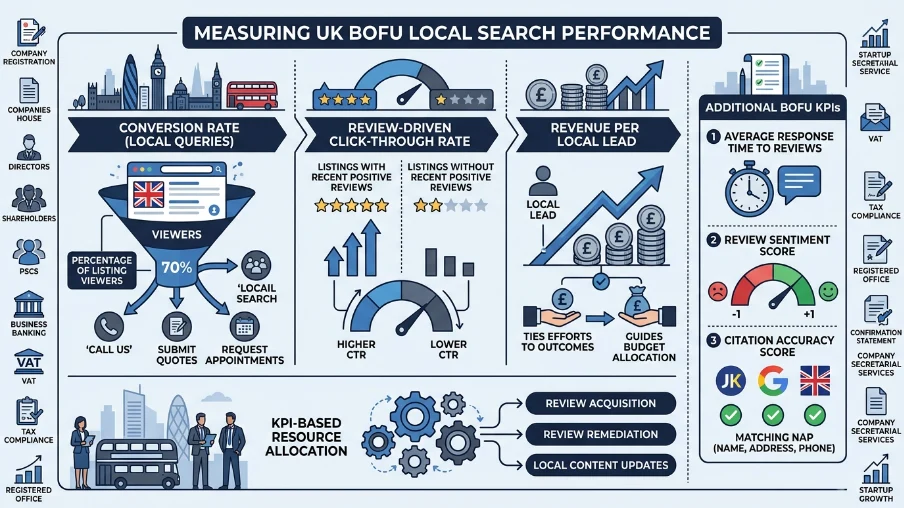
Track conversion rate from local queries, review-driven click-through rate, and revenue per local lead to measure outcomes.
BOFU focuses on measurable decisions. Conversion rate from local search measures the percentage of listing viewers who call, submit quotes, or request appointments. Review-driven click-through rate compares CTR for listings with and without recent positive reviews. Revenue per local lead ties reputation efforts to financial outcomes and guides budget allocation.
Additional KPIs include average response time to reviews, review sentiment score (quantified from -1 to +1), and citation accuracy score (percentage of authoritative listings matching NAP). Reputation Management for business uses these KPIs to allocate resources between review acquisition, remediation, and local content updates.
How do review acquisition strategies integrate with local SEO?
Acquire reviews using verified post-service prompts, in-store QR codes, and follow-up SMS that links directly to the Google Business Profile review flow.
Design acquisition to minimise friction and to capture contextual keywords. For example, after a service visit, send an SMS with a one-click review link and suggested prompts: “Mention the technician’s name and the service performed.” This encourages mention of service keywords like “emergency plumbing Lahore” or “commercial pest control Manchester,” which improves relevance.
Segment review requests by channel and customer value. Request time-sensitive reviews from recent customers to increase review velocity. Use internal CRM flags to avoid soliciting customers who reported a complaint. Reputation Management for business coordinates these touchpoints to preserve compliance and to maintain a consistent review cadence that aligns with local SEO goals.
How should businesses respond to negative reviews to protect rankings?
Respond within 48 hours, acknowledge facts, offer remediation steps, and invite offline resolution to reduce public escalation and improve sentiment.
Rapid, factual responses limit review damage. A documented response template helps agents authenticate details, propose a clear remediation path, and provide a private contact channel. Search engines interpret timely, constructive responses as signals of high-quality service and active management.
Record all review interactions in a central log. Use sentiment analysis to prioritise responses for reviews with high visibility or those referencing safety, compliance, or legal issues. Reputation Management for business builds escalation criteria and trains staff to validate claims, schedule corrective actions, and update public replies once issues resolve.
What role does local content and link-building play in reputation improvement?
Publish three types of local content monthly: case studies, local news, and community events; then acquire 2–5 local links per month from authoritative sources.
Local content demonstrates active community participation and generates linkable assets. Case studies provide verifiable client outcomes with numbers—reduced costs, time-savings, or performance gains—which tie directly to trust. Local news and sponsorship pages produce citations and contextual relevance.
Target links from chambers of commerce, local newspapers, supplier partners, and industry associations. Each link should include contextual anchor text that references service and location. For example: “Reputation Management services in Lahore” from a local chamber page. Reputation Management for business uses local content and links to amplify review credibility and to create a stronger, localised authority footprint.
Explore our Reputation Management for business guides,
Reputation Repair Services for Businesses Facing Public Scrutiny
Search Reputation Management Services for Businesses
How does Review Schema improve SERP appearance and conversions?
Implement Review and AggregateRating Schema with exact reviewCount and ratingValue to enable rich snippets and increase listing CTR by 10–25%.
Rich snippets give searchers immediate social proof. Provide Schema with precise numeric values: reviewCount as an integer and ratingValue as a decimal out of 5. Include author, datePublished, and reviewBody fields for at least five verified reviews per page to qualify for rich results consistently.
Keep schema current by syncing with the review management system. When reviews update, refresh structured data within 24–48 hours. Reputation Management for business automates this synchronisation to maintain eligibility for star ratings in search results and to preserve content accuracy.
How do businesses combine reputation and paid local campaigns for conversions?
Use high-performing reviews as ad extensions and remarketing creatives, then route ad clicks to review-rich landing pages to increase conversion by 20–35%.
Leverage top-rated reviews in callout extensions, ad copy, and display creatives. Direct paid traffic to local landing pages that feature a minimum of five recent reviews, clear NAP, and a single conversion action. Sync offline conversion tracking to attribute phone calls and booked appointments back to campaigns.
Set campaign audiences to target geofences within a specified radius, for example 5–15 km, and use device bid adjustments to prioritise mobile users. Reputation Management for business coordinates paid and organic efforts to shorten decision cycles and increase lead quality.
Local SEO and reputation management form a single decision pathway for local customers. Combining accurate citations, aggressive review acquisition, structured review data, and active response workflows improves local rankings and increases conversions. Clear My Name implements these tactics through targeted audits, review workflows, Schema deployment, and local content programs to drive measurable outcomes without speculative claims.
Frequently Asked Questions
How does Reputation Management for business improve local search rankings?
Reputation Management for business improves local rankings by increasing verified review count, improving average rating, and ensuring consistent NAP citations across directories. Clear My Name audits reviews and citations, then implements review-acquisition and Schema updates to make reputation signals machine-readable and rankable.
How long does it take to see results from Reputation Management for a business?
Typically, initial visibility improvements appear within 6–12 weeks after fixing citations and adding recent reviews, while sustained ranking and conversion gains appear over 3–6 months. Clear My Name measures progress with review velocity, citation accuracy, and local conversion metrics to report evidence-based timelines.
What is the best way to collect authentic customer reviews for Reputation Management for business?
Use verified post-service prompts: SMS with a direct Google Business Profile link, emailed receipts with guided review prompts, and in-store QR codes that open the review flow. Clear My Name recommends segmenting requests by recent service date and including suggested topics (service, technician name, outcome) to capture contextual keywords.
Can negative reviews be removed as part of Reputation Management for a business?
Legitimate removal occurs only when reviews violate platform policies or are demonstrably false; most negative reviews remain but can be mitigated through timely public responses and dispute procedures. Clear My Name documents policy violations, submits formal disputes where applicable, and uses response templates to limit reputational damage.
Which metrics should businesses track for successful Reputation Management for business?
Track review count, average rating, review response time, citation accuracy percentage, and conversion rate from local search queries. Clear My Name ties these KPIs to revenue per local lead and provides regular, citation-friendly reports showing measurable progress.