

Online reputation directly impacts a law firm’s client acquisition, credibility, and revenue. Around 87% of clients review online ratings before contacting a lawyer, and firms with strong digital trust signals generate up to 3 times more qualified enquiries and higher-value cases.
How does online reputation influence client decisions for law firms?
Online reputation shapes first impressions before any consultation occurs. Research shows 87% of legal clients read reviews and 72% trust them as much as personal referrals, making digital perception a primary factor in selecting a law firm.
Clients evaluate legal services through search results, review platforms, and legal directories. They compare ratings on platforms such as Google, Trustpilot, and Avvo. A firm with a 4.5-star rating and 120 reviews attracts more inquiries than one with 3.2 stars and 15 reviews.
Search engine results act as a screening layer. When potential clients search for “family lawyer Lahore” or “corporate law firm UK,” they assess credibility based on visible reputation signals. These signals include review count, average rating, and sentiment consistency.
Trust forms within seconds. A negative headline or unresolved complaint reduces conversion rates immediately. Positive testimonials, verified case outcomes, and consistent feedback increase trust and shorten decision time.
Law firms operate in high-stakes environments. Clients seek reliability, confidentiality, and expertise. Online reputation provides measurable proof of these qualities before direct contact.
Why is trust critical in legal services marketing?
Trust determines whether a potential client contacts a law firm or moves to a competitor. Legal services involve sensitive issues, and 92% of clients prioritise credibility, verified experience, and transparency when choosing legal representation.
Legal matters involve financial risk, personal disputes, and regulatory consequences. Clients cannot test legal services before engagement. They rely on reputation indicators to reduce uncertainty.
Trust builds through three measurable elements: consistency, transparency, and validation. Consistency appears in repeated positive reviews. Transparency shows in detailed service descriptions and clear communication. Validation comes from third-party platforms and verified testimonials.
Negative trust signals include unresolved complaints, inconsistent messaging, and outdated content. For example, a firm with recent negative reviews about poor communication will experience reduced inbound calls even if expertise remains strong.
Search engines reinforce trust signals. Google’s algorithm prioritises businesses with high engagement, accurate information, and positive sentiment. This directly affects ranking positions and visibility.
Reputation management for business ensures that trust signals remain accurate, updated, and aligned with client expectations.
What role do search engines play in law firm reputation?
Search engines act as the primary gateway to a law firm’s reputation. Over 68% of legal service searches begin on Google, where rankings, reviews, and featured snippets collectively influence perception and click-through rates.
Search results present a consolidated reputation snapshot. This includes Google Business profiles, review ratings, website content, and third-party listings. Each element contributes to perceived authority.
High-ranking firms benefit from increased exposure. Position one on Google receives approximately 28% of clicks, while position five receives less than 10%. Reputation signals directly influence these rankings.
Search engines evaluate content relevance, authority, and user engagement. Law firms with strong reputational signals generate higher click-through rates, longer session durations, and lower bounce rates. These metrics reinforce ranking improvements.
Negative content also ranks. News articles, complaints, or outdated information can appear on the first page. Without active management, these results dominate brand perception.
Professional solutions such as reputation management for business services help law firms monitor, suppress, and replace negative search results with authoritative content.
How do online reviews impact law firm growth?
Online reviews directly affect lead generation and conversion rates. Law firms with over 50 reviews and a rating above 4.2 stars experience up to 270% higher client inquiries compared to firms with fewer than 10 reviews.
Reviews act as social proof. They validate service quality through independent voices. Detailed reviews describing case outcomes, communication, and professionalism carry stronger influence than generic feedback.
Review quantity also matters. A firm with 120 reviews demonstrates consistent client engagement. A firm with five reviews appears less established. Volume signals reliability.
Review recency impacts trust. Reviews within the last 90 days indicate active service delivery. Outdated reviews reduce perceived relevance.
Negative reviews require structured responses. Addressing complaints publicly shows accountability and professionalism. Ignoring feedback signals poor client care.
Law firms benefit from systematic review acquisition. This includes requesting feedback after case completion, verifying authenticity, and responding to every review.
For deeper insight into common issues, explore reputation challenges law firms face online.
What risks arise from poor online reputation for law firms?
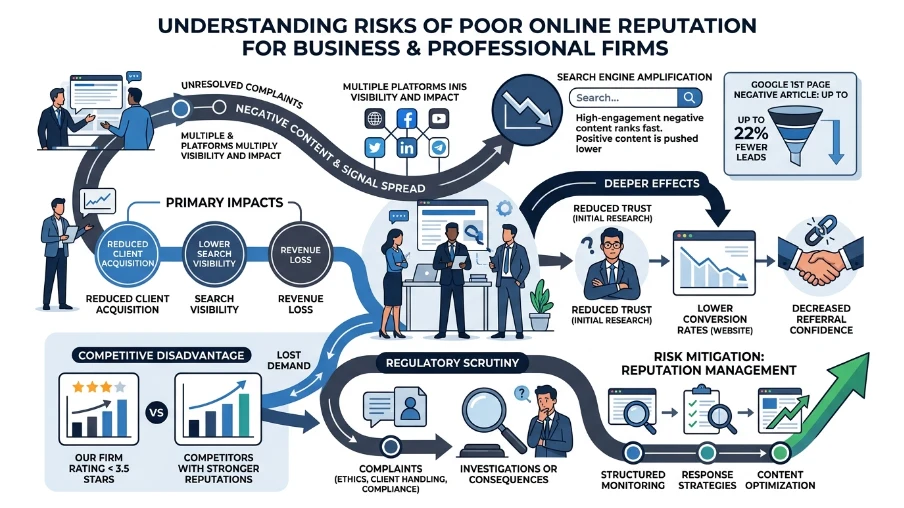
Poor online reputation leads to reduced client acquisition, lower search visibility, and revenue loss. Studies show that a single negative article on the first page of Google can reduce potential leads by up to 22%.
Negative content spreads quickly. One unresolved complaint can appear across multiple platforms. This multiplies visibility and impact.
Reputation damage affects multiple areas:
- Reduced trust during initial research
- Lower conversion rates from website visits
- Decreased referral confidence from existing clients
Search engines amplify negative signals. High-engagement negative content ranks faster. This pushes positive content lower in results.
Legal competitors benefit from gaps in reputation. When one firm’s rating drops below 3.5 stars, competitors with stronger reputations absorb the lost demand.
Regulatory scrutiny also increases risk. Complaints related to compliance, ethics, or client handling can trigger investigations or professional consequences.
Reputation management for business provides structured monitoring, response strategies, and content optimisation to reduce these risks.
How does online reputation affect search rankings for law firms?
Online reputation directly influences SEO performance through engagement metrics, review signals, and content authority. Firms with strong reputations rank higher, generate more clicks, and maintain longer user engagement across search results.
Google uses multiple ranking signals tied to reputation. These include review ratings, review frequency, and response rates. Businesses that actively engage with reviews show higher credibility.
User behaviour metrics reinforce rankings. When users click on a law firm’s listing and stay on the site, search engines interpret this as relevance. High bounce rates signal dissatisfaction.
Backlinks from authoritative sources strengthen reputation. Legal directories, news mentions, and industry publications validate expertise.
Content quality also contributes. Informative, accurate, and updated content improves search visibility. This includes practice area pages, blog articles, and legal guides.
Negative reputation weakens these signals. Lower engagement, fewer backlinks, and negative sentiment reduce ranking performance.
Firms seeking measurable SEO improvement often invest in reputation management for business services to align reputation with ranking factors.
Explore our reputation management for business guides,
How to Encourage More Customers to Leave Positive Reviews
Enterprise Reputation Management Explained
Why is proactive reputation management essential for law firms?
Proactive reputation management ensures consistent trust, protects against negative content, and strengthens long-term visibility. Law firms that actively manage their reputation experience up to 35% higher client retention and stronger brand authority.
Reputation management involves continuous monitoring, content optimisation, and engagement. It prevents issues before they escalate.
Three core processes define proactive management:
- Monitor mentions across search engines, review platforms, and social media
- Respond to feedback with clear, professional communication
- Optimise positive content to dominate search results
Content creation plays a key role. Publishing authoritative articles, case insights, and legal updates builds credibility. This content ranks in search engines and shapes perception.
Crisis prevention is another benefit. When negative content appears, early detection allows a faster response. This reduces visibility and impact.
Law firms operate in competitive markets. Reputation management provides a measurable advantage by maintaining consistent trust signals.
For firms evaluating service providers, review reputation management services for law firms to understand available solutions.
How does online reputation impact revenue and case quality?
Online reputation influences both the quantity and quality of legal cases. Firms with strong reputations attract higher-value clients, while poor reputations result in price-sensitive inquiries and lower conversion rates.
High-value clients prioritise expertise and reliability over cost. They select firms with proven track records and strong reputational signals. This leads to better case portfolios and higher revenue per client.
Reputation also affects pricing power. Firms with strong reputations maintain premium pricing structures. Clients accept higher fees when trust is established.
Lead quality improves with reputation strength. Positive reviews filter out unqualified inquiries. This reduces time spent on low-value consultations.
Poor reputation has the opposite effect. It attracts price-driven clients who prioritise cost over expertise. This reduces profitability and increases operational inefficiencies.
Consistent reputation management aligns brand perception with business objectives. It ensures that inbound demand matches the firm’s expertise and pricing strategy.
Online reputation functions as a measurable business asset for law firms. It influences trust, search visibility, client acquisition, and revenue outcomes. Strong reputational signals increase conversion rates and attract higher-value cases, while negative signals reduce visibility and credibility.
Clear My Name delivers structured reputation management for business services that align legal firms with search engine standards and client expectations. Through monitoring, optimisation, and strategic content control, law firms maintain accurate, authoritative, and competitive online presence.
Frequently Asked Questions
What is reputation management for business and how does it work?
Reputation management for business involves monitoring, analysing, and improving how a company appears online across search engines, reviews, and media. Clear My Name applies structured methods such as content optimisation, review management, and search result improvements to ensure accurate and positive brand visibility.
Why is online reputation important for businesses today?
Online reputation directly affects customer trust, search rankings, and conversion rates. Around 87% of users check online reviews before engaging with a business, making reputation management for business a key factor in attracting and retaining clients.
How long does it take to improve a business’s online reputation?
Reputation improvement timelines depend on factors like existing negative content, review volume, and search visibility. Clear My Name typically sees measurable changes within 30 to 90 days through consistent monitoring, content updates, and reputation management for business strategies.
Can negative search results be removed or suppressed?
Negative content can be addressed through removal requests, legal compliance actions, or suppression using higher-ranking positive content. Reputation management for business focuses on replacing harmful search results with accurate, authoritative information to improve overall visibility.
What platforms are included in reputation management for business services?
Reputation management covers search engines, review platforms like Google and Trustpilot, social media channels, and news mentions. Clear My Name analyses and manages these sources to maintain consistent and trustworthy brand perception across all digital touchpoints.