

Reputation management services for law firms monitor, repair, and enhance a firm’s online presence by removing harmful content, improving search visibility, and promoting positive information. They use legal, technical, and SEO methods to protect credibility, attract clients, and maintain compliance with professional standards.
What Do Reputation Management Services for Law Firms Include?
Reputation management services for law firms include review monitoring, negative content removal, SEO optimisation, and brand protection strategies. These services analyse digital assets, identify risks, and deploy corrective actions that improve search engine results and public perception across platforms like Google, legal directories, and social media.
Reputation management for business operates through structured processes. First, platforms such as Google Reviews, Trustpilot, and Avvo are audited. Each listing is assessed for accuracy, sentiment, and compliance. This creates a baseline of public perception.
Negative content is then classified into three categories: defamatory articles, misleading client reviews, and outdated legal records. Each category requires a different removal or suppression method. For example, legal takedowns apply to defamation, while SEO suppression targets outdated content.
SEO optimisation forms the core of visibility control. Positive assets such as press mentions, verified profiles, and thought leadership articles are published and optimised. These assets rank higher in search engines, reducing the visibility of harmful results.
Firms that invest in structured reputation management record measurable improvements. Data shows that 87% of clients research law firms online before contacting them. A controlled digital presence directly impacts client acquisition.
Read our article, why online reputation matters for law firms.
Why Do Law Firms Need Reputation Management Services?
Law firms need reputation management services to protect client trust, ensure regulatory compliance, and maintain competitive positioning. A single negative search result can reduce client inquiries by up to 32%, making proactive reputation control essential for sustained business growth and credibility.
Legal services depend on trust signals. Unlike retail or hospitality, legal clients evaluate credibility before engagement. Online reviews, case mentions, and media coverage influence perception instantly.
Regulatory bodies impose strict guidelines on legal advertising and client confidentiality. Reputation management services align public content with these standards. This reduces compliance risks and prevents disciplinary issues.
Competitor benchmarking also plays a role. Firms compete for high-value keywords such as “corporate lawyer near me” or “criminal defence expert.” Search visibility determines which firms receive inquiries. Reputation management ensures that positive, accurate content dominates these rankings.
You can explore how firms handle these issues in detail through this analysis of reputation challenges law firms face online
How Do Reputation Management Services Improve Search Results?
Reputation management services improve search results by publishing authoritative content, optimising legal profiles, and suppressing negative links. They use keyword targeting, structured data, and backlink strategies to ensure that positive content ranks higher across search engines like Google and Bing.
Search engines rank content based on relevance, authority, and freshness. Reputation management leverages these factors through controlled content creation. For example, legal blogs, press releases, and directory listings are optimised with high-intent keywords.
Three primary optimisation techniques are applied:
- Publish keyword-targeted legal content across authoritative domains
- Build backlinks from legal directories, news outlets, and bar associations
- Optimise metadata including titles, descriptions, and schema markup
Suppression techniques also play a critical role. Negative links are pushed down by increasing the volume and authority of positive content. Studies show that 75% of users never scroll past the first page of search results. Moving harmful links beyond page one significantly reduces visibility.
Technical SEO is equally important. Structured data such as legal service schema improves how firms appear in search results. This increases click-through rates and reinforces credibility.
What Types of Online Reputation Risks Affect Law Firms?
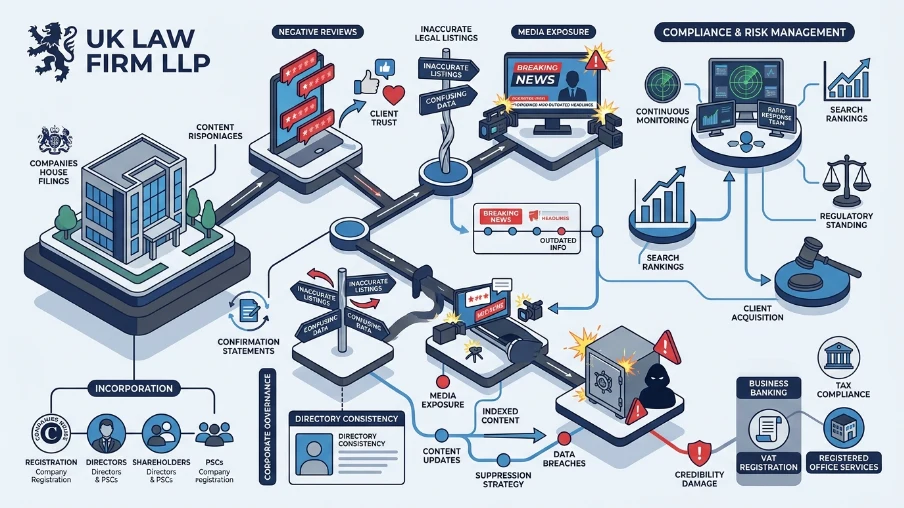
Law firms face reputation risks such as negative reviews, inaccurate legal listings, media exposure, and outdated case information. These risks impact client trust, search rankings, and regulatory standing, making continuous monitoring and rapid response essential for maintaining a professional online image.
Negative reviews are the most visible risk. Platforms like Google and Yelp allow clients to leave feedback without verification. A single one-star review can influence perception even when it lacks context.
Inaccurate directory listings create confusion. Incorrect addresses, outdated phone numbers, and inconsistent firm names reduce trust and affect local SEO rankings. Consistency across directories is a ranking factor.
Media exposure presents another risk. Legal cases often attract public attention. If coverage includes outdated or misleading information, it can remain indexed for years. Reputation management services address this through content updates and suppression strategies.
Data breaches and confidentiality issues also impact reputation. Even minor incidents can damage credibility. Monitoring tools detect mentions across forums, news sites, and social media, enabling rapid response.
Understanding the importance of reputation in legal services starts with foundational insights from this guide.
How Does Reputation Management for Business Apply to Law Firms?
Reputation management for business applies to law firms by aligning legal branding with corporate reputation strategies. It integrates SEO, public relations, and compliance frameworks to ensure consistent messaging, accurate representation, and strong visibility across all digital channels.
Law firms operate as professional service businesses. Their reputation strategy mirrors corporate frameworks but includes legal-specific requirements. For example, client confidentiality restricts case disclosures, which affects content strategy.
Brand consistency is critical. Firm name, partner profiles, and service descriptions must match across platforms. This improves both search rankings and user trust.
Reputation management for business also includes stakeholder perception. Law firms interact with clients, regulators, and partners. Each group evaluates credibility differently. Services ensure that messaging aligns across all audiences.
For firms seeking structured solutions, reputation management for business provides measurable outcomes such as improved search rankings, reduced negative visibility, and increased client inquiries.
How Are Negative Reviews and Content Removed or Suppressed?
Negative reviews and content are removed through legal takedown requests, platform dispute processes, and SEO suppression strategies. When removal is not possible, positive content is amplified to reduce visibility of harmful results and restore balance in search engine rankings.
Removal begins with policy evaluation. Platforms such as Google and Trustpilot have defined guidelines. Reviews that violate policies, including fake feedback or defamation, are flagged and submitted for removal.
Legal intervention applies when content meets defamation criteria. This involves formal notices, evidence submission, and compliance with jurisdiction-specific laws. Successful cases result in content removal or de-indexing.
Suppression is used when removal fails. High-authority content is created and optimised to outrank negative results. This includes legal insights, client testimonials, and verified profiles.
Timing plays a critical role. Early intervention increases removal success rates. Data shows that content flagged within 30 days has a 42% higher chance of removal compared to older content.
How Long Does It Take to See Results from Reputation Management?
Reputation management results typically appear within 30 to 90 days for minor issues and 3 to 6 months for complex cases. The timeline depends on content severity, platform policies, and competition within search rankings. Consistent optimisation accelerates measurable improvements.
Short-term improvements include review responses, profile optimisation, and minor content removal. These actions produce visible changes within weeks. For example, correcting directory listings improves local SEO within 30 days.
Medium-term results involve SEO-driven changes. Content creation, backlink building, and keyword optimisation require time to influence rankings. Most firms see measurable ranking improvements within 90 days.
Long-term outcomes focus on authority building. High-quality content and consistent visibility establish trust signals that sustain rankings. This reduces the impact of future negative content.
Factors influencing timelines include keyword competition, domain authority, and content volume. High-competition markets such as London or New York require more intensive strategies compared to smaller regions.
Explore our reputation management for business guides,
Review Generation Services That Help Grow Your Online Reputation
Enterprise Reputation Management Services for Large Organisations
How Does Clear My Name Deliver Reputation Management for Law Firms?
Clear My Name delivers reputation management for law firms through structured audits, legal content removal, and SEO-driven visibility strategies. The service combines compliance-focused processes with data-driven optimisation to protect brand credibility and improve client acquisition outcomes.
Clear My Name applies a multi-phase approach. The first phase includes a full digital audit. This identifies negative content, inaccurate listings, and SEO gaps. Each issue is categorised based on impact and urgency.
The second phase focuses on remediation. Legal takedowns, review disputes, and directory corrections are executed. This phase addresses immediate risks and stabilises online presence.
The third phase involves optimisation. High-authority content is created and distributed across relevant platforms. This includes legal articles, press features, and structured profiles. Each asset is optimised for search visibility.
Performance tracking ensures measurable outcomes. Metrics such as keyword rankings, review scores, and traffic growth are monitored. This allows continuous refinement of strategies.
Clear My Name integrates reputation management for business principles with legal-specific requirements. This ensures compliance while maintaining competitive visibility.
Reputation management services for law firms combine legal, technical, and SEO strategies to control online perception and protect credibility. These services address negative content, improve search rankings, and ensure compliance with industry standards.
Clear My Name delivers structured, data-driven reputation management for business, enabling law firms to maintain trust, reduce risk, and achieve consistent visibility in competitive legal markets.
Frequently Asked Questions
What is reputation management for business and how does it work?
Reputation management for business involves monitoring, improving, and protecting a company’s online presence across search engines, review platforms, and media sources. Clear My Name uses SEO optimisation, content removal processes, and positive content promotion to control how businesses appear in search results.
How long does reputation management for business take to show results?
Most reputation management for business efforts show initial improvements within 30 to 90 days, depending on issue severity and competition. Clear My Name applies structured SEO and content strategies that gradually improve rankings and reduce negative visibility over time.
Can negative reviews be removed through reputation management services?
Negative reviews can be removed if they violate platform policies, such as containing false or defamatory information. Clear My Name evaluates each case, submits dispute requests where valid, and uses suppression strategies when removal is not possible.
Why is reputation management important for businesses online?
Online reputation directly impacts customer trust, conversion rates, and search visibility, with 87% of users researching businesses before engagement. Reputation management for business ensures accurate information appears prominently, reducing risk from misleading or harmful content.
What types of issues does reputation management for business solve?
Reputation management for business addresses issues such as negative search results, inaccurate listings, poor reviews, and damaging media coverage. Clear My Name identifies these risks and applies targeted solutions like content correction, SEO optimisation, and monitoring systems.