

Layoff news affects employer reputation through the rapid creation, indexing, sharing, and ranking of information across digital platforms and search results.
Reputation management is the process of monitoring and interpreting information that shapes how an employer is perceived, while online reputation refers to the combined digital signals associated with an organisation.
How does layoff news spread across digital ecosystems?
Layoff news spreads through a network of corporate announcements, employee discussions, news reports, social platforms, industry publications, review websites, and search engines. Each source creates or republishes information that can become part of an employer’s digital footprint. Once indexed, these references become discoverable through branded and employment-related queries. Social sharing can increase the speed at which information reaches new audiences, while publisher authority affects how strongly individual pages compete for search visibility. The result is an expanding information network in which one event generates multiple reputation signals.
The spread of layoff information also involves information transformation. An original announcement can become a news article, a social discussion, a review, or an employment-related commentary page, with each format presenting the event from a different perspective. Search systems then process these separate documents according to relevance, authority, freshness, and query alignment. This means the initial announcement does not necessarily remain the dominant source when people search for the organisation. Content indexing therefore determines which interpretations enter the searchable information environment.
Why does layoff news influence employer reputation?
Layoff news influences employer reputation because employment-related information directly contributes to how an organisation’s identity is interpreted online. Employer reputation refers to the perceived credibility and character of an organisation as an employer based on available information and associated signals. Layoff reports introduce information about workforce stability, organisational change, management decisions, and employment conditions into that perception structure. Search users then encounter these signals alongside company-controlled information, reviews, recruitment pages, and third-party references. The resulting perception depends on the overall composition and prominence of the available information.
The effect also depends on search intent. A branded search containing an organisation’s name exposes users to an entity-focused information environment, while searches involving layoffs, redundancies, or employment conditions activate more specific reputation-related results. Search engines evaluate each query independently, meaning the same organisation can have different SERP compositions for different searches. A highly visible layoff article therefore becomes particularly significant when it ranks prominently for queries connected to the employer. Search visibility transforms an isolated news event into a persistent component of digital reputation.
How do search engines interpret layoff-related information?
Search engines interpret layoff-related information by analysing the relationships between entities, documents, queries, topics, and sources. An organisation is identified as an entity, while articles, reviews, social posts, and employment pages provide contextual information about that entity. Ranking systems then evaluate which documents provide relevant information for a particular query. Authority, topical relevance, content quality, freshness, and other signals influence the position of those documents within the SERPs. Search engines therefore organise layoff information rather than assigning a simple positive or negative reputation score.
Entity perception develops through the accumulation of these relationships. If independent sources repeatedly connect an organisation with layoffs, restructuring, redundancies, or workforce reductions, those concepts become more strongly associated with the entity in the searchable information environment. This does not mean that search engines automatically classify the organisation negatively. Instead, the indexed information provides context that users interpret alongside other reputation signals. Search visibility determines which aspects of that context receive the greatest attention.
How do news articles affect an employer’s search reputation?
News articles can become influential reputation signals because established publishers often possess strong authority and indexing capabilities. A report about layoffs can rank for branded searches, employer-related queries, and industry topics when the article demonstrates strong relevance to those searches. Its visibility then places the reported information directly within the user’s initial research environment. The article’s headline, content, publication date, and source reputation contribute to how the information is interpreted. Search ranking dynamics therefore determine how strongly a news report participates in employer perception.
The persistence of a news article also distinguishes it from short-lived social content. An indexed article can remain searchable long after the original event, continuing to appear when users research the organisation. Its continued visibility depends on ranking competition, query relevance, source authority, and the availability of newer information. A historical article therefore remains part of the digital footprint even when the organisation’s circumstances have changed. Reputation analysis examines this relationship between information age and continued search prominence.
How do employee reviews change after layoff announcements?

Employee reviews provide user-generated reputation signals that can change the interpretation of an employer following workforce reductions. Reviews contain qualitative information about workplace culture, management, communication, leadership, compensation, and employment experience. Search systems process this material as part of the wider information environment associated with the organisation. Sentiment interpretation can identify recurring positive, negative, or neutral themes within review content, although sentiment does not function as a standalone reputation score. The importance of reviews therefore depends on their content, source context, visibility, and relationship to the search query.
Review platforms also introduce a different information perspective from corporate communications. An organisation controls its official announcement, while employees and former employees contribute independent accounts through third-party platforms. This creates a contrast between owned information and external reputation signals. Search users often evaluate both forms of information when assessing employer credibility. The resulting entity perception reflects the interaction between formal communication, user-generated content, and search visibility.
How does social media amplify layoff-related reputation signals?
Social media amplifies layoff-related reputation signals by allowing information to circulate rapidly between employees, journalists, industry observers, and members of the public. Posts can generate discussions that introduce additional descriptions, opinions, links, and references associated with the employer. Although not every social post receives strong search visibility, highly discussed content can influence broader information discovery. Social conversations can also direct users towards news reports, reviews, company statements, or employment-related discussions. This creates a network effect in which separate sources reinforce the visibility of the same event.
Social media also increases the speed of sentiment formation. Users encounter reactions before examining the underlying announcement, creating an environment where interpretation can develop alongside factual reporting. Search engines then encounter a mixture of original information, commentary, and secondary reporting. These documents differ in authority and informational value, so SERP evaluation determines which sources become prominent. The digital footprint consequently contains both factual records and interpretive material surrounding the layoff event.
What role does employer communication play in reputation perception?
Employer communication provides an authoritative source of information that helps define the organisation’s stated interpretation of workforce changes. Official announcements, newsroom pages, investor communications, and corporate statements become indexed content when search engines discover and process them. These sources provide factual context about organisational restructuring, affected business areas, or strategic changes. Their presence gives search systems additional information with which to associate the event and the organisation. Communication therefore contributes directly to the entity’s searchable information structure.
The strength of official communication also depends on clarity and consistency. Conflicting statements across corporate pages, press releases, and other public sources create additional information relationships that search systems and users need to reconcile. Consistent terminology supports clearer entity understanding and reduces ambiguity around the event. This does not control how external publishers report the story, but it creates a stable factual reference within the digital footprint. Employer communication therefore operates as one component of reputation management rather than a complete reputation system.
Dive Deeper With Our Expert Guides:
Why B2B Buyers Read Case Studies Before Trusting a Vendor
How a Data Breach Announcement Damages Customer Confidence
How do authority and trust signals affect layoff-related search results?
Authority and trust signals influence which sources receive visibility when users search for information about an employer. Authority refers to the recognised strength and relevance of a source within a particular subject area, while trust relates to the reliability and consistency of the information presented. Established news organisations, official corporate sources, professional publications, and credible industry websites can occupy different positions according to their relevance and ranking signals. Their relative visibility determines which interpretations users encounter first. Search perception therefore depends partly on the authority structure surrounding the information.
Trust also involves consistency between separate sources. If professional directories, corporate pages, news reports, review platforms, and other references identify the same organisation consistently, search systems gain clearer entity relationships. Contradictory information creates additional complexity within the entity graph. This distinction matters because reputation is not formed from one document alone. It emerges from the relationships between multiple sources and the visibility those sources receive within relevant SERPs.
Why does the digital footprint matter after a layoff?
A digital footprint matters after a layoff because the event becomes connected to existing information about the organisation across the web. The digital footprint includes corporate pages, recruitment content, reviews, news articles, social profiles, directories, industry references, and other indexed material. New layoff-related content enters this existing structure and becomes associated with the employer entity. Search engines then process the new information alongside older content when responding to relevant queries. This creates a dynamic reputation environment rather than a fixed profile.
The age of existing content also affects perception. Outdated recruitment pages can conflict with current restructuring information, while older positive coverage can coexist with newer negative reporting. Search users encounter whichever pages receive visibility for their specific queries. Reputation analysis therefore considers both new information and the pre-existing digital footprint. This provides a more accurate understanding of how an organisation’s online identity changes following workforce reductions.
How does content ranking determine the visibility of layoff news?
Content ranking determines visibility by ordering indexed pages according to their relevance and competitiveness for individual search queries. A layoff article can receive strong visibility when its subject closely matches the query and the publishing source possesses relevant authority. Competing pages then influence whether that article remains prominent as new information enters the search index. Ranking is therefore dynamic rather than permanent. Search visibility changes as search engines reassess documents and as new content alters the competitive environment.
This process explains why one event can have different visibility levels across search terms. A specific news report can rank prominently for a branded layoff query while remaining less visible for a general employment search. Search systems evaluate the relationship between the query and the document rather than applying one universal ranking to the organisation. Reputation analysis consequently requires query-specific evaluation. Measuring only one branded search provides an incomplete picture of the employer’s search reputation.
How can organisations understand reputation changes after restructuring?
Organisations can understand reputation changes by evaluating the information ecosystem before and after restructuring rather than relying on a single ranking or review score. The analysis examines branded SERPs, news coverage, employee reviews, social references, corporate communications, and other indexed content. Each source is assessed according to visibility, authority, sentiment, relevance, and relationship to the employer entity. This creates a structured view of how the digital footprint has changed. The resulting analysis distinguishes changes in information volume from changes in information prominence.
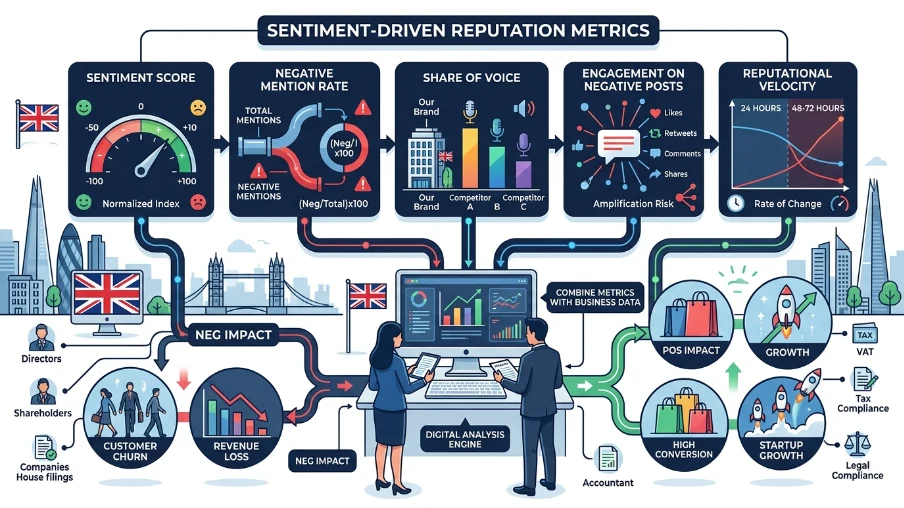
A useful evaluation framework includes four connected actions:
- Identify layoff-related content by locating indexed news articles, reviews, social references, and corporate announcements associated with the employer entity.
- Evaluate search visibility by measuring which sources appear for branded, employment, restructuring, and reputation-related queries.
- Analyse sentiment distribution by examining recurring themes across employee reviews, public commentary, and other user-generated information.
- Compare entity signals by assessing whether authoritative, accurate, and consistent information remains visible alongside newer restructuring-related content.
This approach separates factual information from its search prominence and public interpretation. It also demonstrates why reputation cannot be evaluated solely through the presence of negative content. A page can exist without substantial search visibility, while a highly authoritative article can become a dominant reputation signal. Understanding this distinction is essential when analysing employer reputation after layoffs.
What is the relationship between layoffs and long-term employer reputation?
The relationship between layoffs and long-term employer reputation is determined by how restructuring information remains represented across the digital ecosystem. A layoff event becomes part of an organisation’s reputation when associated information continues to be indexed, referenced, discussed, and retrieved through relevant searches. Over time, newer content can change the composition of the SERPs, while older pages can retain visibility because of authority and relevance. Employer reputation therefore evolves through continuing information relationships rather than through the original event alone.
Long-term reputation also depends on the broader digital footprint surrounding the employer. Recruitment content, workplace reviews, corporate information, news coverage, professional references, and subsequent organisational updates all contribute to entity perception. Search systems continuously evaluate these sources as users submit new queries. The resulting reputation is therefore a cumulative representation of available information and its relative visibility. Understanding this mechanism explains why layoff news can influence employer reputation long after the initial announcement.
What should organisations understand about layoff news and search reputation?
Layoff news becomes a reputation signal when it enters the searchable information environment and gains visibility for queries connected with an employer. Search engines evaluate the information through entity relationships, content relevance, authority, indexing, and ranking dynamics rather than through a single reputation score. Reviews, social discussions, news coverage, and official communications then provide different forms of context. Their combined visibility shapes how users interpret the organisation. Employer reputation is therefore closely connected to the structure and prominence of its digital footprint.
The central insight is that reputation develops through information systems rather than through isolated events. A layoff announcement creates an initial information signal, while publishers, employees, review platforms, social networks, and search engines determine how that signal travels and remains visible. Understanding SERP evaluation, content indexing, sentiment distribution, authority, and entity perception provides a clearer framework for analysing the resulting reputation. For organisations examining restructuring-related reputation, protecting employer reputation through layoffs and restructuring provides a focused consideration of how these information dynamics connect with broader reputation strategy.
How do layoffs affect an employer’s online reputation?
Layoffs can affect employer reputation when news reports, employee reviews, social media discussions, and corporate announcements become visible in search results. These reputation signals influence how users perceive organisational stability, workplace conditions, and employer credibility.
Why does layoff news rank in an employer’s search results?
Layoff news can rank when search engines identify strong relevance between the article, the employer entity, and the user’s query. Publisher authority, content relevance, freshness, indexing, and ranking signals influence its search visibility.
Do employee reviews affect reputation after layoffs?
Employee reviews provide user-generated reputation signals that contribute to an employer’s digital footprint. Recurring themes, sentiment distribution, review content, and search visibility influence how prospective employees interpret workplace reputation.
How does social media affect employer reputation during layoffs?
Social media can accelerate the spread of layoff-related information by connecting employees, journalists, industry audiences, and other users. Discussions can generate additional references and direct searchers towards news articles, reviews, and corporate statements.
How can businesses monitor their reputation after layoffs?
Businesses can monitor branded search results, news coverage, employee reviews, social references, and indexed corporate content. Analysing search visibility, sentiment, authority, and entity consistency provides a structured view of changes in employer reputation.